

The latest monthly ANZ Business Outlook survey has produced a "mixed bag" of results, with overall business confidence bouncing from low levels, but the more significant measure of firms' view of their own activity dipped again.
ANZ chief economist Sharon Zollner said she would take the mixed signals out of the October survey "as a positive sign", as it interrupts a deteriorating trend. "It’s a start.”
She said there was "something for everyone" in the survey, "with mixed moves and different interpretations possible, depending largely on whether you choose to focus on the change or the level”.
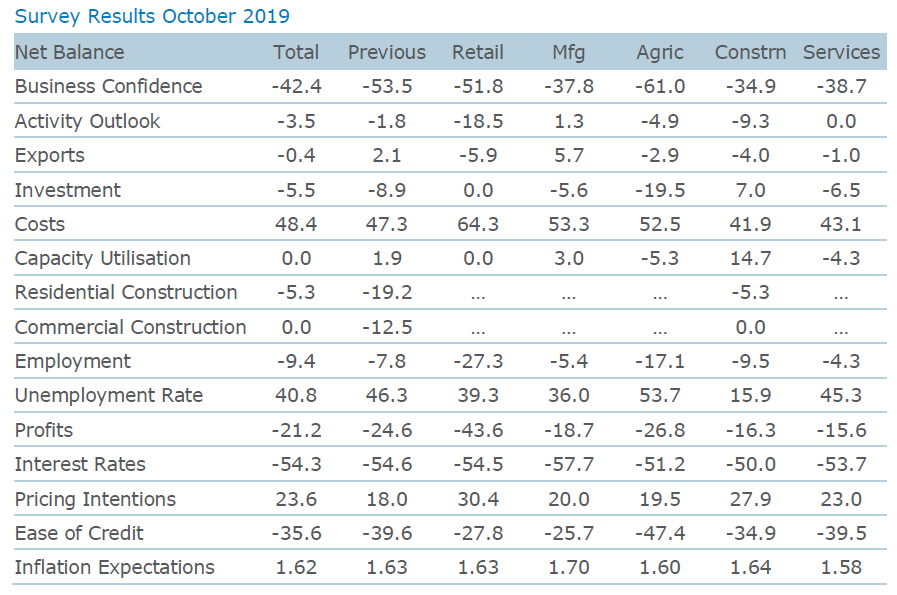
The headline "business confidence" measure jumped up 12 points. However, that still left a net 42% of respondents reporting they expect general business conditions to deteriorate in the year ahead.
"Firms’ expectations for their own activity over the year ahead, a better economic indicator, fell 2 points to -4, the fifth fall in a row. It is the lowest read since April 2009 but still well off the recession low of -21."
The detail:
·Employment intentions fell 1 point to a net 9% of firms intending to reduce employment. Investment intentions rose 3 points but remain negative at -6%. Capacity utilisation fell 2 points to a decade low (0).
·Profit expectations rose 4 points but remains in the red with a net 21% of respondents expecting profitability to decline.
·Pricing intentions rose 6 points to a net 24% of firms expecting to raise prices, but fell 10 points in the retail sector (+30%). Cost pressures rose 1 point to a hefty net 48% of firms expecting higher costs. Inflation expectations were broadly unchanged at 1.62%.
·Commercial construction intentions jumped 13 points to be flat; residential lifted 14 points to -5, continuing to send mixed signals.
·Export intentions fell 2 points to zero. Expected availability of credit rose 4 points to a net 36% of firms expecting credit to be harder to get.
“The increase in business confidence is welcome, though this question asks firms about what they (or indeed, anyone) know with the least certainty, namely how business conditions will evolve over the year ahead," Zollner said.
“The expected own activity measure is something firms know more about and so is a better economic indicator. This ticked down again. However, it appears that the activity indicators are generally finding a floor. It’s true that the levels for most indicators remain uninspiring, but it’s good to see signs of bottoming out.
“The retail sector clearly remains very downbeat. Of all the sectors, they have the weakest own activity, profits, and employment (despite pretty robust consumer confidence), and the highest expected cost pressure.
“Encouragingly, things seem to be looking up for the construction sector. It is amongst the strongest (not saying a great deal, admittedly) for business confidence, profits, investment and capacity utilisation."

We welcome your comments below. If you are not already registered, please register to comment
Remember we welcome robust, respectful and insightful debate. We don't welcome abusive or defamatory comments and will de-register those repeatedly making such comments. Our current comment policy is here.