

 By Roger J Kerr
In the short-term, US fiscal and monetary management issues will continue to dominate foreign exchange market conditions and direction for the NZD/USD rate.
The USD itself has not weakened any further against the major currencies since the US Government shutdown commenced two weeks ago.
The US politicians will inch towards a compromise deal before the 17 October debt ceiling deadline date as no-one wants to be the one responsible for sending the US Government into debt default. The risk of that happening remains extremely remote and that is why the FX markets have not been at all volatile in the run-up to the debt ceiling date.
However, while there are uncertainties in the markets on the timing of fiscal and monetary changes in the US, the USD has been unable to make gains in the foreign exchange markets.
The NZD/USD exchange rate has therefore become marooned around 0.8300 over recent weeks with no aggressive buyers to send it higher, however a no fresh reasons for the speculators to sell it either.
The economic data in the US that comes from Government sources is off course delayed with Government departments shutting down; however there will be a whole swag of US employment, housing, inflation and industrial production figures flowing over the next seven days.
The fact that the US dollar has not weakened too much above $1.3500 against the Euro over this period of the unwinding of quantitative easing by the Federal Reserve being unexpectedly delayed and the fiscal shenanigans to boot, provides confidence that when these two short-term US factors rectify themselves, the propensity being built in the forex markets appears to be for the USD to strengthen.
The improvement in US economic data, particularly the sharp reductions in the size of both the internal budget deficit and external Balance of Payments deficit still stands as far superior to the situation in Europe where interest rates will be kept very low for years to come and the sovereign debt mountains remain almost insurmountable.
On all scores the USD should be moving well below $1.3000 against the Euro and it is only a matter of time before the currency markets reflect these differentiated underlying economic fundamentals.
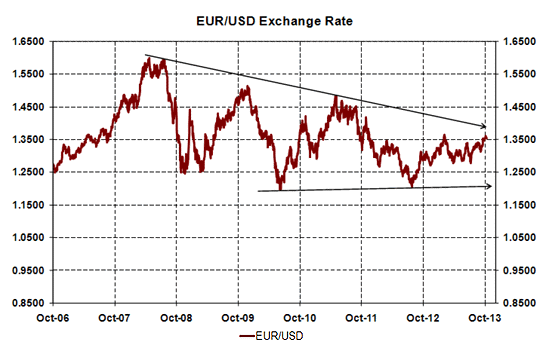
The EUR/USD exchange rate has remained below the downtrend line since the peak of Euro strength against the USD at $1.6000 in 2008.
This latest test of the downtrend line with the Euro strengthening to $1.3600 also seems destined to fail (refer chart below). For these US dollar sides of the currency pair reasons there remains a higher probability that the NZD/USD rate returns to 0.8000 rather than pushing higher to 0.8500.
Despite the general weakness of the USD on the global currency stage and very positive specific factors for the NZ dollar itself with wholemilk powder hitting new record highs, the NZ dollar has not been able to push higher.
The level of foreign investor interest in the NZ dollar as an attractive investment destination has certainly reduced since the levels seen earlier this year.
Global fixed interest fund managers are no longer aggressively buying Governments bonds since yields jagged sharply upwards in May/June. Previous impressive positive returns for the fixed interest fund manager have turned to custard as bonds reduce in value as their yields increase.
Therefore, the Asian sovereign wealth funds that were happily flooding into NZ bonds earlier this year, simultaneously buying the NZD, have retreated as their strategy now is to shore up poorly performing portfolios. A major positive force for the NZ dollar has reduced significantly.
Looming on the horizon as a potential NZ dollar negative in 2014 is “political risk” if the Labour/ Greens combination start to pass the National Party in the opinion polls.
General elections and political outcomes in New Zealand have not pushed the Kiwi dollar around since Labour took office in 1999, as there has been no real threat to change fiscal, monetary and other economic policy settings.
However, next year may change that complacency as stated policy positions from the Labour/Greens would see fundamental changes to how monetary policy is conducted by the RBNZ.
Foreign investors and currency traders would conclude that there is real risk of a major U-turn in NZ economic policy and reduce their long NZ dollar currency positions accordingly, well ahead in time before the November election event.
A lower NZ dollar would be positive for the export sector; however inflation would increase with imported goods going up in price.
Resulting increases in NZ interest rates as monetary policy is adjusted to the rising inflation would prevent any major depreciation below the 0.7500 area.
-----------------------------------------------------------
To subscribe to our daily Currency Rate Sheet email, enter your email address here.
No chart with that title exists.
Roger J Kerr is a partner at PwC. He specialises in fixed interest securities and is a commentator on economics and markets. More commentary and useful information on fixed interest investing can be found at rogeradvice.com
We welcome your comments below. If you are not already registered, please register to comment
Remember we welcome robust, respectful and insightful debate. We don't welcome abusive or defamatory comments and will de-register those repeatedly making such comments. Our current comment policy is here.