

As the new government prepares to throw the Productivity Commission into the dustbin of history, perhaps they could at least pause to give one of its suggestions to their predecessors some serious consideration.
The suggestion is that New Zealand ought to move from an ad hoc immigration policy, disconnected from other public policy settings, to a long-term government policy statement on immigration to assist with infrastructure and other planning.
This came after the Productivity Commission's inquiry into NZ's long-term immigration settings, which I discussed with Ganesh Nana, the Productivity Commission's Chairman, in an episode of our Of Interest podcast last year.
The National-ACT coalition agreement outlines plans for "disestablishing the Productivity Commission" to fund ACT Leader David Seymour's new plaything, a government department to "assess the quality of new and existing legislation and regulation."
Nana's key point was the level of immigration influences the overall population, and thus demand for infrastructure including roads, public transport, hospitals, schools, energy needs, early childhood needs, and regional development. Currently there's a "disconnect" between immigration settings and these other areas, and a "disconnect" between workforce training, skills development and labour market policy.
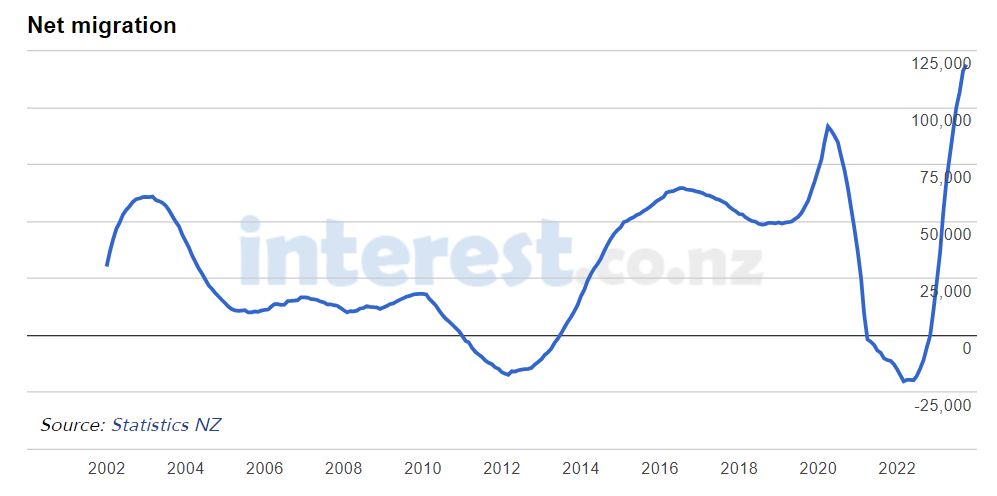
Nana suggested a longer-term focus for immigration, of at least 10 years, rather than the "ad hoc adjustments" currently made every few months or years which contribute to a roller coaster ride for inward migration numbers, as demonstrated in the chart below.
Call for a Government Policy Statement
As the Productivity Commission puts it, commitments to increasing productivity require long-term thinking by both government and businesses. Such long-term thinking is, however, at odds with how the immigration system is currently run given it's "reactive to short-term and sometimes conflicting priorities."
"A Government Policy Statement (GPS) [on immigration] would improve transparency, clarify the Government’s objectives within the immigration system and its link to other Government objectives, improve the Government’s accountability for achieving the objectives, and promote a longer-term focus, the Productivity Commission's report, Immigration fit for the future says.
"A GPS should require governments to state how the demand for temporary and residence visas will be managed taking account of significant pressures (if any) on New Zealand’s absorptive capacity over the period of the GPS including: – specification of a planning range for the intake of new residents over the period covered by the GPS; and – the criteria for managing access to temporary work visas and projections of migrant flows based on these criteria, over the period covered by the GPS."
"A GPS would promote longer-term credibility about population projections and planning ranges for migrant volumes. It would increase certainty for the general public, businesses, communities and other stakeholders such as local government. This in turn would help these parties to plan and implement long-term investments," the Productivity Commission said.
"By requiring Ministers to make clear policy choices about migration, including fiscal and regulatory choices, a GPS would inform the public about how the Government will adjust migration and/or absorptive capacity should net population growth threaten to put damaging pressure on the latter."
In its response to the Productivity Commission's inquiry, the Labour government said it supported the intent of a GPS. The then-Immigration Minister Michael Wood said in April he had asked officials to provide advice on what a GPS for the immigration system would look like.
New Minister of Immigration Erica Stanford ought to continue this work. Confidence around immigration numbers could help enable more planning certainly for central government, local government and the private sector in the need for and provision of key infrastructure such as housing, transport, hospitals, school and energy requirements.
Findings from the Productivity Commission's inquiry include; the immigration system currently uses a range of tools that may suppress wages, job creation, and productivity; and the supply of infrastructure is less responsive to population growth now than in the past.
237,100 arrivals
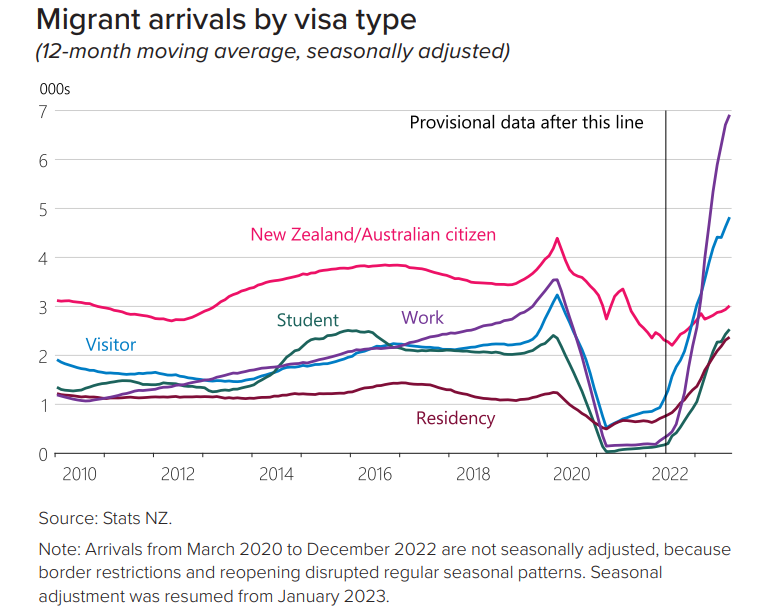
According to Statistics NZ's provisional estimates, in the September year NZ received 237,100 migrant arrivals from overseas. That's 237,100 people who need somewhere to live, will want to travel around by car and public transport, need water and create waste. Some of them will be children who'll go to school, while others will need healthcare.
Because another 118,200 people migrated from NZ to somewhere overseas, there was a net annual migration gain of 118,800. So those departing will have created some space for those arriving.
However, for a country with an estimated resident population of 5,269,200, recent migrant inflows are very big numbers. In fact Statistics NZ says the 237,100 migrant arrivals, 118,200 migrant departures, and net migration gain of 118,800 in the September year are all the highest figures on record for an annual period.
That's in stark contrast to the unique pandemic closed border period when NZ had a migration loss and its slowest population growth rate since the late 1980s, with an increase of just 0.2% in the June 2022 year. This, of course, led to businesses across a range of industries crying out for staff in a very tight labour market with historically low unemployment.
Infrastructure deficit
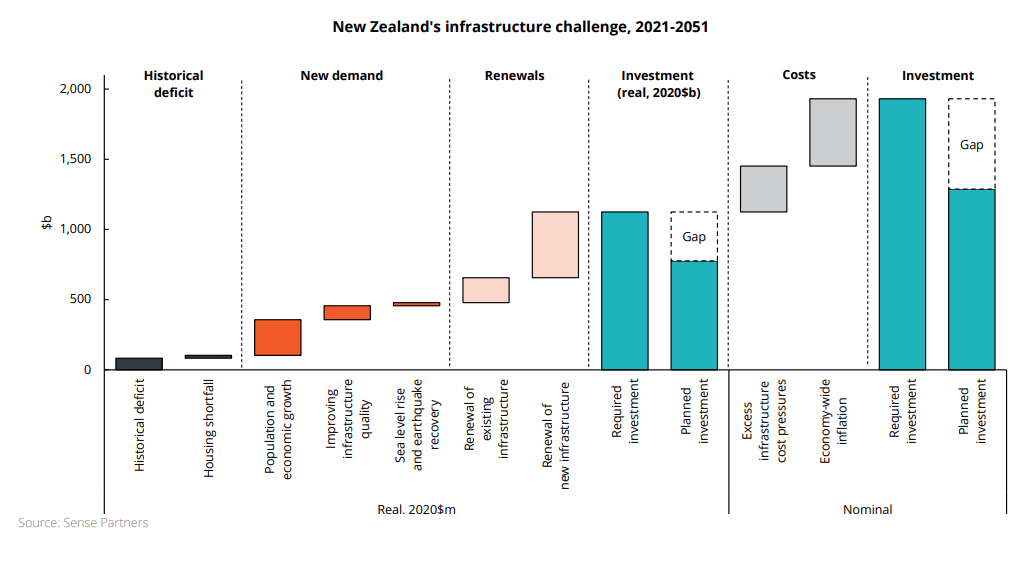
Even before the recent population surge Sense Partners, in a 2021 report commissioned by the Infrastructure Commission, estimated NZ had a historical infrastructure deficit of $104 billion. This, it said, was made up of a shortfall in public investment relative to the private sector and an estimated need for 115,000 additional homes to eliminate overcrowding.
On the housing front, interest.co.nz's Greg Ninness recently reported Auckland could be on the verge of another housing crisis as the recent surge of immigration-driven population growth outstrips the supply of new homes being built in the region. Ninness estimates Auckland's population growth of 47,000 in the 12 months to June requires an additional 15,667 homes. However, Auckland Council figures show the number of new dwellings completed in the 12 months to June came in at 15,263, leaving a shortfall of 404 homes for the year.
And according to the Ministry of Social Development, there were 25,284 applicants on their register seeking public housing as of September 30. The register provides the number of applicants assessed as eligible for social housing who are ready to be matched to a suitable property.
Plenty of infrastructure in NZ is already struggling to cope. For example, witness the tales of woe over recent years from ageing Wellington pipes spewing sewage and water onto city streets and into the harbour. They've have been joined this year by disruption, mess and bad smells caused by three sinkholes appearing in Auckland, featuring a collapsed sewer line in Parnell, and problems with stormwater pipes in College Hill and Ōtāhuhu.
Inflation concerns
The word "immigration" appears 43 times in last Wednesday's 58-page Reserve Bank Monetary Policy Statement. Primarily that's because the Reserve Bank, battling the highest inflation in 30 years, has become concerned high immigration could make its job harder.
In an episode of our Of Interest podcast this week, Reserve Bank Governor Adrian Orr noted inward migration numbers were currently historically significant. While strong migration has " been very useful" by helping ease pressures in the labour market, the impact on the demand rather than supply side is now "becoming more and more evident," Orr said.
In its Monetary Policy Statement the Reserve Bank said: "[Monetary Policy Committee] members noted that net immigration has been higher than previously assumed. This has increased the supply of workers into a tight labour market. However, the demand side effects are becoming apparent. Strong population growth has contributed to an increase in housing rents. Rent increases, and any increases in construction costs in response to greater housing requirements, affect inflation directly, as rental prices and construction costs are accounted for in the consumer price index."
"Immigrants need to establish new homes in New Zealand, which increases demand for housing and housing-related goods and services. Over recent months the inflationary impacts from high net immigration have become more evident...High net immigration is a significant contributor to the recent recovery in house prices."
They're not alone
The Productivity Commission and Nana aren't the only ones raising questions about our ad-hoc immigration stance. On this website alone, Massey University's Paul Spoonley described immigration as "the missing election issue" earlier this year. Economist Brian Easton has also aired concerns, Keith Woodford called for a resource-based perspective on immigration, and in 2020 David Hargreaves suggested that, with the border closed, it was a good time for a national discussion on migration and population.
Indeed, in a broader discussion on migration, is there a certain level where we want our population to be over the longer-term?
Given existing pressures on the environment, housing, transport and other infrastructure, it would be a shame if at least one strand of the Productivity Commission's work wasn't given serious consideration by the new government before it makes way for Seymour's shiny new toy.
*This article was first published in our email for paying subscribers. See here for more details and how to subscribe.
We welcome your comments below. If you are not already registered, please register to comment
Remember we welcome robust, respectful and insightful debate. We don't welcome abusive or defamatory comments and will de-register those repeatedly making such comments. Our current comment policy is here.