

It's been three months. And it's been too long*. But this coming week we finally get the Reserve Bank's latest definitive view on how we are doing in the war with inflation and whether another interest rate hike is on the menu.
On Wednesday February 28 the Reserve Bank (RBNZ) releases its first Monetary Policy Statement (MPS) for the year and the RBNZ Monetary Policy Committee will decide whether or not to change the Official Cash Rate, which has been at 5.5% since May 2023.
It's fair to say that for the first time since May of last year the upcoming rate review is a 'live' one - with a real chance we may see a hike.
The prevalent view though, is that the OCR will be left unchanged. Nobody is, to the best of my knowledge, picking a cut. Notably economists at the country's biggest bank ANZ are swimming against the tide with a pick of a 25-basis-points hike, followed by another at the next review in April, taking the OCR to 6%. And the ANZ economists cite a key quote from the last OCR decision on November 29 that: "If inflationary pressures were to be stronger than anticipated, the OCR would likely need to increase further."
No doubt the language from the RBNZ has been tough and uncompromising - and the 'hawkish' nature of the comments at that November review surprised everybody.
So, where do we stand?
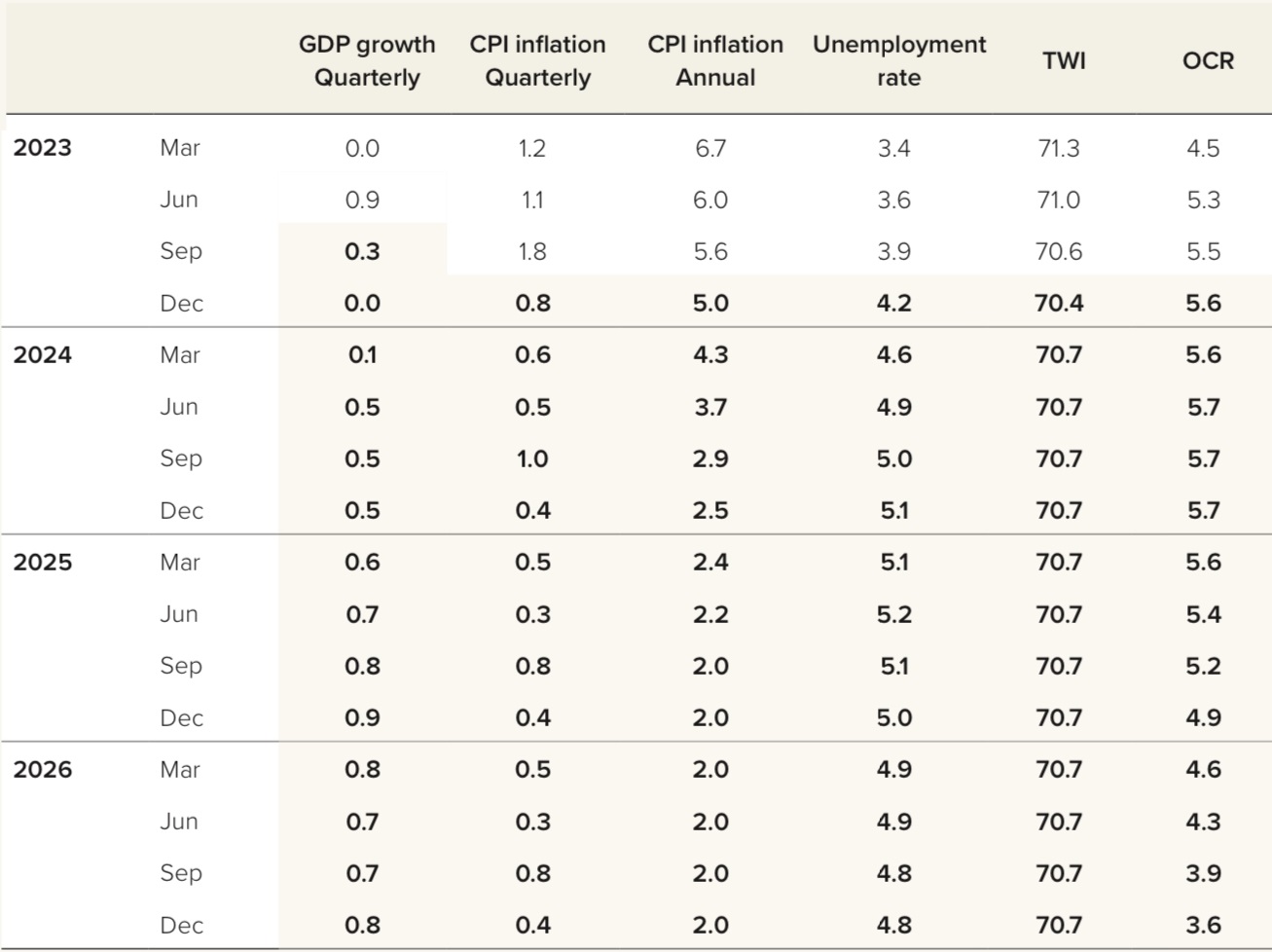
For the record, here is an abridged version of the key forecasts contained in the RBNZ's November MPS (the shaded, emboldened bits are the RBNZ's forecasts):
Since the last OCR hike in May of last year there have been four consecutive 'no change' decisions by the MPC. So, another 'no change' in the coming week would make five on the bounce.
Much has happened since the last OCR review at the end of November, so, I will cherry-pick what I see as the more salient developments that will likely most influence the RBNZ's February 28 decision.
Remember, the RBNZ aims to get inflation within 1% to 3%, with an explicit target of 2%. And Governor Adrian Orr has reiterated that he sees this approach - with the focus on 2% - as still the best way to go.
In terms of what the RBNZ has expected to happen with economic developments since last November, there's been a bit of what economists like to call 'unders and overs'.
Significant in the 'unders' category was the shock 0.3% contraction of the economy in the September quarter (versus, as you can see above, the RBNZ's pick of 0.3% growth). Significantly also, that GDP announcement, put out by Statistics NZ on December 14, was accompanied by substantial revisions to earlier GDP figures, including the revelation that we had a 'technical' recession earlier in the year.
Against that, while 'headline' annual inflation for the December quarter came in at 4.7%, down from 5.6% and against an RBNZ pick of 5.0%, the so-called 'non-tradable' (domestic) inflation was 5.9%, down from 6.3%. And that 5.9% was HIGHER than the RBNZ's pick of 5.7%.
Also, unemployment's rising much more slowly than anyone's been picking, going up from 3.9% to 4.0% in the December quarter - when the RBNZ picked 4.2%.
But a number of more recent, lower-level, economic results have very much gone the way of the RBNZ. Included in this has been the latest monthly Selected Prices Index (SPI) data (covering about 45% of the items in the official measure of inflation the Consumers Price Index). The SPI showed annual food price inflation down to 4.0% - its lowest level since late 2021 - and also sharp falls to the ever-volatile airfares. Rents are rising though, which will be of concern.
The RBNZ pays a lot of attention to its own Survey of Expectations, and the latest results were the most favourable for the RBNZ in recent memory - with inflationary expectations down right across the board.
Going completely contra to that, however, was the results just on Thursday in the past week (February 22) of the RBNZ's latest Household Expectations Survey, which showed that while households expected inflation in the next 12 months to be lower than they expected in the previous survey three months ago (but they still saw inflation being 5.1% in 12 months' time), expectations of inflation for both two years and five years time actually ROSE. Not what anybody wanted. And a bit of a late shock for the RBNZ, I would bargain. How much weight might the RBNZ put on this survey? Traditionally it didn't. But it has extensively revamped it and does appear to have been seeking to give it a bigger profile recently. It will be discussed by the Monetary Policy Committee, of that you can be sure.
As I indicated higher up, there's been much happening since the last OCR review in November. But the above are what I see as the standouts.
So, for me there's been both a number of significant 'overs' that feed into an 'inflation-is-strong, higher-rates-for-longer' narrative (the non-tradable inflation level, the super resilient labour market, that - for me - very surprising household survey result) and a number of 'unders' that at the very least point in a 'this-is-working, wait-and-see' direction for monetary policy.
The RBNZ has recently been at pains to stress that the most important thing is 'core inflation' - of which it has a variety of measures.
For the RBNZ then, it is in the interesting position of deciding what things it wants to place most emphasis on - because it has data in front of it that would easily enough justify either an OCR hike, or just as easily, a 'hold'.
At time of writing wholesale interest rates were pricing in about a 1-in-4 chance of an OCR hike this Wednesday. Against that the odds of future CUTs have been sliding. At one point the markets were pricing in FOUR cuts, THIS year. Now it's just ONE, probably in November.
Personally, I think the RBNZ would prefer not to make another OCR hike now . But what I think it wants is for the markets to keep chilled, to not get ahead of themselves agitating for rate cuts, and for mortgage rates and deposit rates to stay about as near to where they are right now - for as long as the RBNZ wants them to stay up.
And that would be for how long?
Well, till whenever the RBNZ starts to feel confident this inflation thing really is under control. The signs are good, but nobody can say definitively yet that it is under control.
In the meantime, I wouldn't really see any value in the RBNZ starting to hike again. It's an odd situation. I think if the RBNZ came out, guns blazing and used up its bullets now, the wholesale markets would be immediately saying: 'Is that all you got?' - and start to price in cuts again!
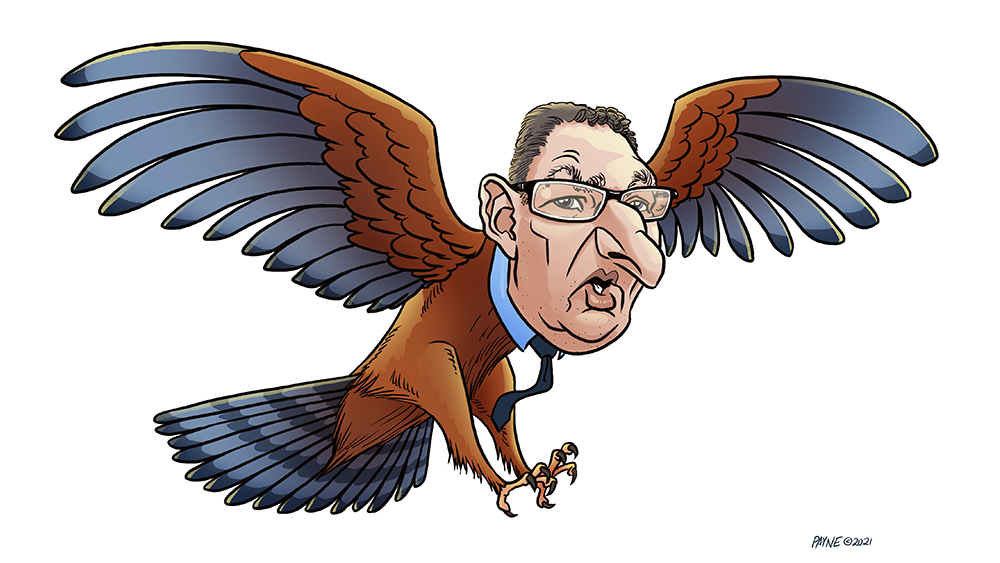
No. Surely it's far better for Governor Orr to appear on Wednesday clad again in his 'hawk' suit talking tough and with his gun in his holster - but tapping it on occasions, just for effect. 'I have the ammo - you know I have.'
I don't happen to think that anything this Governor says is ever a 'bluff'. If he says he's prepared to hike the OCR again (as he has) then he would be prepared to follow through on that.
But in this instance, surely the threat of action, rather than an actual hike may well do a better job of holding wholesale and retail interest rates up at a level that continues to do the job for the RBNZ.
It does seem likely, however, that the threat of the hike will stay on the table virtually right up to the time we do see the first cut - whenever that is. November is the current favourite date. The Orr-Hawk is not going anywhere for a while.
*PLEA TO THE RBNZ: Please bring back the 'eighth' OCR review in the year! (There's currently seven.) How about having the last OCR review for the year in December and the first OCR review for the next year in January (as WAS the case till 2016). It would cut out a lot of the kinds of febrile market speculation, which I think has been unhelpful to the cause, that we've seen in the past three months.
*This article was first published in our email for paying subscribers early on Friday morning. See here for more details and how to subscribe.
We welcome your comments below. If you are not already registered, please register to comment
Remember we welcome robust, respectful and insightful debate. We don't welcome abusive or defamatory comments and will de-register those repeatedly making such comments. Our current comment policy is here.