

Quotable Value (QV) is warning of more bumps in the road yet for the housing market, which hasn't reached the bottom despite the biggest fall in 2022 for more than 15 years.
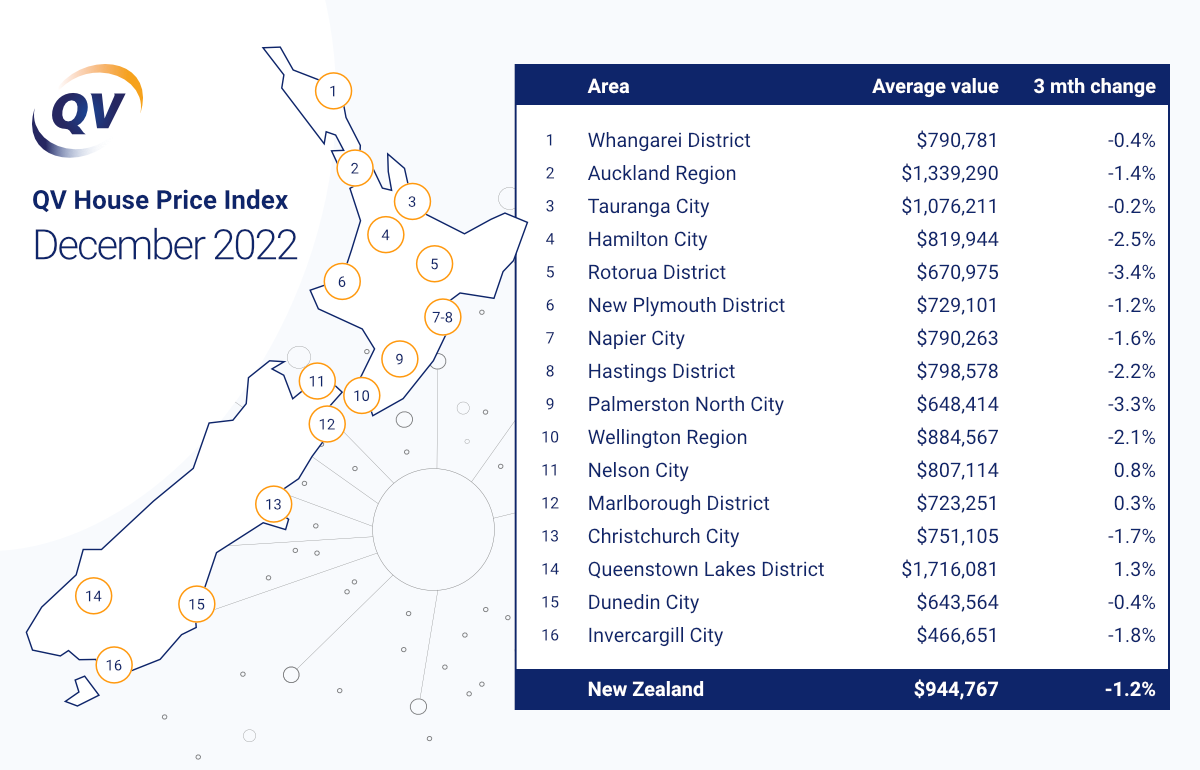
The latest QV House Price Index shows home values fell nationally by an average of 10.3% last year, which compared with increases of 13.3% in 2020 and 28.4% in 2021.
During that period the average home value increased from $724,185 three years ago to $1,053,315 at the peak of the market.
It now sits at $944,767 at the start of 2023.
According to the latest QV figures, from January 1 to December 31 last year, the largest recorded drop in average home value across NZ’s main urban centres occurred in the Wellington region (-18.6%). Palmerston North (-15.7%), Hastings (-13.4%), Auckland (-12.3%), and Napier (-11.6%).
New Plymouth (-2.5%), Marlborough (-1.5%), and especially Queenstown (+5.9%) proved to be the most resilient. The latter saw the only average home value increase across these centres in 2022.
However, QV chief operating officer David Nagel says the market hasn’t bottomed out yet.
"The latest figures show the average home value slipped a further 1.2% on average this quarter, which is a slight improvement on the 2.9% negative growth reported for the November quarter, but not really the usual ‘summer surge’ that we’d expect to see in the run-up to Christmas - and certainly a stark contrast to the last couple of years."
In terms of some of the regional detail, Auckland home values fell further last year than they did in the wake of the Global Financial Crisis.
From January 1 to December 31, 2022, the average home value in the Auckland region went down by 12.3%, compared to a 10.4% average reduction in the 2008 calendar year, which also the last time the region experienced a double-digit calendar year decline. Papakura (-13.1%), Waitakere (-13%), Auckland City (-12.3%), and Manukau (-11.7%) all averaged double-digit declines last year. Rodney (-8%) and Franklin (-9.3%) were the most resilient of the Super City’s former territorial authorities.
Local Auckland QV valuer Hugh Robson said it was predicted that Auckland's downward trend will continue until at least midway through 2023, as it’s been primarily driven by increasing interest rates and the rising cost of living.
"Many buyers are now waiting to see how far sale prices will eventually fall. Some agents have reported that numerous ‘cheeky’ offers are now being presented to sellers, while the number of development land sales has also dropped off considerably, indicating developers are now being very cautious due to rising building costs and declining sale prices."
Home values fell further in Wellington last year than in any other New Zealand city. In the full calendar year the average home value dropped 18.6% to $884,567.
Despite this, the Wellington market still has some way to go before home values are back to pre-pandemic levels. Values climbed by an average of 19% and 25.5% in 2020 and 2021 respectively.
Local Wellington QV senior consultant David Cornford said the rate of decline is slowing, "which could be a possible indication that we’re getting closer to the bottom of the market now".
He said the Wellington market is likely to remain subdued in 2023 and further value declines are expected, particularly as interest rates continue to rise and put further pressure on mortgaged home owners.
"Buyers continue to have plenty of choice and bargaining power in the market."
Nagel notes that it has been a relatively quiet start to the summer, "which hasn’t been helped by some of the atrocious weather we’ve had to endure".
"More significantly, people seem to be taking note of widespread forecasts of further interest rate rises and a likely recession to come in 2023 and they’re now being much more cautious than they have been these past few years. That’s understandable given the outlook."
In terms of the year ahead, Nagel thinks people should be cautious.
"It looks highly likely that we will experience a good deal more economic pain to help curb inflation this year, particularly if a recession does come to pass and unemployment figures start to climb as a result. Increasing interest rates will continue to impact the residential property market, with those who purchased around the peak of the market in 2021 most likely to bear the brunt of that," he said.
"Covid-19 isn’t going anywhere anytime soon, the situation in Ukraine is ongoing, wild weather events only appear to be increasing, and this is an election year to cap it all off. So it’s fair to say that we could well be in for a fair bit more volatility, a few more bumps in the road before things maybe start to level out somewhat in the residential property market during the latter part of 2023."
We welcome your comments below. If you are not already registered, please register to comment
Remember we welcome robust, respectful and insightful debate. We don't welcome abusive or defamatory comments and will de-register those repeatedly making such comments. Our current comment policy is here.