
By Alex Tarrant and David Hargreaves
The gloves have well and truly come off, and National has launched a broadside on Labour's economic policies, claiming to have found a $11.7 billion "hole" in Labour's fiscal numbers.
In response, Labour launched a scathing attack on National Party finance spokesman Steven Joyce over what it said was a misunderstanding of its spending plans. "I regard this as a desperate, cynical attempt by Steven Joyce to create a diversion," finance spokesman Grant Robertson said.
Joyce on Monday claimed Labour’s numbers were out of step by about $11 billion – mostly due to a failure by Labour to accumulate extra operating spending commitments for each year.
But Grant Robertson said Joyce had misunderstood Labour’s fiscal document and that Labour was being more transparent than National by actually including out-years’ spending commitments under specific spending 'Vote' tranches like health and education, rather than just leaving it aside in the operating allowance over the next five years.
Confused? It’s a matter of semantics, Robertson told media Monday afternoon in Parliament buildings.
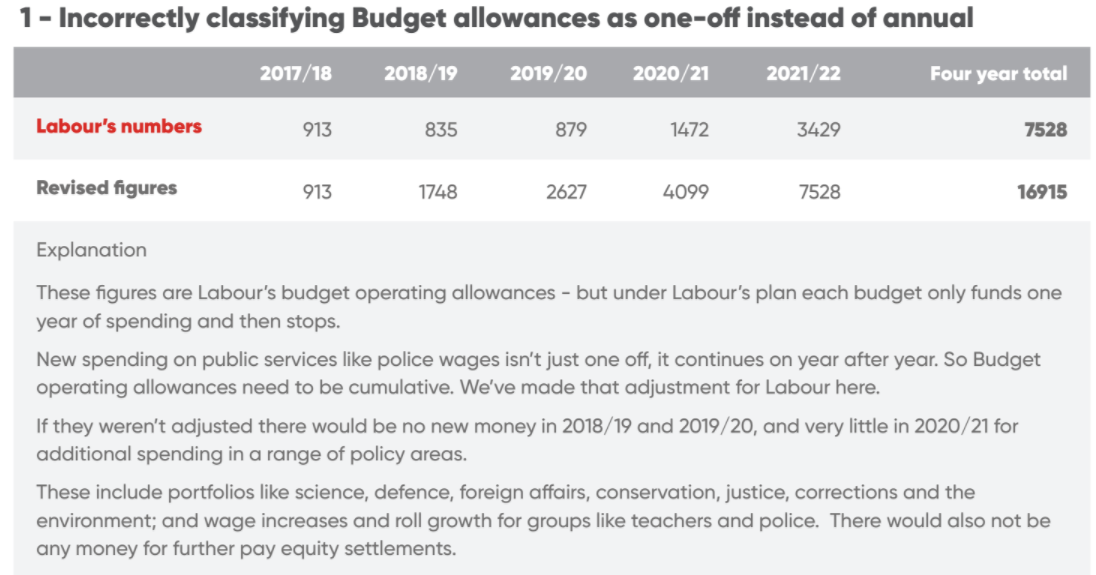
You can see here on page 14 of Labour’s fiscals, right at the bottom of the page, entries for ‘operating allowance’ of $913 million in 2017/18, then $835m in 2018/19, $879m in 2019/20, $1.472bn in 2020/21 and $3.429bn in 2021/22.
Joyce claimed Labour should be adding each previous years’ spending to future years, as operating allowances should be cumulative – for example an extra $100m spent in 2018/19 on a policy would be expected to also cost at least the same the next year, he argued.
Joyce published what National believes Labour’s table should have shown. Beginning with $913m in 2017/18, then adding 2018/19’s $835m to give required operating allowance of $1,748 in that year, and so on. He produced a table claiming this meant Labour had incorrectly classified budget allowances to the tune of $9.4 billion.
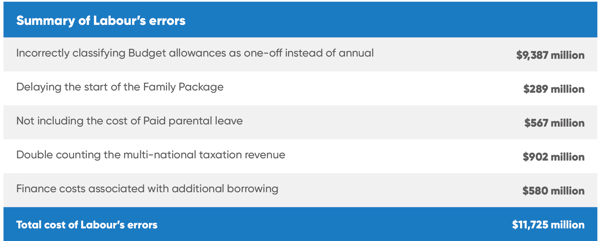
With other criticisms on multinational tax and paid parental leave, Joyce claimed Labour were out by $11.7 billion on what they had indicated in its most recent fiscal plan, released after the pre-election fiscal update last week.
But Labour finance spokesman Grant Robertson quickly hit back. Rather than “hiding” operating spending in the allowance, Labour had placed it under specific items “above the line” like in health and education – the extra spending was effectively accumulating within each 'Vote' line, rather than the operating allowance line.
That line on operating allowance referred to cash left over every year after all spending commitments, Robertson said. Asked why Labour had chosen to present its fiscals this way, Robertson said it was to indicate what extra unallocated cash there would be above existing commitments in each of the next five years individually.
Asked whether this was to indicate to potential coalition partners how much might be available for coalition negotiations, he said every government had to set aside funds for a rainy day.
Meanwhile, in response to criticism from Joyce that Labour had banked on multinational tax revenue that was already caught by the pre-election update, Robertson said Labour was relying on calculations in Budget 2017 that for a every extra dollar spent by IRD on tax avoidance, they would gain $7 in extra revenue. Labour had therefore calculated an extra $30 million spent on catching avoidance would net an extra $200m or so.
Robertson also maintained that Labour's paid parental leave policy was already costed in the party's 'families package'. Joyce had claimed this wasn't the case, with National adding on an extra $850 million over the next five years for the plan. Not so, said Robertson - it's already in there, apparently.
See the table below released by Joyce which National used to back its argument that operating allowances needed to be cumulative.
Labour expecting efficiencies
Robertson said Labour's fiscals for every year included the total amount expected to be spent on each area each year, at the least. Spending projections for 'next year' were adjusted to take into account inflation and population growth - effectively indicating where operating allowances earmarked in Prefu would go.
For example, Labour was expecting to spend an additional $1.535 billion on health in 2018/19, and $2.361 billion in 2019/20 - the latter being a combination of the year before and extra expected spending (Labour's 'above the line' accumultion as opposed to National's 'below the line' operating allowance accumulation, Robertson said.)
He called on Joyce to do the same - saying National was hiding expected spending committments in its operating allowance line, meaning there was no transparency on how much funding would be put towards key public services like health and education over the next five years above already announced policies. Robertson used the opportunity to talk up the need for an independent reviewer of government spending plans.
Joyce had earlier attacked Labour for indicating nothing would be left in the tank to deal with public service wage increases, or keeping policy commitments funded longer than the initial year (his operating allowance attack).
Robertson said much of that attack was blunted by Labour's 'above the line' spending accumulation, but did say that Labour was expecting departmental efficiencies, and that Labour would look at reprioritising certain spending commitments as a way of freeing up extra capital. For example, Labour has pledged to not open any new prisions, so spending earmarked for that currently will go somewhere else, he said.
Watch Joyce in the video below:
This is the statement from National's Finance spokesperson Steven Joyce:
The Labour Party has an $11.7 billion hole in its fiscal plan that blows its debt out and breaks its own budget responsibility pledge, National’s Finance spokesperson Steven Joyce says.
"These are significant errors that raise questions about Labour's whole spending approach and their fiscal competence," Mr Joyce says. "Their spending numbers were already high and this makes them a lot worse.
“Labour’s recipe would lead to more debt, higher interest rates and a slower economy – not to mention the host of extra and unexplained taxes they would impose on households and businesses.
“All of this would cost jobs and eat into family budgets.”
The five errors are as follows, over four years:
· Failing to roll out their operating allowances for each year into subsequent years ($9.4 billion).
· Failing to allow for any increase in paid parental leave in their Family Incomes package despite saying they have included it ($567 million).
· Counting additional BEPs multinational tax revenue when Treasury has already counted it in the PREFU update ($902 million).
· Only including costs of their Family Package from 1 July 2018 when they said it would begin on 1 April 2018 ($289 million).
· Further finance costs associated with extra borrowing ($580 million).
“The biggest error is their failure to continue each year’s operating allowances for additional expenditure into subsequent years. When operating expenditure is added, for example an increase in wages for police, that expenditure continues into following years. Labour’s operating allowances don’t allow for that.
"Once corrected, Labour’s spending plans result in net debt increasing by nearly $20 billion from current levels of $60.6 billion to $79.3 billion over four years.
"Labour was already increasing debt by $7 billion from current levels by their own admission, but this takes it to nearly $20 billion. This would be an irresponsible level of debt increase at this stage of the economic cycle. New Zealand should be reducing debt now, not increasing it, so we are ready for the next rainy day.
"They also would break their fiscal responsibility rules as net debt would not fall below 23.5 per cent of GDP by the end of the forecast period, in fact it would be higher than it is now, and get nowhere near their own plan to reduce debt to 20 per cent of GDP by 2022.
“That level of spending and increased debt can only lead to one thing – higher interest rates for Kiwi mortgage holders.
"Labour’s true spending plans as revealed in this analysis confirms that behind the leadership change we are dealing with the same old irresponsible tax, borrow and spend Labour Party.
“Labour needs to withdraw its fiscal plan and re-work its proposals.”
Below is a table released by Joyce which Labour says is incorrect:
Below is a press release from Robertson:
Labour’s Fiscal Plan is robust, the numbers are correct and we stand by them despite the desperate and disingenuous digging from an out-the-door Finance Minister, says Labour’s Finance spokesperson Grant Robertson.
“Steven Joyce has embarrassed himself. This is a desperate, cynical stunt to create a diversion. Our plan has been approved by BERL and they continue to stand by this plan. We stand by this plan. These numbers are robust and I refute Joyce’s allegations.
“Our operating expenses are above the line and are clearly stated. For health and education, which represent the lion’s share within any year’s operating allowance, there is around $6.7b for health, and around $1.8b for education, both clearly stated in our Fiscal Plan.
“This is a desperate act from a flailing Finance Minister. He knows that we have accounted for our expenditure in health and education going out into future years, He’s being disingenuous and trying to mislead the New Zealand public. I’m sure they’ll see through it.
“We have quite clearly put in the spending requirements to meet the promises we have made. Our fiscal plan adds up. We are absolutely clear that we have the money to meet the commitments that we’ve made.
“I challenge Mr Joyce. Is he going to fund health and education for the cost pressures of inflation and demographic changes? He needs to be up front with New Zealanders, because that’s what we’ve done.
“Labour’s Fiscal Plan details funding for housing, health, education, transport, police and other priorities, while running surpluses and paying down debt. We can afford to do this because we have put those priorities ahead of National’s plan for tax cuts that deliver $400m a year to the top 10 per cent.
“National has serious questions to answer about their own fiscals – they haven’t allowed $8.5b for cost pressures in health and education. They haven’t funded their GP policy properly. They haven’t said where the money for their $11b of capital spending will come from.
“We’ve been transparent, which is something that the National Party has never been. We’ve produced a detailed fiscal plan, they’ve produced a double-sided piece of A4 that lists their campaign promises,” says Grant Robertson.
Response to Steven Joyce’s claims:
Failing to roll out their operating allowances for each year into subsequent years ($9.4b)
· National have made a simple mistake – Labour has put the money that National hides within the operating allowance in the accounts. Doing it this way is more transparent as New Zealanders can see how much more money will be going into the system.
· National on the other hand has not done this, In 2018/19 National will have to provide $650m for inflation in health and education alone. Once you take this from their operating allowance they have less available than Labour.
Failing to allow for any increase in Paid Parental Leave in their family incomes package despite saying they have included it ($567m)
· The money for this is incorporated within the Families Package Line within the Fiscal Plan. This has always been Labour’s position – and we have led the debate on PPL for the past three years.
· The costing is based upon the MBIE advice to Ministers that was provided to the Select Committee that examined Sue Moroney’s original Bill.
Counting additional BEPS multinational tax revenue when Treasury has already counted it in the PREFU update ($902m)
· Page 202 of Vote Revenue shows that for every dollar spent on investigations $7 of discrepancies are found. This has been a consistent message from IRD in select committees and in their publications. We are going to provide them with $30m of additional revenue for investigation activities so that they properly assess multinationals’ taxation statements.
Only including costs of their Family Package from 1 July 2018 when they said it would begin on 1st April 2018 ($289m)
· Both versions of the Fiscal Plan have been clear that the Families Package will commence on the 1st July 2018. We will need to pass legislation to make this happen and to undo the $400m tax cut for the top 10 per cent of earners.
· The website of the Labour Party did have a statement saying under the Families Package when it was first announced that it would be 1 April. But in terms of the numbers in the fiscal plan they have not changed at all, it has always been 1 July 2018.
Further finance costs associated with extra borrowing ($580m)
· This is an erroneous figure. If indeed we were missing $11b in spending then we would need to find that finance cost. However, as is clear from P.14 of the Fiscal Plan we have accounted for the additional finance costs that our fully costed programme would deliver (see line “additional finance costs”).

We welcome your comments below. If you are not already registered, please register to comment
Remember we welcome robust, respectful and insightful debate. We don't welcome abusive or defamatory comments and will de-register those repeatedly making such comments. Our current comment policy is here.