
By Jenée Tibshraeny
We live in “unprecedented times” and need to adjust to the “new normal”.
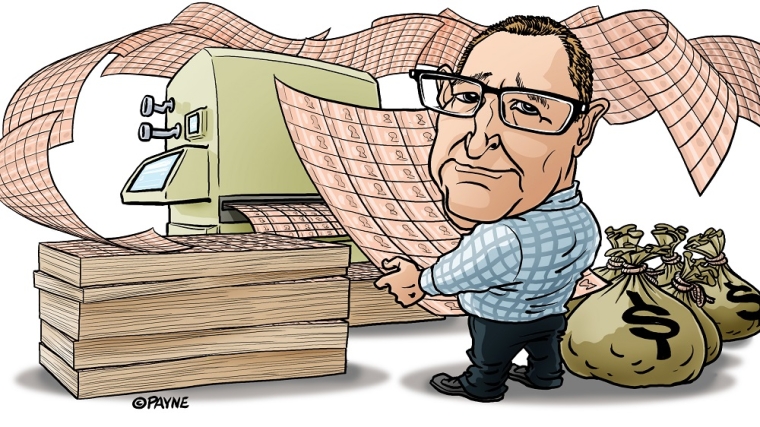
We all know it, but the country’s two largest political parties are refusing to acknowledge it when it comes to one kind of major situation - the billions of dollars figuratively being printed by the Reserve Bank (RBNZ).
As the debate in Parliament tirelessly rages over James Shaw’s poor judgement pushing his ministerial colleagues to allocate $12 million towards a “shovel ready” “green” private school, there is zero conversation around the implications of the RBNZ’s monetary policy, literally worth several thousand times that sum.
The RBNZ, along with other central banks around the world, is working to lower interest rates by doing quantitative easing (worth $100 billion) and signalling further cuts to the Official Cash Rate (OCR) in a bid to keep inflation and employment buoyed. It’s mandated to do this by law.
However, RBNZ Governor Adrian Orr, in a speech delivered on Wednesday, explicitly said: “We acknowledge that lower interest rates inflate asset prices.”
He was open about the fact the RBNZ actually wants asset price inflation.
"Higher house prices, for example, make people feel wealthier, more inclined to spend, which supports the economy,” he said.
Employment front and centre
Orr said he and his colleagues had thought “a lot” about high asset prices “widening the wealth divide”.
However, “It’s high and persistent unemployment that keeps me awake, not house prices,” he said.
He believed it was more important for the RBNZ to continue loosening monetary policy to try to prevent people losing their jobs, than for it to hold back in fear of the side-effects of such policy.
“Job security and a predictable household income has the most immediate and beneficial impact on economic wellbeing. Unemployment worsens economic wellbeing and underpins income inequality,” Orr said.
“The biggest contribution we can make right now to economic wellbeing is to improve New Zealanders’ job prospects through lower interest rates.”
RBNZ's remit: look at the system as a whole
However, Orr said: “We want to understand and make sure that any unintended consequences, or consequences that we just know are going to happen, are managed…
“We as a central bank need to be aware: are those asset prices being unnecessarily inflated? Are they going beyond any sense of fair value? And what would a sudden adjustment in those asset prices… [mean] for the financial system as a whole?”
Orr noted the RBNZ could restrict bank lending against houses using loan to value ratio (LVR) restrictions, which require borrowers to have certain sized deposits. It could also require banks to hold more capital, as it is, to make them stronger.
However, these actions must work to bolster the banking system “as a whole”.
“We can’t help individuals or make decisions for them,” Orr said.
“They need to invest soundly and the financial system needs to make sure that they’re not selling undue risk to individuals.”
Orr acknowledged the RBNZ could also draw the Government and industry’s attention to some of the risks associated with it working to lower interest rates.
But he concluded: “That’s not our role, to influence in any direct meaningful sense, income equalities or wealth inequalities.
“That is a far more complex task around broader government policies, whether it’s welfare, taxation, education, health, all of those very critical, important components that allow everyone to have equal opportunity for wellbeing.”
In other words...
So in essence, Orr is saying, ‘We get it - we’re helping people with mortgages. We’re reducing their debt servicing costs, and increasing the value of their houses, which gives them more equity to leverage off to borrow more for other investments. We’re also boosting the value of people’s share portfolios. We know all this makes wealthy people wealthier.
‘But we trust the environment we’re creating will stimulate the economy as a whole. This is better than people losing their jobs, which would hit the most vulnerable the hardest.
‘We’ll make sure asset prices don’t inflate to the point they destabilise the banking system. But we’ll leave it to the Government to deal with the distributional impacts of what we’re required to do by law.’
Orr made no secret of the situation, setting it out in a slightly less direct way on Wednesday.
Tax and welfare reform required
One could argue the model central banks around the world use is flawed, as it’s predicated on using debt to drive growth, even when households and governments are already heavily indebted and don’t necessarily see more debt as a pathway to growth… if in fact growth should be the ultimate economic goal. Big existential questions, too large to tackle in this article.
But if we accept the Government isn’t going to let the RBNZ experiment with even more unconventional “unconventional monetary policy”, then the Government needs to ensure its policies factor in the effects of the gigantic levers the RBNZ is pulling.
Put bluntly, the tax and welfare systems need tweaking.
The RBNZ’s stimulus (low interest rates) has a trickle-down effect through the banking system. The Government needs to balance this with a bottom-up approach to ensure the most needy don’t miss out.
Finance Minister Grant Robertson's initial economic response to the Covid-19 crisis, including the flagship wage subsidy, has been good.
But now's a good time to pull out those Tax Working Group and Welfare Expert Advisory Group reports. Their recommendations are even more pertinent than they were pre-Covid.
Pragmatism not ideology
This pitch isn’t rooted in some sort of socialist ideology. It’s rooted in the view the world is evolving, so policies and mindsets need to evolve accordingly.
The “new normal” is a society with higher unemployment, as Orr pointed out, disproportionately affecting people with lower skills or more transitory attachment to the labour force (young people, women, Maori and Pasifika).
It's also one where low interest rates are prompting people to seek yield in property and equities at a time their prices are already inflated.
Narrow thinking, which says ‘Labour supports workers’ rights, a strong state and wellbeing’ or ‘National is a pro-business party that advocates for low taxes and less regulation’, is outdated and redundant.
Politicians need to show some leadership and reframe their thinking. They are closer to the RBNZ at number 2 The Terrace than the public is, so have a moral duty to tackle the tough issues bubbling away pre-emptively, rather than reacting once it's too late.
If you’re stuck on left/right liberal/conservative political framing, consider the fact the largest economic intervention underway under this “centre-left” government is one that provides a form of welfare to the wealthy.
And before “free-marketeers” grumble over the suggestion those on Jobseeker Support should receive more than $250 a week, they should consider how much less their mortgage repayments are, or how much their KiwiSaver balances have grown, through no doing of their own or “market forces”, but through the interventions of central banks.
*This article was first published in our email for paying subscribers. See here for more details and how to subscribe.
102 Comments
The RBNZ, along with other central banks around the world, is working to lower interest rates in a bid to keep inflation and employment buoyed. It’s mandated to do this by law.
Again, bank reserves only tell us that policymakers are reacting to something else going on in the monetary system, something negative, which in all likelihood has already gripped the real economy and begun to drag it downward. Inflation and all.
That is why we continuously observe, all over the world, the solidly inverse relationship between gobs of “free money” and the inflation rate contrary to all wisely-held beliefs about gobs of free money. It can’t be that, otherwise this wouldn’t always happen Link

Spot on.
Orr has learned absolutely nothing from the many years of failures of Central Banks' policies both in Europe and Japan.
He is going along the same route, while expecting to obtain different results: this would be sort of funny if it was not so potentially destructive to the NZ economy in the longer term.
The solutions to this bank driven ponzi scheme are going to be painful, so don't expect leadership from government; especially around election time.
Is there ever such a thing as an honest politician?
Eventually the market will decide, as cashflow is king. We can only hope it flushes the current (so called) democratic system down the toilet; including these professional politicians with it. Neo liberal economics has been nothing more than a big con job, predicated on free market trade between countries which doesnt exist. All its done is redistribute capital and centralise capital and resources.
Much of the world has been controlled by interests associated with the oil, banking and defence industry hiding out in the US, abusing the US citizens taxes to keep their private party going. Its all coming to an end, as US living standards continue to slide. Greed gets you in the end.
They also have a mandate to maintain price stability, but they are completely and willfully blind when it comes to asset prices. They have adopted the dangerous notion that they can prevent a correction and inflated asset prices are the 'new normal' and have backed themselves into a corner whereby they must always apply more QE at the hint of a correction. The larger the bubble the bigger the crash springs to mind.
This pitch isn’t rooted in some sort of socialist ideology. It’s rooted in the view the world is evolving, so policies and mindsets need to evolve accordingly.The “new normal” is a society with higher unemployment, as Orr pointed out, disproportionately affecting people with lower skills or more transitory attachment to the labour force (young people, women, Maori and Pasifika).
It's also one where low interest rates are prompting people to seek yield in property and equities at a time their prices are already inflated.
New Zealand's astounding wealth gap challenges our 'fair go' identity
A sobering but truthful article.
Spot on Jenée
Personally I think the central bank should have to take into account these distributional effects when making these decisions. While in the distant past it could brush this off as the effects of tweaking interest rates in this way were fairly minor (a fall from 8% to 7.5% is a 6.25% reduction in lending costs, a fall from 1% to 0.5% is a 50% reduction in lending costs) the inability of CBs to take interest rates back up after the GFC has resulted in inflated asset prices for well over a decade now and they are likely to continue into the future.
The CB should have scope to use whatever tools it wants and be explicitly outlining:
1) why it has chosen the tools it has
2) what the impacts will be of using these tools on finc stability, employment, inflation and distributional effects
3) whether it has evaluated other tools and whether they would achieve the same or better outcomes in one of the above areas
Well, well said, Jenée.
It's really an embarrassment that we have Orr saying, “The biggest contribution we can make right now to economic wellbeing is to improve New Zealanders’ job prospects through lower interest rates.”
When there is no empirical evidence to support the statement - in fact the evidence is quite to the contrary and it's staring him right in the face;
https://www.stuff.co.nz/business/122515536/rules-relaxed-for-government…
https://www.stuff.co.nz/business/prosper/finances/121648683/loans-and-l…
https://www.stuff.co.nz/business/121457990/coronavirus-only-23m-of-loan…
How central bankers can go about spouting this kind of [expletive] with a straight face these days is beyond me.
Meanwhile;
https://www.stuff.co.nz/national/health/300096203/new-zealand-continues…
hmmm, welfare starts us down a path of entitlement that's very hard to reverse from. Parents fail children, I think that's a responsibility we take when we have them. Obviously we need to support children and families in crisis. However we also get what we pay for. My daughter has a friend, her sister had her first baby at 16 and now has 5 children ,wants to have 10, more than one father and all on welfare.
Families are so important and if anyone has an idea of how to fix the problem of children being raised in families without fathers, poor quality housing, lack of discipline, drugs available, abuse, hunger, welfare dependence etc, i would love to hear it. It's heartbreaking and it's happening right under our noses and most of us don't even notice.
Low wages are a huge problem, we have allowed hundreds of thousands of people to come here on short term work visas, these people often from very poor countries ,have lower expectations, work hard for a lot less money, often single and bunking. Dairy farmers can supply a cottage deduct rent, pay a salary based on a 40 hour week but make them work 60-70 hours. The workers cannot leave because their visa is tied to their employer.
Work in orchards is paid a lot less that it would be in a free labour market, without imported labour. Same in vineyards, squash industry, etc all have become dependent on cheap hard working immigrant labour.
We let 1.3 million new migrants into the country without increased spend on infrastructure, perhaps we never could afford it in the first place. We also allowed a housing bubble which means for many around here, they are nothing more than subsistence earners, surviving paycheck to paycheck.
Most of one salary going to rent. It's seriously screwed up, inequality leads to high crime and unenviable outcomes
It's worse than that AJ.
The smart work out we have to reduce population, so they do their bit by not. The not so smart keep breeding, and thus outnumber the smart within one generation. Bill English had six offspring, Marama Davidson did too, so it is a fair hypothesis that this skewed population is voting for itself in proportion.
We probably peaked in smarts per-head (and in terms of good academic study, I feel) in the 1970's. Certainly the level of debate was higher. But it's an interesting observation that just at the time society needs to be its smartest, it's already gone off the boil, averagely.
Plus the Greens marketing their agenda to the young that fall on love with the pie in the sky without haveing much of a clue about the larger issues involved.
We have the tail wagging the dog and feeding it to produce a larger market share than it deserves.
Ultimately the only way the system will change is when its bankrupted.
Most western economies are very close to this position, which I think will lead to the banking industry being nationalised. 'The business of banking shouldn't have been allowed to be sold off to interests outside the system in the first place. Nationalisation is the only solution, as it added no value to NZ in its present form; where out of proportion profits are exported.
How can a system support private business only added debt, when the consequences are a greater cost than the system can support? It cant.
NZers lost their jobs and got stuck with debt and it's consequences.
welfare starts us down a path of entitlement that's very hard to reverse from.
I think neoliberal values started us down a path of entitlement that's very hard to reverse from.
We should kill the 4 billion accommodation supplement, thats welfare we can really do without
'Tis incredible that not only do we support the sacred property cow with monetary policy, but also with subsidies to increase yields.
What a fine bit of redistribution we have going on from poor to rich.
Utter Right Wing drivel.
Is it not enough the Mr Orr's asset inflation is making the rentier class richer by the day.
Nope, we had best screw the poor too.
Usual playbook bigotry
Kate, Neo Liberalism was not the answer sure. But the welfare state resulted in trouble in all the western world too providing the opportunity for Neo Liberalism to rise. Look at the economic crisis in Nordic countries and New Zealand in 1970s and 1980s. It is pointless to continue to live in the past. Both Neo Liberalism and Welfare States have failed us when allowed to take us to their extremes. We either need a completely new approach or a comprehensive analysis of what were the best and worst of what we have tried in our modern time to develop a more balanced approach.
Look at the economic crisis in Nordic countries and New Zealand in 1970s and 1980s. It is pointless to continue to live in the past.
Hmmm...actually the Nordic countries have quite well developed industrial bases compared to NZ. They also have a better understanding of the social contract in the welfare state.
Don't know why you're lumping NZ in with the Nordic countries.
The overseas banksters gained control of NZ in the early 1970's, when they called in the loans taken out to fund the think big projects.
These banksters didnt need to call in the loans, but their wider interests (which extend to oil) periodically manipulate the global money supply to take advantage of those too exposed to their practices. I suspect they could see the NZ economy was heading towards self sufficiency and didnt want that to happen. We are not the only country that has and is being exploited by wider private global interests.
The moral of the story is dont trust banksters, live within your means, ensure you spread your risk and grow slowly through conservative lending practices.
The 70s economic cataclysm was down to oil quadrupling I think you will find
Explore how the oil price quadrupled, and you'll find american oil industries abusing their power.
We can thank Elon Musk for disrupting the oil men's abuse of power. Look back through history, and you'll find the majority of US presidents have links to them. The planet and its people may finally enjoy less population, as a result of less carbon dioxide being burnt off as energy.
Excellent comment B1980. Over generous welfare states created a cross to bear for generations. Neo-liberal policies screwed the poor who were made more vulnerable by the over generous welfare state. You are totally correct -some balance is required. But as one response indicates, to dial back the welfare state, there must first be decent jobs to go to.
And the problem is we've ended up lurching from Muldoonist subsidising of one favoured set (farming) to favouring another (property). And once more, we're inflating debt and reducing our economic soundness in the process, to the point of looking decidedly unstable.
The RB has indicated they will likely "print" $100b. These numbers are often too big to understand, so lets put it in context.
We have roughly 100k poor children in the country. That's an indictment of poor policy over the last few decades. If you instead gave that money to those 100k children, they would have $1 million each.
We could literally remove poverty from this country overnight and ensure we get a whole lot of inflation all at the same time. Instead, we give money to wealthy people and banks because the system is designed that the money flows to them.
For Orr to blah blah about how he isn't responsible for the distributional impacts is shallow at best and callous at worst. If he sees the issues, he should damn well use his platform to demand the government to make meaningful changes. And threaten to resign if they do not. Nobody has ever come off looking bad for making bold moral stands. They DO come off looking bad if they add fuel to a fire knowing that it won't put it out and not suggesting a change of thought. Orr hides behind his position instead of using it as a platform for change. A bureaucrat more interested in keeping his job (and probably his investment properties?) instead of helping the country - i.e. the worst kind.
Why don't they just give every man, woman & child $25,000 each? I guess this would be too honest.
Well said Mr or Ms Blobbles
"A bureaucrat more interested in keeping his job (and probably his investment properties?) instead of helping the country - i.e. the worst kind."
Very well said.
Exactly, they forget we have the internet and we can educate ourselves and listen to alternative views and views expressed by commentators in other countries where their central bankers are playing the same record. Central bankers provide money to the banks who then decide who to lend it too.... want to buy a house? Here’s some money.... want extra overdraft or loan facilities to keep your business afloat then you’re on your own, they are not interested apart from providing the standard government assistance. Hearing this from NZ, Australia and the US. Central bankers will only provide financial assistance directly to the people who need it when then can control hiw that money is spent. The fed coin is one such example. Until then they will continue to put their faith in the banks to do the right thing which of course they won’t. Only concerned with profits.
Inequality increases in recessions.
Propensity to consume and increase GDP commensurately, is higher at bottom 35% of economy.
So, redistribution makes sense at moment in particular.
Increasing debt instead of wages is what got us where we are now.
Income taxes are daft; it is a tax on working.
Wealth taxes are more sensible, esp on land ownership over say, 10H, pa, or an increased rate.
Rates and GST are regressive.
No tax allowance when it is $25,000 in UK.
Jenée
This is exactly the debate that we need to be focusing on as a nation.
The people who are being advantaged are those who are on the property ladder. The people who are most disadvantaged are those who are not yet on the property ladder and lack parental support to get onto that ladder.
Among other things, we need better mechanisms for people to be able to save house deposits, where those savings are at least the same rate as house asset inflation.
KeithW
KW - you'd enjoy Wright's Short History of Progress. Well worth the read, short and punchy. He mentions that the end-game for the Maya, the Sumerians and others, seemed to be heralded by an elite emerging (social stratification, as per now), monuments to them being erected, increasing disquiet from the lower-orders and friction between grandees.......
I wonder, sometimes, whether for Tikal we could substitute 'Auckland in 2040'?
Keith, I have a good friend who works as a school counselor, the stories he tells are shocking, poverty is a real thing for so many kiwi families today. Children without winter coats and Jerseys, no decent socks, no food in fridge so no breakfast , dinner with an aunt. Playing video games often till 3 in the morning , turning up exhausted, hungry and cold at school.
A constant battle with my two oldest kids at present is the bedtimes and computer use. 10 & 12 argue that they should be allowed to stay up past their respective bed times of 8.00 and 8.30 as they say that they have the earliest bed times of their peers and that they basically only get computer to do homework.
We get comments that we are a bit hard on them and then that they are really well behaved, great manners and eat everything put in front of them. It takes a hell of a lot of time and engery to build good kids in the fast paced world we live in.
Stick with it. Good parenting is the hardest and most rewarding work anyone can do.
They will thank you in the long term. Guarantee it.
I have heard bad stories too from school councillors but on a different point. Well educated parents, both working, kids looked after by a series of au pairs, after school activities every day, weekend sports etc but very little down time. Every minute of their time is allocated with little time for play or relaxing or just being bored. Councillors are finding that kids are just exhausted, turning to alcohol and drugs and also under tremendous pressure to perform. Many believe that the kids will burn out once they get to 30 and many will have serious health issues as a consequence.
What I have noticed is how fast parents give their kids painkillers. It's crazy to hear 'you look a bit under the weather, here take this'.... that in my view is creating a generation that takes something as soon as they aren't running at 100%. Dose this play out to be 'I'm not happy, no need to feel this way, pop some Prozac or self medicate with MDMA.
I only take painkillers when I can't bear the pain a more, not because it hurts a bit.
I taught at decile one schools for the best part of 20 years.
Most of what you've described is due to poor or neglectful parenting. Teachers left to pick up the pieces.
Disagree
I practiced in the private-commercial sector as a company doctor, trouble-shooting, salvage and fix-ups
If you have a factory set up to manufacture sausages but keep getting black-puddings out the other end you dont keep manufacturing - you stop manufacturing altogether and fix it. If you cant fix it you shut it down. Or pretend and go into the black-pudding business
quote: "we need better mechanisms for people to be able to save house deposits"
That's simply playing at the edges. You know that mass-immigration flooding into the country has to increase house prices unless there is a commensurate increase in building residences. You know that mass increase in the number of houses built will have to be done on the fringes of cities and society. You know that there will be a substantial increase in demand for schools, hospitals and roads etc
There is a lot of things that you can do. But making it easier for each wave of young people entering adulthood and the workforce to conjure up a deposit isn't going to fix that. If you can please advise. Australia tried substantial Federal and State First Home Owner Grants and that hasn't helped them
My recommendation is to close the immigration spigot until sanity resumes, retrospectively increase the 5 year bright-line tax to 10 years, let the IRD loose and tax the s**t out of them. Yesterday some clown paid $2,900,000 for a 1200 square metre property in Three Kings with a liveable starter house on it. That automatically makes all the surrounding houses in the area the same value. That's the way the valuation profession and valuers work.
How would you do it?
Iconoclast,
I am suggesting it is a very important mechanism but not the only one. I have previously written here about the need for a structured immigsation deabate (https://www.interest.co.nz/opinion/106554/any-debate-immigration-has-co…) and I have also writte about QE and the implications when it is taken to excess. (https://www.interest.co.nz/opinion/106222/quantitative-easing-surely-dr…}
KeithW
Keith
We are beyond debates. 40% of AKL population are born overseas. How do you think they would vote. Where would their alleigances be. All I "have been" saying is we need to suspend all immigration until all the downstream pressures are fixed. As GDP increases exports as a share decrease. Migrants are not participating in the export economy. With payday filing and data matching it is possible to ascertain every month to what extent the collective of all those who have arrived in country over the past 5 years, how many are employed, how many are unemploted, how many are on welfare, how much they have earned and how much tax they have paid. Then we can begin to assess if we are getting the unstated dividend. That's only the income side. Debating it doesn't fix it.
And then there's the TLA-induced cost layers on land and build prices - Productivity Commish had a lot to say about this over several reports, but they've been memory-holed....the working counterfactual is of course Christchurch, where deep-sixing the land/subdivision restrictions after the earthquakes has resulted in a fairly-much-plateaued house plus plot price (in real terms) for new builds....
"Higher house prices, for example, make people feel wealthier, more inclined to spend, which supports the economy,” he said.
How could Adrian Orr think this way? What part of less saving and more debt makes people feel more inclined to spend, which supports the economy? This is just stupid. The value of an unsold house wont be converted to cash. We all know that.
"Higher house prices, for example, make people feel wealthier, more inclined to spend, which supports the economy,”, then explain why is this happening?
https://www.interest.co.nz/business/106860/retail-nz-says-about-10000-r…
I've lost my confidence in Adrian Orr...
Agreed. As someone who recently did the maths on buying an expensive house, our first thoughts were "how do we afford this as much as possible?". The answer is simple. Stop spending.
He's done as well as he can up to this point. From here on in it's all a confidence game. If we head into a massive deleveraging the fallout will be huge given the ridiculous amount of household debt we already have.
While everyone should save up for what they want to buy even car loans at 1.99% make more sense than saving (except that many people take on too many debt obligations).
How could Adrian Orr think this way?
Education and institutional indoctrination. He wouldn't have got the where he is in his career by thinking any different.
I would imagine being in possession of a property portfolio also unavoidably influences one's thinking. It would be difficult to avoid.
Certainly seems to have a clouding impact on the thinking of others.
He's basically sing the 'Debt is Good!" mantra, and ignoring the looming fact that it will hurt when it bites.
He's not just propping up property prices, he's also pimping for the banks. Makes me wonder if he's on a commission for them?
Well he has no option but to prop the PONZI scheme.....but hey its the only way how New Zealanders can get rich......
Great piece. Thank you.
We are indeed writing a new story.
My outrage spilleth over
James Shaw didn't push - he did more than that - he abused his ministerial power - one prominent writer is on the record referring to it as greenmail - in my neck of the woods I go further than that
I have been waiting for the torrent of outrage from the higher echelons of society
So far silence
Grant Robertson down-played it as Shaw asserting his view
The email from Shaw's office clearly stated Shaw was withholding $600 million projects unless he got his green-school approval
I'm disappointed at the silence of the elites
It condones this behaviour. Once condoned it becomes accepted
That is what is happening. Tacit evidence of passive acceptance
In my opinion it is borderline criminal
I think he should resign
He should have been gone by lunch time
I don't have time for Shaw - his 'we can have growth just green growth' is baloney:
https://www.nature.com/articles/s41467-020-17928-5
But he fronted up and apologised. Which puts him ahead of Collins by a country mile.
He only apologised because he was caught red handed, not because he is genuinely remorseful
Exactally!
The characteristics of a true politician. He could maybe get a job as a bank CEO if he’s needing a career change.
*Any job where a suit and tie is a requirement
That sure is going to happen, there are a lot of quid pro quo deals that happen in the higher rungs.
I guess we await Judith Collins' apologies on Oravida et al still, true.
Let's point out the elephant in the room.
The Greens did not need to be in this COL, Labour dragged them in needlessly.
It's another Labour management screw up.
Funding for a single green school - $11m, funding for Kura Kaupapa nationally, $1.5m (2019)
What a farce, complete clowns playing kingmakers. We are all poorer as a result of these idiots.
Yes your are poorer.
And yes, because of idiocy.
But not the Green's idiocy - the pursuance of growth within a bounded system was the idiocy. Both main Parties (all Parties, come to that, except the Greens in their first iteration and the Values Party in its) are guilty.
Surely they all do what Shaw has done... it’s called bargaining power.
Wikipedia
Extortion also called shakedown is obtaining benefit through coercion.
In most jurisdictions it is likely to constitute a criminal offense
One mans extortion is another’s crust....the way some business operates. I don’t need Wikipedia to know that
Perfectly stated.
We live in “unprecedented times” and need to adjust to the “new normal”.
We all know it, but the country’s two largest political parties are refusing to acknowledge it when it comes to one kind of major situation - the billions of dollars figuratively being printed by the Reserve Bank (RBNZ).
'We' a good portion of those on here know this. But most of the population dosen't really have a clue. Our mainstream media write one articial about this in an ass covering exercise, then follow on with ten nothing to see here BAU articials to calm the masses.
A lot of people who I talk to are ho hum the economy is strong(ish) keep investing.
We all know it, but the country’s two largest political parties are refusing to acknowledge it when it comes to one kind of major situation - the billions of dollars figuratively being printed by the Reserve Bank (RBNZ).
Yes Kezza. Both parties are still tied to the status quo based around money creation. They don't know anything else. Well, it's not clear there is anything else.
Labour has been selling us that they are an outside of the box Party that can change NZ, where is that transformation Govt?
There is always another way, to simply ignore it and continue on the same path is doomed to failure.
We just haven't got people of experience in power or any other Parties that can step up.
The current COL (& National) only react once it becomes a political foot ball, hence we need to talk a out it to create an environment of change.
Kezza, not a single person i've spoken with in NZ (apart from on here) knows about the OBR. None of my husbands family (and some of them have large property portfolios, so you'd think they'd have some awareness of economic policy), no one at work, no friends. Admittedly, it's not something you just casually drop into conversation around the BBQ but i've maybe asked a dozen people and not a single person has even heard of it.
‘We’ll make sure asset prices don’t inflate to the point they destabilise the banking system. But we’ll leave it to the Government to deal with the distributional impacts of what we’re required to do by law.’
about a decade too late.....the banking system has been unstable, is increasingly unstable and despite the best efforts of the RBNZ that instability will continue to increase....and they know it.
.the banking system has been unstable, is increasingly unstable and despite the best efforts of the RBNZ that instability will continue to increase....and they know it.
Exactly. Let me remind you how often the RBNZ and retail banks speak to the public via the media with the aussurance that the banking system is among the most stable in the world. It's propaganda because it is. The stability is built on the ignorance and trust of the sheeple. However, a massive spanner has been thrown.
What's the point in having a "job" when you can't afford a place to live with your wages?
There should be looting and rioting happening over what this crook is up to.
His ex-colleagues at the NZIER were right.
At the risk of repetition, I'll note:
"The REALLY smart people don't work for a Central Banks"
Adrian Orr and his ilk are up against a marketplace very clever operatives who (1) know more than them ( Adrian Orr was just a market commentator, sorry - economist - for Westpac when I arrived.), (2) Know what they are going to do next and (3) Know how to maximise the gains from what's enacted.
This isn't personal. It's a fact.
You don't work for the RBNZ for a million bucks a year if you are clever enough to get 10 or 100 times that much working in the private market.
The difference?
Stuff up in private enterprise and you lose your job. Do it as a Government appointee, and just keep doing the same old thing, hoping that one day it works.
If you think the attribute that determines whether you're at the RBNZ or an equivalent role at Westpac is intelligence you are sorely mistaken. By far the biggest determining factors will be the value you place on $'s over contributing to society and whether you are prepared to stab a colleague in the back. https://www.nzherald.co.nz/nz/news/article.cfm?c_id=1&objectid=12361402
... which role is favoured by backstabbers?
Not the lower paying one.
Look Central banks are horrendous forecasters and it shows how hard the job is...so we shouldnt be too hard on them or assume they know everything..they dont. Please look back at the market’s lamentable track record of predicting rate paths, be it disbelieving that the BOJ or ECB would ever cut into negative territory, before the viral crisis pricing a normalisation of the ECB back to zero or the largely dismissive reaction I received on my 2019 call that the ECB would cut TLTRO rates beneath the deposit rate to colleagues as an example. There is a near enough 100% track record of markets being wrong , or at least very slow, big picture...so why should RBNZ and the like be on the money.
I think we should focus on providing opportunities for the next generation of New Zealand from the 50% of families with little to no wealth. They are inheriting institutional disadvantages that unequal wealth accumulation entails. It is important that the future life is not a trap for most of kids growing up in NZ.
I guess education for poorer areas must be a priority. They must have best resources allocated to them and they must be held to harder educational achievement standards and helps extended to them from as early as possible to become strong (or at least adequate) in reading, math, science, art, etc. If they do not have food, feed them, if they do not have cloth, give them clothing, if they are better off spending more time in school, encourage them. DO whatever it takes for a greater number of them to pass a higher bar. But whatever you do, do not lower the bar for them (as is unfortunately often the strategy adopted by governments to make it look like they are doing a good job). It is really betraying their future, as they will have no help when they grow up. They have to work harder (in achieving skills I mean) to be ready.
I also think we should rewarding them for success at school. And not just the very best, but anyone with acceptable achievement. And such achievements can be how they progress against themselves (this would be a fair comparison for everyone) as well as how they compare with their peers.
Agree. Simplest way to wealth is kiwisaver for the poor and beneficiaries Labour should be shot for not thinking of it. They do have some sort of rent to own scheme though, combine that with kiwisaver and boom, poverty gone by lunchtime.
Following on from this, the concept of allowing inflation to run hot it something close to a fantasy as it has to be created in the first place. The real danger here and in the US, is simply that we have observed a transient stasis in the economy where the lower and middle segments have been simultaneously showered with money, receiving a pay hike in essence net of daily outgoings, affording consumption to remain elevated in comparison of other countries. The notion of the $100k+ upper middle classes and higher being a source of pent-up consumption is wrong as they typically had sufficient funds already and now will save additionally, in addition to becoming ever more fearful over jobs and for the retired population, health.
Fantastic article. With the coverage provided by our mainstream media being negligible at best, there continues to be no real conversation about this in the wider public. Unfortunately I think that things will have to get a whole lot worse, before people are made uncomfortable enough, to start actively insisting on real change. I have little hope that our politicians will proactively show some true leadership and begin to reframe their thinking in this area.
Please don't close it before putting some money in my bank account.
QE = legal Counterfit
QE = War on people who save money by people who borrow and spend Money
Earlier use to say save for a rainy day / better future and now the new mantra is borrow money as much as to spend - What a contrast
Defination of Economy to be rewritten - no more, based on supply and demand but will be based on QE.
James Bond has licence to kill and government has Licence to print money :)
End Result is bad in both.
It amuses me that people spend more time deciding wether to label a policy, socialist / capitalist , Left/right , than they do deciding on the merits of the actual policy.
Yep. It seems it is about how they view the next best team in their past performance and not nothing to question the here and now of what their team is failing at.
True. We're lucky to have a fairly moderate duo of major political parties, compared to much of the West. I wonder why we waste our time in these mindless debates.
Great article - keep ‘me coming! Touches on a number of issues concerning me, chief among them the QE balancing act, which is well beyond my understanding right now. From what I’ve read, Britain‘s first £375 billion worth of QE in response to the GFC created a mere 1.5 to 2 per cent growth in GDP (24 to 28 billion) - meaning it just isn’t worth it, surely? There must be better and more effective ways of directly stimulating growth me thinks.
Its worrying really. Those with assets, like me, are getting richer when I dont need to. My kids and their partners are all well educated and well paid (almost obscenely so). They will inherit their parents stuff as we cant spend it all and be even wealthier. (Someone will probably lose it all in a few generations but I dont care as Ill be well gone.)
I personally think we need to tax capital as we tax labour - make it a bit more level. Its a hard pill to swallow as I have worked hard all my life, been careful and would be hit on a capital gains tax et el but in all honesty I wont live in the gutter or my kids be short on anything if I was. Technology is going to make this worse and again those that understand it and can take advantage will only increase in wealth again by another multiplier. You cant keep increasing the gap unless you want unrest. No answer is perfect but we need to try at least.
Those criticising Orr are misguided, he is doing a good job (and I'm not a fan of his). I do believe now is the time to consider a capital gains tax however, no it's not perfect but the state will derive income from appreciating house prices which can be re-distributed. This is the Govt's role, not the central banks.
Depends - given how much housing prices have blown out, an inheritance is the only path some people have towards being debt-free in retirement, through no fault of their own. I fail to see how the state suddenly deciding to clip the ticket is going to improve things, given governments of all stripes have proven themselves incapable of making the kind of radical change they would need to morally justify taxing capital (much of which for some people will just be an accumulation of already-taxed income). It's basically a signal to people that they should be plundering the basics of live to make sure they get a share because the state doesn't if they've already had a bite at your savings - they'll come back for another chomp every year until you're dead, by which time they'll probably take an even bigger chunk.
It's these sorts of one sided arguments that show why people are so stupidly against assert taxes. One sided because they can't see that the dramatic rise in untaxed capital gains has caused a massive wealth gap. Claiming that this rise had something to do with you earning money is absolutely fallacious and you know it. What propped up your gains was lower and lower interest rates, QE and obscene levels of immigration.
A claw back of wealth will come, you get to choose whether it will be peaceful or forced by voting for or against sensible taxation of wealth.
It hasn't been articulated yet Jenee, maybe you can start it off - but we need to realize that 'democracy' is relegated to us the people deciding who to govern over the fallout of unelected banking bureaucrats. We're voting for who drives the ambulance to the bottom of the cliff. We have no call over monetary policy. That's F******
Agreed. Independent monetary policy looks good on paper, but in practise... you’re actually guaranteed robotic, rather than responsive monetary policy. Maybe it would work in a world where economics was actually a science.
This is exactly right. During these unprecedented times we need emergency laws etc. One of them should be to put the central bank back under government control, recognising they are doing a poor job.
However we also need a government in power with a bold taxation plan and a sensible solution to the slowly unwinding economic, social, environmental mess. It's why I will be voting TOP again, the only party actually wanting to change things.
A central bank pursuing negative interest rates at the lower bound when inflation is zip and rates are zip is smoking crack...this will be policy error akin to the ECB hiking rates in 2008...their only argument t5hat higher house prices make people feel better hence spend more iso somewhat fanciful....sounds like the sort of thing a populist government would preach really. Given NZs relatively low level of government debt vs the rest of the globe its time to spend fiscally guys and finally give NZ some infrastructure. Austria recently raised 100year debt at 88 Bps for example.
Major sticking point. Labour can not deliver.
Hi Jenee, I usually agree with your articles but not this one. Your assumption of welfare to the wealthy assumes one is benefiting from this artificial low interest rate created by Orr. If you are truly wealthy and have no debt but lots of cash you are being put at greater risk by the day and your returns have fallen through the floor. The nature of a bond is that the return increases with increased risk but TD’s have fallen from 2.9% to 1.5% and heading to zero and the risk of bank default and a possible OBR event increased substantially with some 140,000 households on some form of mortgage deferral.
The constant news feeds of Mortgage holiday assistance, help for business, partnering with the Government to loan money to business and relaxing of RBNZ of capital adequacy requirements. There are absolutely zero statements on protecting deposit holder’s money. Instead we get BS statements of be bold and take risks and lend with deposit holders’ money from Robertson and Orr. The finance minister refuses to bring forward the deposit guarantee not that one being proposed is of much use with limit of 50k whereas the Australia and the US have 250k. Interestingly since the US federal deposit scheme was introduced in 1933 by President Roosevelt it has cost the tax payer absolutely zero.
You also mention kiwisaver growth as a benefit but the reality is the Government is robbing kiwisavers with its FIF tax regime to the extent they are in international equities. On 1 April 2020 they happily tax everyone on 5% of their kiwisaver balances even though the vast majority had gone down substantially. Further as they recover during 2020 they will tax them on 1 April 2021 on another 5%. So yes, we get taxed when kiwisaver makes losses and then get taxed again when the recover to pre-existing levels. So this Government is not doing any favours to kiwisavers. It’s a tax cash cow for the Government that nobody wants to talk about. The same applies to anyone invested in equities outside NZ and Australia. All the while gains in houses supported by Orr and Roberston remain tax free.
Personally, I think it would be good for the country if they let the market be the market and houses fell 30% and stayed that way for the long term prospects of the next generation in NZ. As without the welfare to the indebted class it would happen.
So my view is the welfare is going to those who have never learnt fiscal conservatism and live a life fueled on credit upgrading houses and buying a boat and the latest iphone, car and 8k TV instead of paying off there obligations. I am not getting any welfare from this Government! In fact the wealth I acquired by working hard and being taxed via PAYE for many years is being put at greater and greater risk for zero return at NZ banks and getting taxed on unrealized losses in foreign equities.
The RBNZ is doing it's job, and believe in their eyes that LSAP (even negative interest rates) are the best mechanism the maintain price stability. Even if it may create more problems, LSAP serves their directive under the Act. Ultimately, it is the role of central govt and the business community to determine what is the best way to economic recovery. At the end of the day, the economy is determined by the reference point that are used to quantify it, the govt could achieve recovery by changing these reference points. If the reference points moved away from economic growth, instead towards economic sustainability and social mobility, then they would achieve a form of economic recovery, this would ultimately create economic growth. Pursuing growth for growths sake isn't necessarily beneficial, as to achieve it requires market distortions. There is a reason why the pineal gland stops your growth at a certain point, people who grow too large face many challenges, and the stress shortens their lifespan. The same is true for the economy.
We welcome your comments below. If you are not already registered, please register to comment
Remember we welcome robust, respectful and insightful debate. We don't welcome abusive or defamatory comments and will de-register those repeatedly making such comments. Our current comment policy is here.