

By Brian Fallow
The tax policy the National Party has announced is economically specious and politically brazen.
It is specious to claim that it is intended to provide stimulus to an economy in recession. Instead it looks like a brazen use of borrowed money to bid for votes in the mortgage belt.
If stimulating spending were the aim the fiscal largesse would be targeted at people with what economists call the highest marginal propensity to consume, that is, to spend every extra dollar that comes their way.
Tax cuts are not an efficient way of doing that. Instead they mainly benefit middle and higher income earners, who pay most of the tax.
On that score it is instructive to look at the distribution of the proposed income tax cuts, achieved by “temporarily” raising thresholds, alongside a helpful table the Treasury produces with each Budget. It breaks down the population aged 16 or older into income bands $10,000 wide and estimates how many people fall into each band.
It’s below and can also be found here.
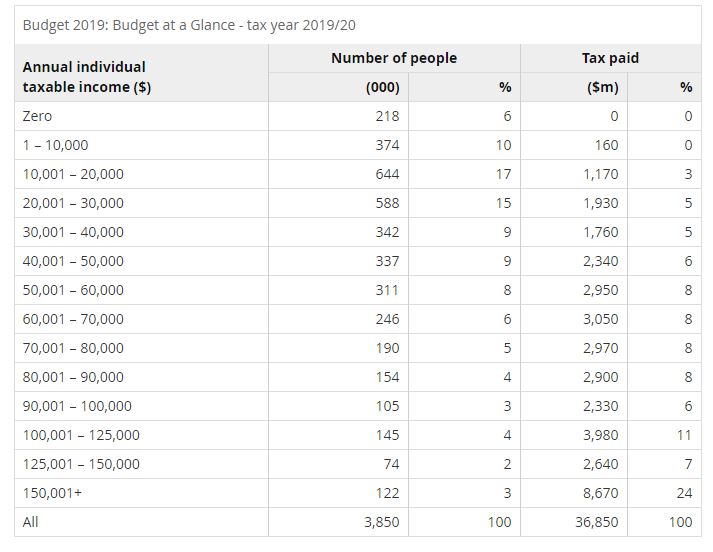
At the time of last May’s Budget, the Treasury reckoned more than half of the working age population -- 2.2 million or 56% to be precise -- had less than an annual taxable income of $40,000.
The most they could get under National’s policy is $8.10 a week.
Around 900,000 would get nothing as their incomes fall below the current bottom threshold of $14,000 so raising it to $20,000 does them no good.
To be fair, nothing is also what Labour’s tax policy offers everyone by way of tax cuts.
National’s threshold adjustments seem designed to deliver the maximum percentage increase (3.8%) at the level of the average wage. That is $64,000 a year if calculated from average weekly earnings per full-time-equivalent employee, including overtime and the public sector, according to the June 2020 quarterly employment survey.
The average wage-earner, so defined, would get $46.50 extra a week.
Those earning more than the average wage -- just over 900,000 taxpayers or one in four -- would see marginal rate of 30c in the dollar up to a top threshold of $90,000, at which point the tax cut is worth $58 a week.
Two other ways of calibrating the scale reinforce the point that this tax relief is not targeted at those who would spend every extra dollar:
The median weekly earnings from wages and salaries in the June quarter just past, according to the household labour force survey, would deliver an annual income of $55,000 and a tax cut on national’s plan of $25 a week.
The median income from all sources ($652 a week) is squarely back in the $8.10 a week bracket.
When challenged that the tax cuts are skewed to those on higher incomes National’s finance spokesman Paul Goldsmith was unabashed: Tax cuts naturally benefit those who pay the most tax.
Income tax that is. His leader, Judith Collins, when talking about the more generous depreciation provisions for business capital expenditure the tax package also includes, made the point that businesses have to make that investment to gain the tax benefit.
The equivalent reasoning applied to consumption would argue for cutting the GST rate instead of shifting income tax thresholds. Consumers would have to buy stuff to get the benefit.
The International Monetary Fund suggested a year ago that a temporary GST cut is a measure New Zealand should think about if fiscal stimulus were required. The idea got short shrift from the Finance Minister Grant Robertson at the time.
As GST is a regressive tax, a cut aimed there would especially benefit people with a high marginal propensity to consume, aka the poor.
As it is, the minority of the population who would stand to gain the most from National’s policy will not necessarily go out and spend those extra dollars.
Given what we know about the income distribution, especially when people’s peak earning years are, those on above-average incomes are most likely to be found in the one-third of households who are owner-occupiers with a mortgage.
So what would they do with those extra dollars? Is a lack of income keeping them away from the shops, restaurants and bars of the nation?
Or is it caution? If so, putting the money in the bank Is not attractive, when deposit interest rates are already negative in real terms and set to become more so when the Reserve Bank delivers on its threat to take the official cash rate negative.
The risk therefore is that National’s policy would add billions of dollars to the public debt so that people can shave a few thousand off their mortgages, and this fiscal largesse would not touch the sides, in terms of stimulating spending.
How big that risk is only time would tell.
National, of course, does not see tax cuts in those terms.
“We believe that the person earning the money owns the money,” Collins declared when formally launching the party’s election campaign on Sunday.
But while the Government is running a deficit it is fair to describe any policy change which increases the deficit, whether it is revenue forgone or spending increased, as being funded with borrowed money.
And as government debt in practice is never paid back and only ever rolled over, the interest bill on that debt is essentially eternal. The best we can hope for it that it shrinks relative to the size of the economy and the tax take.
And that is why it is unfortunate that we have to put quotation marks around the “temporary” nature of the tax cuts.
It is far easier politically to cut taxes than to put them up again.
As April 2022 approaches and the recovery is still looking tentative and frail, what are the odds we would hear: “Now is not the time to be raising taxes on hard-working New Zealanders.”
So how temporary the tax cuts would prove to be, and therefore the fiscal price tag attached, remains to be seen.
The big picture is that we have to get used to the idea of paying more tax, not just because of the debt legacy of the current crisis, but because of the fiscal impacts of an ageing population.
As far as latter goes, the IMF reckons that by 2030 superannuation and health care spending will need to rise by 1.5% and 1.7% of gross domestic product respectively.
That is the medium-term fiscal rip that tax cuts now would be swimming against.
We welcome your comments below. If you are not already registered, please register to comment
Remember we welcome robust, respectful and insightful debate. We don't welcome abusive or defamatory comments and will de-register those repeatedly making such comments. Our current comment policy is here.