

 By Roger J Kerr
Since the RBNZ OCR review statement on 25 July the local moneymarkets have pushed one to three year wholesale market swap interest rates downwards by 0.20%.
The forward market for 90-day rates is now priced at just one 0.25% OCR increase by June 2015.
With the current three-year swap rate at 4.24% and the 90-day sitting at 3.67%, the markets are telling us that they only expect another 0.50% of OCR increases over the next three years.
That market interest rate pricing is far too low in my book.
It suggests that the “new normal” for 90-day floating rates has been re-rated to about 4%.
Most pundits would see the new norm for 90-day interest rates averaging 4.5% to 5% based on a 2% inflation rate and GDP growth above that each year.
What do the investors and borrowers (who have pushed the three year swap rates down) know about future economic conditions and forces that I have missed?
The markets now seem to be pricing a much lower economic growth path and thus inflation track than what the RBNZ and bank economists are currently forecasting.
There has not been any poor NZ economic data apart from the plummet of dairy prices to suddenly support a much weaker economic outlook.
Part of the explanation for the reduction in three year interest rates is the extraordinary rally downwards in US 10-year Treasury bond yields to below 2.40% over recent weeks.
The lower US yields have pulled our three to 10-year swap rates down with them, as usually occurs. The US bond market has responded to the weight of global investor money seeking a safe-haven from the various geo-political events dominating the newswires in recent weeks.
Over the same period US economic data has generally been stronger with home building and manufacturing indices moving higher.
My view is that the spooking of investors by geo-political ructions generally blows over, while the US economic improvement is more permanent as a bond market influencing factor.
US bond yields could easily increase by 0.6% to 3% over coming months, lifting our three year swaps rates with them.
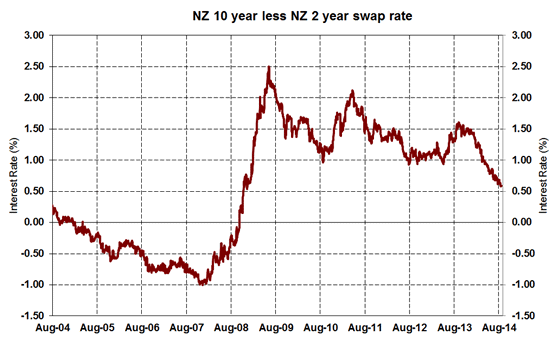
Therefore borrowers have another unexpected bite of the cherry to lock-in term fixed rates only marginally above current OCR levels. The two year swap rate gap to the 10-year swap rate has closed up to just 0.60%, a new six year low (refer chart below).
You have to go back to the 2004 to 2007 period when Alan Bollard pushed monetary policy to extreme tight levels at 8.25% and caused an economic recession to find the last time 2-year swap rates were the same or above the 10-year swap interest rates.
The yield curve is now super-flat and the extra premium cost of fixing for a 10-year period has completely dropped away and borrowers need to take advantage of this interest rate market pricing anomaly.
A decision not to increase long-term fixed rate borrowing at current swap market levels is tantamount to saying that the New Zealand and US economies are both going to weaken back to much lower growth rates or even return to recession.
I cannot find any credible economic commentators who have that view as the evidence of the upward momentum is just so compelling.
It just needs Janet Yellen at the US Federal Reserve to be convinced about the recovery in the US labour market and the long-term swap rates will be a lot higher than the current 4.45% to 4.7% levels.
-----------------------------------------------------------
To subscribe to our daily Currency Rate Sheet email, enter your email address here.
Daily swap rates
Select chart tabs
Roger J Kerr is a partner at PwC. He specialises in fixed interest securities and is a commentator on economics and markets. More commentary and useful information on fixed interest investing can be found at rogeradvice.com
We welcome your comments below. If you are not already registered, please register to comment
Remember we welcome robust, respectful and insightful debate. We don't welcome abusive or defamatory comments and will de-register those repeatedly making such comments. Our current comment policy is here.