

By Gareth Vaughan
How much is too much?
In the case of retail bank net interest margins (NIMs) it's an interesting question. A former New Zealand bank CEO once told me anything above 2.25% was too high. But doubtless others in bank hierarchies welcome NIMs significantly higher than that, and many bank customers undoubtedly think 2.25% is way too high.
ASB's interim results this week showed a NIM of 2.50%, an increase of 15 basis points from 2.35% in the same period of its previous financial year. ASB's NIM has been ahead of its rivals of late with the highest from the other banks, from their most recent quarterly disclosures, Westpac's at 2.36%.
But BNZ's aside, all of ANZ's, Westpac's, Kiwibank's and TSB's NIMs rose in their latest quarterly disclosures. And of all six banks mentioned, only Kiwibank's was below that 2.25% threshold at 2.13%.
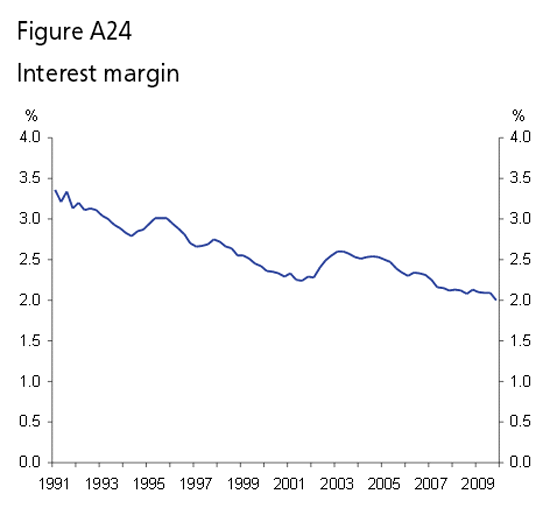
This follows on from the Reserve Bank's figures for retail bank NIMs, which show the combined NIM from across the banks at 2.34% in August, the latest month of data in the series. That's the highest it has been since the series began in 2009. Going back before that New Zealand banks' NIMs have, of course, been significantly higher, as evidenced by the chart at the bottom of this story.
One of the factors cited by ASB's parent Commonwealth Bank of Australia for ASB's rising NIM was improved deposit margins. Improved from the bank's perspective that is, meaning the bank is effectively paying savers less to borrow their money.
Undoubtedly factors in this are the ongoing low interest rate world we're living in, ongoing strong deposit growth, and relatively soft credit growth.
Bruce McLachlan, CEO of the Co-operative Bank, neatly summarised this in a Double Shot interview in December. Discussing expectations for interest rates this year, McLachlan predicted "quite a big transfer in value" over the coming year from depositors to borrowers.
"My personal view is that more value is going to switch from depositors to borrowers and that's based on a simple supply and demand. Credit is growing at half the rate that deposits are, and I think bank funding generally is really sound at the moment but everyone is struggling to grow their asset book. So that can only mean more competitive pressure on home loans," McLachlan said.
"So I think you'll see a continued edging down of fixed mortgage rates and that'll be paid for by similar moves in deposits."
In terms of credit versus deposit growth, the ASB results back up what McLachlan said. They showed customer deposits up $2.45 billion, or 5.5%, in the six months to December 31, and net loans up $1.98 billion, or 3.3%.
To emphasise the point the banks are well funded, across the industry the core funding ratio, through which banks have to use a set amount of deposits and longer-term wholesale funding to fund their lending, is currently running at 86.3% against the minimum requirement of 75%.
Asked about the boost to her bank's NIM from deposit margins, ASB CEO Barbara Chapman acknowledged the impact.
"We live in a world of very low interest rates globally. You only need to look at interest rates in Switzerland, Japan, the UK and US. These are all sub 1% and in New Zealand interest rates are historically low. But from our perspective ASB is probably paying the top (deposit) rates in the market, but there's just a low interest rate environment globally," Chapman told interest.co.nz.
In terms of which bank(s) have the best advertised deposit rates, all is revealed here for one to nine month terms, and here for one to five year terms.
But whilst there may be debate over which banks are offering depositors the best deals, there can be no dispute that it's a borrower's world. And aside from borrowers playing banks off against each other to get better deals, the other winners are the banks given the assistance "improved deposit margins" are giving to their net interest margins.
Term deposit rates
Select chart tabs
*As demonstrated in our chart here, deposit growth has been running hot for several years now.
The chart below is taken from the RBNZ's May 2010 Financial Stability Report
This story was first published in our email for paying subscribers . See here for more details and how to subscribe.
We welcome your comments below. If you are not already registered, please register to comment
Remember we welcome robust, respectful and insightful debate. We don't welcome abusive or defamatory comments and will de-register those repeatedly making such comments. Our current comment policy is here.