

By Bernard Hickey
The Reserve Bank is back in a familiar place: between a rock and another rock.
For a third time in three years the Reserve Bank faces conflicting objectives where achieving one could obstruct or destroy the other.
Our central bank is unusual in that it is responsible for both monetary policy, which means keeping inflation between 1-3%, and for financial stability, which means ensuring the banking system is stable. That is both a curse and a blessing. It worked brilliantly during the Global Financial Crisis, but now it's a pain in the proverbial.
The Reserve Bank is now in a sadly familiar situation.
It needs to cut the Official Cash Rate to stimulate the economy to get inflation back up into that target range, and more specifically, up around the 2% mid-point specified in Governor Graeme Wheeler's Policy Targets Agreement with Finance Minister Bill English. Inflation figures out this week showed annual Consumer Price Index inflation of 0.4% in the March quarter, which means it has been below the bottom end of the bank's target range for a year and a half and below the mid-point for four and a half years.
But at the same time the Reserve Bank has to keep the banking system stable and has been worried since at least 2013 that Auckland's over-valued housing market could fall sharply and stress our big four banks. It knows that ever-lower interest rates will encourage more borrowing to buy houses, potentially pumping more air into a bubble and adding to the stress in the event of a slump.
This conundrum drove the Reserve Bank to bring in two rounds of controls on mortgage lending. The first round in November 2013 introduced an 80% Loan to Value Ratio limit on all borrowers and the second round in November last year tightened that limit to 70% for rental property investors in Auckland.
Along with the Government's two year bright line test to tax the capital gains of speculators, the Reserve Bank's second round slowed the Auckland market for all of five months, and may actually have fired up the housing markets in the provinces. That's because the November 2015 changes included a loosening of the 2013 limits outside of Auckland and seems to have encouraged Auckland investors to gear up their Auckland equity gains with 80% loans to buy rental properties and sections in the likes of Tauranga, Hamilton, Wellington, Napier and Dunedin.
The Real Estate Institute's March figures released last week removed any lingering hopes that last year's measures would take some of the steam out of the market for longer than a few months. Auckland is off to the races again and the provinces are galloping along in its wake.
The Reserve Bank now faces an ugly combination of double digit house price inflation nationally, falling mortgage rates and a rising currency. It has already forecast one more Official Cash Rate cut, possibly as early as this coming Thursday, and most economists think it will have to cut for a third time this year to 1.75%. That will push fixed mortgage rates substantially below 4%.
Until now, the Reserve Bank has been in reactive mode and has been a reluctant restrictor of lending. It had hoped that once or twice would be enough. As recently as March 10 Governor Wheeler said he was not considering a third round of lending limits, but that was before the latest housing market surge and the currency's rise this week to 10 month highs over 70 US cents. It was also before fresh figures showing New Zealand household debt has hit a record high relative to incomes and the amount of borrowing is now growing just as fast in nominal terms as it was during the 2002 to 2007 boom.
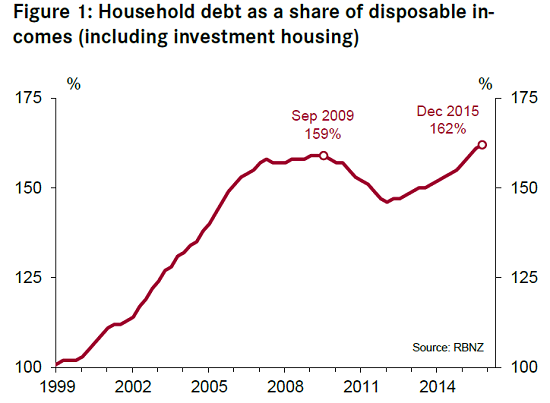
Economists are now predicting a new round of limits that could include reducing the Auckland LVR threshold for investors from 70% to 60% and/or extending the LVR limits for investors beyond Auckland to the rest of the country. Other options include increasing the amount of capital banks have to hold against mortgage lending, or lending generally, and banning the use of interest-only loans to landlords.
It's time for the Reserve Bank to get ahead of the curve and take a more strategic approach. It should make clear to banks and borrowers alike that it will have to progressively tighten lending in line with further cuts in interest rates, particularly while house price inflation is rising at double digit rates.
Our Reserve Bank is rare in the world of central banks that it has yet to cut interest rates to 0% or lower, and it has yet to start other unconventional measures such as buying Government bonds to lower long term interest rates. Given the persistently lower than expected global inflation, the persistently stronger than expected New Zealand dollar and the ongoing failure of Auckland housing supply to meet demand, the bank should signal that progression of tightenings to reset expectations just in case.
At the moment, New Zealand's landlords see a one-way bet. They see central and local Governments failing to allow enough new house building to meet supply. They see interest rates falling despite years of warnings from officials about the risks of rising interest rates and they see little political appetite to tax either capital gains or land. The only thing standing between landlords and yet more easy money is the ability to leverage up their ample stocks of equity.
It's time the Reserve Bank took on that responsibility, if only to give itself some breathing space between those two rocks of very low CPI inflation and very high house price inflation.
A version of this article was also published in the Herald on Sunday. It is here with permission.
We welcome your comments below. If you are not already registered, please register to comment
Remember we welcome robust, respectful and insightful debate. We don't welcome abusive or defamatory comments and will de-register those repeatedly making such comments. Our current comment policy is here.