
By David Hargreaves
If we see Auckland rack up 10,000 new dwelling consents for the 2016 calendar year - and that's still a big 'if' - I for one hope we don't see self-congratulatory press releases from the Government marking that 'feat'.
The fact is any such gratuitous back-slapping would be disingenuous in the extreme, given the rates of growth the Government has previously targeted and the razzle dazzle and huff and puff of initiatives the Government has launched, such as the Auckland Housing Accord.
This Government for a long time rejected doing anything about demand pressures in Auckland, even as houses become more and more unaffordable.
Instead from about 2013 onward there were a variety of initiatives and some big talk about ramping up supply.
So, it has been left to the Reserve Bank to quell the demand side while now, increasingly, it's becoming clear that the Government's supply side initiatives have not done the trick.
The Auckland house building market is proving the point that all the Government song-and-dance in the world is not necessarily going to make 'the market' move if the market doesn't see conditions as right. And clearly the market forces in Auckland have not responded the way the Government hoped.
The latest Statistics New Zealand figures for building consents in Auckland show a continuation of the flattening trend in recent months. That simply is not as it is meant to be.
For the 10 months to the end of October there were 8,024 consents issued for new dwellings in the Auckland region. That's up about 9.5% on the 7,338 consented at the same time a year ago.
If that 9.5% growth rate was extended to the whole year then we would see Auckland hit about 10,100 consents for the 2016 calendar year.
Given the 3000-4000 a year rates of building in Auckland of the recent past, it could be argued this is not bad.
But the Independent Hearings Panel, in its Auckland Unitary Plan recommendations earlier this year, put the current housing shortage in Auckland at 40,000 units and said 131,000 new dwellings - so, well over 18,000 a year - were needed in the next seven years to make up both the shortfall and to provide for expected growth.
Auckland's population gain through migration alone this year is possibly going to be in the order of 40,000 people. At current rates of household occupancy this alone would necessitate over 13,000 new dwellings needed. And that's before you talk about natural population growth.
The below table gives annualised (12 months ending October) consent figures for Auckland going back to the early 1990s, and also includes at the bottom the 10-month figure for 2016 so far. Figures from Stats NZ.
| Auckland dwelling consents (12 months ended October) | ||||||
|---|---|---|---|---|---|---|
| 1991 | 1992 | 1993 | 1994 | 1995 | 1996 | 1997 |
| 5,592 | 4,932 | 5,775 | 7,405 | 8,159 | 8,546 | 9,529 |
| 1998 | 1999 | 2000 | 2001 | 2002 | 2003 | 2004 |
| 7,874 | 11,165 | 8,319 | 7,634 | 11,702 | 11,282 | 12,093 |
| 2005 | 2006 | 2007 | 2008 | 2009 | 2010 | 2011 |
| 8,405 | 7,761 | 6,064 | 4,726 | 3,389 | 3,692 | 3,605 |
| 2012 | 2013 | 2014 | 2015 | 2016 | 2016 (10 months) | |
| 4,440 | 5,691 | 7,518 | 8,935 | 9,947 | 8,034 | |
Looking back at those figures it is interesting to note that during previous 'hot' times for Auckland housing construction the industry was able to ramp up the activity considerably more within the space of a year than has been achieved this time around, for all the Government posturing during this cycle.
For example, between October 2001 and October 2002 there was a more than 4,000 increase in the number of dwellings built, while before that, between October 1998 and October 1999 there was an over 3000 increase.
We haven't seen close to those numbers in terms of increases since the low point of 2011.
And no, the current rate of increase is not 'all part of the plan' - because the Government was looking at achieving much better rates of growth than have been seen.
Looking back at the Ministry of Business, Innovation and Employment's National Construction Pipeline Report issued in July 2015 and trumpeted by the then building AND housing minister Nick Smith, it can be seen, as per the graph below, that just a year and a half ago, the thought was that Auckland would get well over 13,000 dwellings consented in this calendar year.
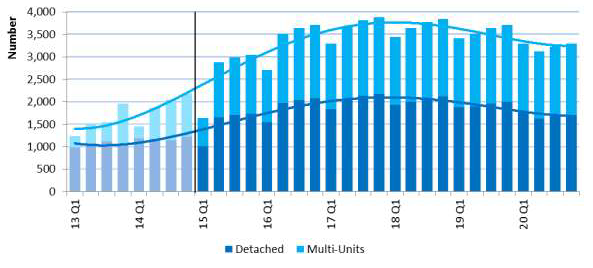
The shortfall between that projection and what's likely to be produced is in the order of 25%. To put it more meaningfully, there will be housing for about 10,000 fewer people this year than was projected about 18 months ago.
Moving on a year to July 2016 and MBIE had another go, with another 'pipeline' report, again trumpeted by Smith, which incorporated some subtly tweaked forecasts for Auckland.
However, the forecasts were still projecting as many as 12,000 consents for this year. That forecast, publicly released only a matter of months ago (as seen below), is likely to fall around 2000 homes short - or around 17%.
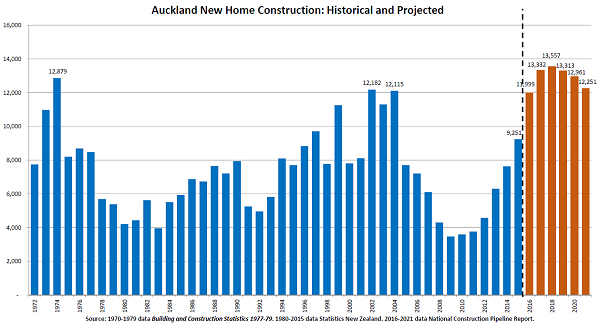
You can see a bigger version of the graph here.
At current rate of progress and with the recent flattening of activity in Auckland, the over 13,000 consents forecast for 2017 look a stretch too. The 18,000 a year suggested as necessary by the Independent Hearings Panel earlier this year looks pie in the sky.
The Government is belatedly taking a more hands-on approach to physically getting houses built through government agencies and initiatives, rather than by simply encouraging 'the market'.
So it will be interesting to see what further direct initiatives - as it surely must - the Government comes up with in election year.
Any efforts to fob the problem off purely to the Auckland Council are unlikely to be well received by the electorate - even if that's what the Government might want to do. In that regard, the dropping of the housing minister title has been a regrettable bad sign of intent.
I think come Budget time we will see some movement from the Government. Anything less and the opposition parties will be clambering all over this issue - and likely getting traction.
78 Comments
I guess you have to question why the market hasn't built more houses if there is such high demand and asking prices? I can only assume it is because land is so expensive that there isn't much profit to be made. If land is expensive it is 100% the council's fault.
Oh not govt's for allowing so much immigration, or foreigners carte blanche in the market or have laws and regs in place that make land banking so attractive, and who is going to pay for all the extra infrastructure needed.
I was saying it is the council's fault that more houses aren't being built (supply). I'm not saying that supply is the only cause of the housing crisis by any means.
Supply of land for building is the first and the last of the housing crisis.
I have reluctantly come to agree with Michael Reddell about the impact restricting immigration would have on house prices. But............
But the four big urban areas in Texas, for instance, have significantly higher population growth rates than Auckland while generating houses at prices that would make us all weep. You can buy a McMansion anywhere in Texas for about $300k. And people are flooding in from New York and California to enjoy those benefits.
There is no speculation, no foreign buyer worries, no DTI, no LVR, no nothing. If you need land for a house you just buy it. End of.
Even lefties like Paul Krugman say that planning restrictions create high house prices. It's not a left/right thing at all.
In texas, places like Huston have a few things auckland doesnt. They have lots of land to expand out into as they arent mostly surrounded by water. And they have the right to build up in the inner suburbs whereas the isthmus is full of single house zone which prevents us getting to the higher densities you see in houston.
The flat, low cost, easily accessible, 20% larger than the Hutt Valley, plains stretching from Takanini to Clevedon?
Houston is a coastal city on the Easter Seaboard of America, which means it can only expand in one direction. This makes Houston highly constricted compared to Auckland which is a city on an isthmus - a strip of land between 2 large land masses.
Undeveloped rural land around Auckland costs less than rural land around Houston.
All of this eff up is the council.
Who is coughing up for all the extra infrastructure, and why do we want sprawl all over the place, why do we need a constantly growing population? The fault is the government's, allowing growth by way of immigration to be far beyond what we can provide for them and foreigners having carte blanche in the market, holdus boldus open up any and all land is last on the list, especially if you want the place to be somewhere decent.
I have no idea why we sprawl all over the place. Ask Auckland Council and if you get an answer please tell us.
Auckland sprawls everywhere except where people want to live, so you get more sprawl and it costs more. About 30 - 50% more is being spent per ratepayer than needed to support an oversupply of sprawl.
As to immigration, it really won't matter how many move here. We will never build enough houses here, because there is not enough land. There is so little land, we need to leave. The only way immigration could solve the problem is if we leave and immigrate.
You need to look at the map Unaha. Your location of Houston is off a couple of thousand kilometres. As is your 'constricted' argument.
So you agree it would require an absolutely moronic, imbecile level, pond scum mentality to restrict the limited land supply around Auckland further by council fiat?
Well let me introduce you to Auckland Council.
Low immigration in 2012 resulted in too few houses being built in Auckland, high immigration in 2015 resulted in too few houses being built in Auckland. Changing immigration obviously does not work.
More immigrants, less immigrants - who cares?
I do.
When i take my kids fishing at the local wharf, i don't like being crowded out by a bunch of gibbering foreigners.
Jimbo, you are 100% right (up to a point).
Look at any $1m house in Auckland. Say $300K accounts for all the house, garage, driveway, and landscaping. The balance of $700K pays for a few electrons in the LINZ database that says these few square metres of dirt belong to the owner and the infrastructure (3 waters and road).
Builders would be going gangbusters if serviced sections were $150K-$200K. At $700K only a handful of people can afford to buy one for themselves. Unfortunately the economics of "investing" are not that flash either. Rents diverged from market reality some years ago in Auckland. An investor buying into a new build today has to be convinced that the asset value of their property will rise in the short term to make "investment" worthwhile. And that looks like a dodgy proposition.
Long story short yes there is real demand but not at these prices.
Yes Auckland Council is largely to blame. They create the artificial shortage of raw land for development (through the Auckland Unitary Plan) that drives prices up. But the Government also shares in the blame in that transport links are almost always the driver of lower land prices in the modern era and the government through its National Land Transport Plan dictate where cities like Auckland can easily grow.
The state of the Auckland property market pretty much comes down to Bill English's historical decisions as Finance Minister.
No wonder the housing problem has been magicked away in the Cabinet reshuffle.
The state of the Auckland property market pretty much comes down to Bill English's historical decisions as Finance Minister.
Nope, Auckland Council is entirely to blame. They create the artificial shortage of raw land for development (through the Auckland Unitary Plan) that drives prices up.
Us poor suffering taxpayer types provide (free of charge or by way of huge subsidies) links that are strong drivers to lower land prices. The National Land Transport Plan provides vast areas where Auckland could easily grow and subsidises infrastructure on a massive level.
There is a whole litany of taxpayers been treated as suckers:
- Us taxpayers paid for the Upper Harbour Hwy, but the Unitary Plan prevents building on 70% of its length.
- Us taxpayers have built a motorway extension from Albany to Dairy Flat, but the Unitary Plan bans building anything from Albany to Dairy Flat.
- Us taxpayers are paying for a four lane motor way from the city to Takanini, but the UP says the drained swampland bordering Takanini mostly cannot be built on.
- Us taxpayers are subsidising a CRL to double the rail network capacity from Swanson to Pukekohe, but the UP says the horse paddocks next to Swanson platform and the land next to the tracks between Drury & Paerata must never be built on (likewise the flat land next to Takanini - see previous).
- Us taxpayers own and maintain a railway line from Swanson to Kumeu, but the UP says this land is forbidden.
- Us taxpayers are about to build a motorway linking West City to Kumeu, but the UP says there is no way we are allowed to build on 4 km of the rolling rural countryside next to this.
Meanwhile Auckland Council is always whining that they are not getting enough money, because (after ignoring all of this easily developable land next to Auckland us taxpayers have subsidised already) this greedy, wasteful, incompetent, pathetic, imbecilic council is developing vast sprawling monstrosities in Wellsford, Kumeu, Silverdale, Pukekohe, Clarks Beach. Sprawl miles away from anywhere, vast car centric sprawl.
Another excellent article thanks David. I guess in this situation, massive shortage, you would look to replacing the housing minister who is failing...but of course there is no housing minister now....
Absolute bull, Houses are just sitting on the market so why would anyone build more housing if they can not sell?
Developers and builders are not stupid, they see what is happening at the Barfoots auction funeral rooms.
The Housing shortage continues thanks to the Reserve Banks tinkering!
perhaps Ted the reason things are not getting sold is people cannot afford them...house prices compared to income show us near top in the world for unaffordabilty
I guess you have to ask why houses are not selling if there is such high demand, high immigration, etc?
If you are this delusional about the Auckland bubble at the (probable) peak of the cycle you might find the next few years difficult to reconcile. I guess having lots of people to blame makes the reconciliation process a bit easier.
First it's the banks. Now it's the reserve bank. Who next to blame? The darned public for not buying? You seem to believe there should be an unlimited supply of credit for housing speculation.
Auckland is the high (land) cost canary in the property speculation coal mine. We have a property boom going on in Auckland, Brisbane, Melbourne, Sydney, Tauranga, Hamilton, Whangarei and so on. All the other places are just so much more profitable to build in.
Supply though important is not the only reason. Anyone and everyone know but Nats cries about supply only with the intention to delay or avoid taking any action.
What happened to DTI - came out in open to say that we (John Key and Bill English) support RBNZ for DTI but when the actual time came, ran away and the only reason that said that have no problem in the first place was with the intention to delay taking any action.
This government is all for delay, denial, lie and manipulation : Legacy of National government for NZ
Rubbish
Nice retort, I like the part where you clearly and concisely state why you think they are wrong
Today National government stand exposed as a result their rubbish is now out in open.
Correct, their action or should we say inaction proves it. People only manipulate and lie when at wrong - if not why has the government manipulated and lying about overseas / non resusent data. Open question to one and all who feels otherwise ( Many will as are benefiting by this manipulation).
As I have said before the market has been artificially and corruptly jacked up to ridiculous levels. The property developers and building material suppliers have treated this like all their Christmases have come at once and raised their prices to match, rather than making a large but fair profit by producing a lot more houses. There is a total disconnect between what the suppliers are demanding and what the people who need houses can afford to pay; so it is not surprising that not enough houses are being built. It is long past the time when the government should have waded in with a big stick and sorted this out. Instead they have sat on their hands and done next to nothing, bleating that the Auckland City Council and the market will sort it out. Clearly they are not, and do not appear to have any will to do so. Given this and the crazy level of immigration, Auckland has a very real chance of descending into some sort of chaos as the consequences of this situation play out. As a regular visitor to Auckland the congestion and consequences of this unplanned and unsatisfied growth demand appear to be growing at a fairly steep exponential rate. Perhaps like the frog that boils to death in a pot on the stove, the residents do not fully notice this developing situation as they are totally immersed in it.
The only way to contain this problem is an immediate halt to any immigration.
Agree with all you've said. We normally avoid going to Auckland but a recent visit after a couple of years absence was horrendous, the road congestion in particular. "Some sort of chaos" pretty much sums it up now.
The affordable supply response looks to be as far away as ever and its not difficult to see the dynamic in the Auckland situation. House prices are well in excess of normal replacement costs; the land owners, developers, council and (probably the least to blame) builders now have an entrenched price expectation that will be extremely difficult to lower. A constant stream of new arrivals is petrol on the fire.
I built a cheap house 20 years ago and I'm building another one now. I am surprised that there isn't much extra cost in building materials. Plywood seems to cost about the same. flooring and framing up a little bit.
I blame the cost of Auckland housing on immigration. 200 people a day mostly staying in Auckland, The council don't have a mandate from their ratepayers to get more rates from them, the government offered to lend them less than a billion for infrastructure and just one new pipeline to carry sewerage from western subdivisions is costing a billion dollars. No money, no infrastructure means no resource consent.
So don't blame the council. Infrastructure costs billions and billions to build, the infrastructure of roading, electricity supply sewerage recovery and treatment is worth a trillion plus dollars and every person born or getting off a plane into NZ gets their share of that for free.
It'll be really interesting to see (in the next census) how many AKL refugees have fled to the provinces. I wouldn't be surprised to see 50k-100k more in excess of Stats NZ's assumptions.
And we don't want Auckland's problems, thank-you very much. Wasn't it John Key who said that it would be great if the rest of NZ had the same galloping house prices as Auckland. Obviously that was his plan and it is working. More importantly this underlies the point that John Key was working to promote house price inflation, not contain it. So all this is a deliberate plan that is about to blow up. Not surprising he quit.
I think he quit now because he failed to gain a legacy of changing the flag, he hung on for that. Straight after that failure would have been too obvious. Enough time has passed now.
I bet they have hung onto an Auckland house!
Easy to return if needed. In the mean time, rent it out.
You don't get it do you James. It's not all about that place you live.
It is a reality. Under national government kiwis have become migrant in their own city to make way for rich immigrant - must admit that national has been successful in their agenda and give them one more term and now have to leave Auckland, than may be NZ. It is a real shame.
It is Land Supply.
Auckland Council is currently spending about 30% more per capita than it needs to for infrastructure on new land supply. It is overspending and wasting money.
Almost all of this new land is around Kumeu, Warkworth, Silverdale, Clarks Beach, Pukekohe, Helensville and so on - wasted expenditure, because none of these towns have a hint of a housing crisis.
Auckland meanwhile has been stripped of new land supply.
Reverse these conditions - we solve the housing crisis and save 30% cost to ratepayers. Simple.
Oh well, council planners what can you do?
I think the reason why not more houses are being built is because the banks themselves are restricting lending in a BIG way, not because of the LVR (which btw exclude new-builds). Banks need deposits at the moment and they don't like to lend.
Usually the cure for high prices is high prices.
Just watch and wait.
The high prices in Auckland are coupled to low prices in Brisbane, Melbourne and even Sydney. So wait until the Aussie economy picks up and move.
Everyone moving to Aussie will solve the Auckland housing crisis. Immigration FTW.
Cross posted comment from the 'housing minister - who he?' thread and edited to suit...
The Game of Two Halves - Land and Hoose:
Land:
- Zoning still exerts a 10x Planners Gain compared to rural pricing of $5K for 600 squares of raw dirt,
- Councils still exert Financial Contribution racketry - no contribution, no consents, permits, movement. As this is early in the development cycle, interest and 'carry' rates start to bite early.
- The 'carry' can easily double initial costs over the typically protracted development cycle. So Councils' injection of Time can, alone, cause significant cost pressures.
- Don't forget GST at 15%...
And for house, we have:
- A cosy
carteloops, my bad, I meant Duopoly, in materials (Farters and Clutchers)... - Councils again with Producer Statements for everything, multiple inspections, and Modest Fees at every turn - figure at least 10%
- Elfin Safety (scaff, fencing, fall protection, tagged cords for builders' battery tool chargers, radios and shavers - it's a long list getting longer by the day) - adds around 15%
- Oh, and GST at 15%
- Engineers, architects at 10% for the terminally stupid, draftspeople, conslutants (yes, Freudian slip there) to navigate the District Plan and Building Regs...
- Tradies who actually do the work. After all, those frames don't go up by themselves, even if they do then stand out in the weather for weeks, maturing like fine cheeses...
A Tiny House can be smacked up for around $15-40K. Sure, it's just a trailer-park deal, but faced with all of the above, it's actually a rational choice for many.
I still think that a pensioned-off cruise ship, docked safely outta sight behind Rangitoto, could well serve as an outlet for at least some of the current pressure at the bottom of the market. After all, the old Wanganella did exactly that for the Manapouri Power Scheme workers, back in the day. No Auckland Council permit needed, either?
Tiny houses have many, many pluses, not the least of which, it sorts out any tendency to impulse buy stuff you don't really need, as you don't have much space to keep it all. Mind you, if you stop buying stuff then you are not doing your duty as a citizen consumer, are you?
And I'd certainly rather be in a decent trailer park type set up than an all but prisoner on and old cruise tub.
I like the idea of tiny houses. They shouldn't be little container boxes but have a bit of style to them. I was in Europe recently and saw many super cute little places that just oozed character. I could happily live in one of these places.
Which reminds me as I travelled on the train into Berlin I saw many, many, tiny houses with gardens clustered around the railway line. They may have been rudimentary housing built just after the war but they looked to still be occupied. Very similar to the little baches you can still see on Rangitoto Island. Does anyone know the history behind these? I tried searching online but couldn't find much.
* Turns out they are Allotment Gardens (Schrebergarten) probably not lived in although you could. Fancy garden sheds!
http://germanyiswunderbar.com/wp-content/uploads/Schrebergarten1.jpg
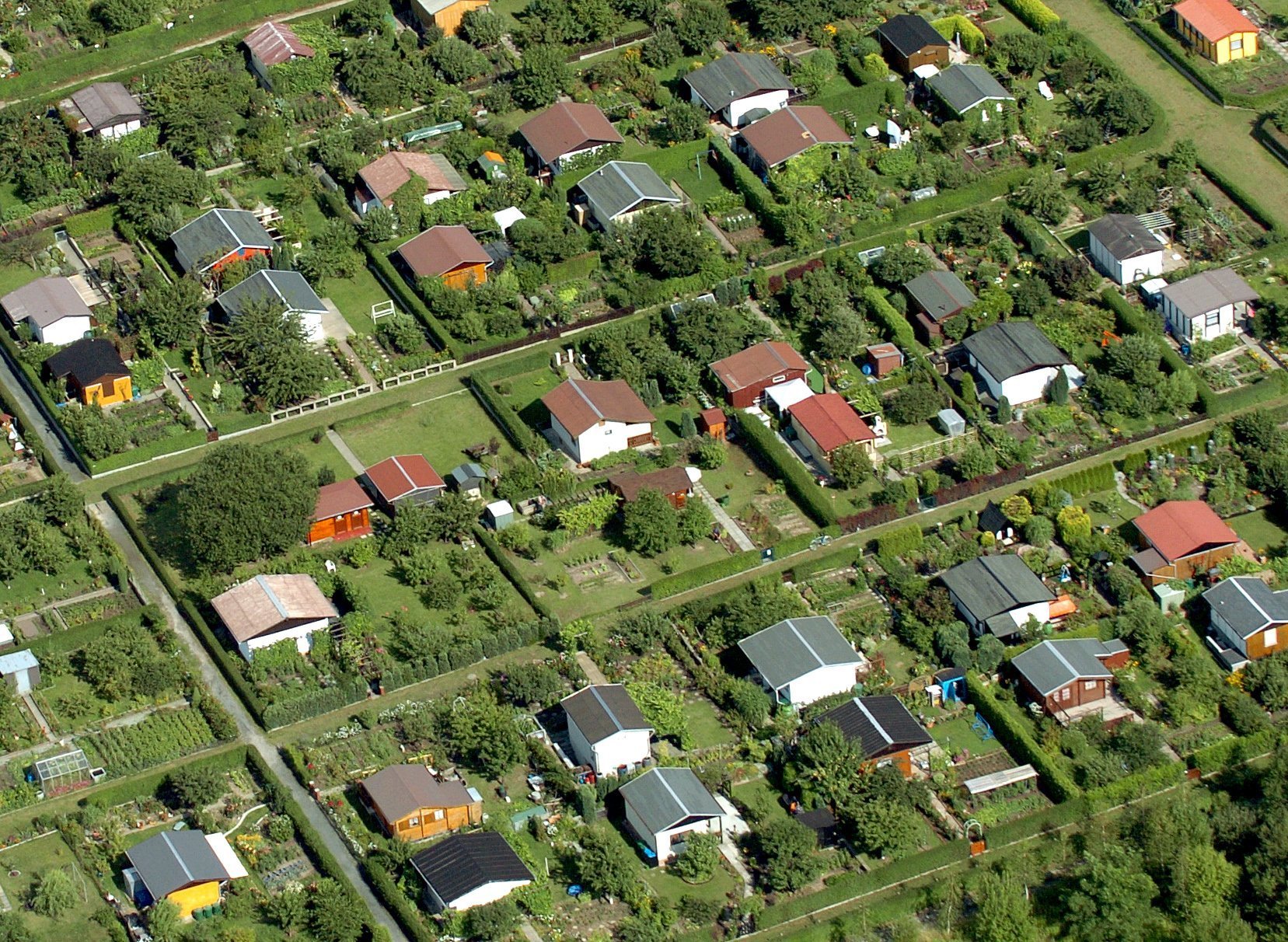
Nice picture, they look like lego blocks in a green Legoland and no cars (that I could see). Would be about $1,5000,000 here per section under the unitary plan if it was here in Meadowbank or Point Chev. Would have to sell the carrots grown by the lego wife for $50 each to justify the price :-(
Yes, lovely. Civilised country Germany; well it was.
let in so many and the bad one or two will easily slip through, I was warned 10 years ago by an immigrant about some countries that NZ is letting people in from and how we will face problems in the future.
I being naïve brushed it off as she be right this is NZ.
after seeing Australian problems and some people being put in prison here, I hate to admit it he was right
It must be too hard to see for those clowns in Wellington
clowns,the bright coloured clothes and make-up are a distraction but we can see past paula and we see laurel without hardy,black & white instead of colour but dont adjust your sets as normal service will be resumed as soon as possible.
You need to see the wood from the trees ................... quite simply the Government needs to state clearly how many migrants are being given residence , etc before developers commit to massive property developments .
First we saw record numbers of migrants with no warning whatsoever .
Now all the taps are closed .
So what the hell is going on ?
Already we see apartment developments tipping over .
The whole thing is just too risky for developers , especially when the Government does not signal its intentions
Can't help thinking maybe it's going like this. For years now foreigners buying like there is no tomorrow, who cares how much to pay, house prices pushed way beyond common sense and the common man, until the day comes, foreigner goes and then SPLAT!
With the terrorist atrocities in Germany, Switzerland, Egypt and Turkey over the past 24 hrs I can't see the immigration levels to NZ falling.
I didn't mention immigrants, but that's been tinkered with recently. I was talking about the foreign money from foreigners that seems might be drying up, courtesy of the country of origin tightening things up.
When laundering money, one doesn't want it permanently stuck in some overpriced mouldy shack which will never generate a decent legit rental return. Just a step before being moved on elsewhere. And anyone laundering money through this conduit who has any sense will be looking to convert it into a more liquid and portable form before the AML measures are extended. Anyone still buying with money sneaked out of China or India will be playing with fire, too. Ideal fox-trap. Small market, easy to trace, government which will bend over backwards and put up zero resistance if those governments come looking for their missing currency.
I guess that would depend on how desperate you are to get the money tucked away, hopefully out of the grasps of the authorities in your home country. Buying sight unseen probably helped push up the prices of very average houses.
They are really desperate and as a result pretty much the entire world (anywhere seen as a stable economy) has had a real-estate boom. Everywhere has had a real-estate boom and everywhere (apart from places governed by constraints of geography, history or incompetence) has had a construction boom.
Vancouver is constrained by a mountain range, the Pacific and the USA. London is constrained by the planning edicts drawn up under Queen Victoria. Auckland is unconstrained by geography and was given a clean sheet of rules, it has merely been governed by the level of competence (or otherwise) on offer.
It is just our great misfortune to live in the same country as Auckland Council, the level of incompetence required to negate a global construction boom is staggering to behold. Talk about not being able to organise a piss-up in a brewery.
Makes you think that there are more capital gain opportunities in as yet undiscovered places in the Western World. I thought one hour south of London was quite reasonably priced.
Corrupt government. Need change
Great article David. A suggested improvement for your next article showing the inadequacy of Auckland's housing construction would be to graph Auckland's population growth (natural growth+international immigration+internal migration) divided by the number of constructed houses. This would show Auckland has a situation where its population growth has to squeeze into houses at a rate far in excess of its average house occupancy of 3 people per house.
Brendon, as I pointed out elsewhere (with tongue firmly in cheek) with no Housing Minister all questions should be directed to the Immigration Minister Woodhouse who can exert a 3:1 ratio on the demand side of Auckland housing.
Does it matter when the the government has no intent to address the problem. Whether it is John Key or Bill English - What's in a name.
As long as Nats in government - problem will not be solved as to solve any situation/problem, first one has to admit that their is a problem. Need say more about our Nats government whom we all voted - to err is human.
Unfortunately the would mean electing the Labour/Green combo that all of Auckland voted for to run this place and their level of incompetence is scary.
It does seem that once the Nats have made a complete pig's ear of things we do need a Labour govt to put it all to rights again for the next time.
Labour have moved along way on its proposals to eliminate land banking.
Earlier in the year it came up with a legislative proposal to eliminate UGBs and to internalise the infrastructure costs of development. It almost got voted through Parliament -coming up one vote short. ACT and National voted against it.
See Phil Twyford on urban growth http://www.inthehouse.co.nz/video/45199 and David Parker http://www.inthehouse.co.nz/video/45201
Julie Anne Genter gave the Green party conditions for supporting the legislation. Being eliminating restrictions on the vertical growth of the city -such as car parking minimums and for the costs of climate change to be internalised too.
http://www.inthehouse.co.nz/video/45200
The amendment was supported by Labour, Greens, NZ First and the Maori Party – and opposed by National and ACT.
Just to re-iterate there was only one vote stopping this legislation which would have dramatically reduced land development costs. The right wing parties voted against a proposal that would have abolished urban growth boundaries.
It's been the pattern for years. Labour do the heavy lifting and get things done, National coast along behind them, keeping what's popular, doing nothing new, running down what's been achieved. Exhibit A: Kiwisaver and the Cullen Fund.
Yep. Labour is the progressive party that makes the big changes -that gets things done. National is the party of the status quo.
Len Brown for instance has secured the retirement fund of every baby boomer property owner in Auckland (who retires to Tauranga). Sure it means people living in cars and a housing crisis, but it is but a small price to pay as Len Brown destroyed the status quo of Auckland being able to build enough houses for its citizens to live in.
Progress.
Couldn't agree more. I recall at the time thinking what a hypocrite ACT/DS was. Apparently he missed the vote - and blamed Labour for not contacting him about it earlier as he was in another meeting at the time. That despite the fact that Labour did send a reminder message through to his office some hours in advance.
John Key, Bill English, Nick Smith and co are bigger hypocrites than David Seymour -he is just a young tike doing what he is told. For a decade or more Nick and Bill have been saying unaffordable housing will be fixed by supply, supply, supply, in particular saying it is the fault of the restrictions on the urban growth boundary. Ignoring all the other demand factors. Yet when they were given the chance to vote for legislation to remove urban growth boundaries -they couldn't stomach it. Basically National lack the political will to provide kiwis with affordable housing. That is the bottom line. When push comes to shove they will do nothing.
The Labour politicians Len Brown and Phil Goff (and the Green politician Penny Hulse) have enforced the strictest UGB in the southern hemisphere.
Instead of looking at your example of political showboating whilst in opposition, look at what left wing politicians do when in power.
Unaha-closp. I agree with you about local government councilors of all descriptions being overly tied to concepts of urban growth restrictions. This is not just Labour and Green councilors -right wing ones too are much to quick to agree with Nimbys and unnecessarily impose restrictions on how cities grow. Then land bankers use those restrictions to corner the market -jack up prices and make huge capital gains.
I have some sympathy for Councils because they are basically economically illiterate and our system of governance means they get very little financial benefit from city growth -the benefits are mainly kept by a minority in the private sector or goes to central government. GST on construction for instance automatically goes to the consolidated fund and is much bigger than local government developer contributions. Local government have no incentive to become more knowledgeable about urban economics. Yet local government faces the costs of city growth -in the form of having to provide city infrastructure. So it is not surprising local government tries to impose growth restrictions in order to control their city infrastructure costs.
Unaha-closp you would have to acknowledge that local government partners in central government have not made their job any easier by opening up the immigration floodgates, refusing to give any direction and funding infrastructure wise, using HNZ as a cash cow instead of using dividends to build more houses, encouraging foreign buyers to enter the market......
Whether Phil Twyford, David Parker, Julie Anne Genter and co were showboating in parliament by proposing to eliminate urban growth restrictions is debateable. It was quite conceivable their proposed National Policy Statement amendment eliminating UGBs and providing new tools for financing infrastructure could have passed into law and then all Councils would have to apply it. It just needed David Seymour to vote for it, as the proposed legislation is consistent with ACT policy -so this was not an unreasonable expectation, instead as he admitted after the fact, he mistakenly gave his proxy vote to National.
NZ could very easily have had a law permanently abolishing UGB's. To me that doesn't seem like showboating....
The Auckland Council does not impose growth restrictions on any urban centre in the Auckland Region apart from one place... wait for it, behold the sheer idiocy of Auckland... the one place in the entire Auckland Region where there is a strict UGB is Auckland City. Auckland Council does not control costs through its use of any UGB, it escalates costs through its use of one UGB. Auckland Council funnels growth to idiotic places and spends a lot of rates doing so.
Auckland City does not control costs.
Unaha-closp you would have to acknowledge that local government partners in central government have not made their job any easier by opening up the immigration floodgates, refusing to give any direction and funding infrastructure wise, using HNZ as a cash cow instead of using dividends to build more houses, encouraging foreign buyers to enter the market......
But Brendon the government has spent billions on infrastructure and opened up vast areas of land for easy development in Auckland. The Upper Harbour Hwy, a motorway and bus lane corridor from Albany to Dairy Flat, 8 lane highway to Takanini, the CRL, a motorway is soon to be built from West City to Kumeu.
Auckland City has banned housing construction adjacent to 70% of the Upper Harbour Hwy, has banned construction from Albany to Dairy Flat, has banned construction on 90% of the Takanini to Clevedon flats (serviced by both the 8 land motorway and the CRL), has banned construction of houses adjacent to Swanson platform, has banned housing from Drury to Paerata next to the railway, has banned construction from West City to Kumeu.
Almost every place the taxpayer has paid through the nose to make accessible to public and private transport, has had a housing ban put on it for the next 25 years by Auckland Council.
Auckland Council has purposefully placed its housing development beyond the area where the tax payer has provided a high level of assistance. Warkworth, Wellsford, Orewa, Clarks Beach, Kumeu, Pukekohe get to double in size. What this means is that the ratepayers have too pay for all that development of new transport and civil works in such unusual places. Duplication of the spending the government is providing to land close to the city.
Huge wasted costs are being incurred by rate payers and tax payers and house buyers.
Immigration floodgates are neither here nor there, if a single immigrant were to arrive in Auckland each year it would be too much for the growth capabilities of this city. The fact that 40,000 are arriving does not help matters, but it really doesn't hurt them either.
And it would have been great if Seymour had grown a pair and crossed the floor on that vote. But I suspect that Labour (having not won a motion in 8 years) were absolutely certain that they would lose that one before they put it forward - so yes grandstanding.
Unaha-closp on balance I agree Auckland Council should remove restrictions in the places where you say -although I think more infrastructure will be needed than you imply -45,000 new people per year need a lot of public facilities and I doubt existing services are enough. But I do get your leapfrog sprawl being more expensive argument. We have the same problem in Greater Christchurch. Restrictions are so tight around Christchurch there is a leap frog sprawl effect to places like Rolleston and Rangiora etc. Which adds costs -especially in increased commuting times across the Greater Christchurch urban area.
But I strongly disagree with you for bad mouthing Labour/Greens for making legislation which you and I agree with -removing urban growth restrictions. Because you have some convoluted argument that in some way it was cynical. Because it was obvious that other parties would vote against it.
That is just dumb reasoning -criticising someone for doing the right thing rather than criticising the person for doing the wrong thing because somehow the doing right person should have realised the doing wrong person was going to do wrong? Really is that the level of public debate these days?
Surely we should keep it simple? If a party brings good legislation to parliament then we should praise them for promoting it and those that voted against it should be publicly criticised.
Also Unaha-closp if the government has spent considerable amounts of taxpayers money providing transport infrastructure to all these new areas, plus it has lots of existing urban areas which can be opened up for vertical development. And if it was concerned about the politics of affordable housing then why wouldn't it use the available tools to it, such as RMA National Policy Statements to direct Auckland Council to open up those areas up for affordable development? If this was done in a large enough scale then land banking would be impossible and the house price boom would stop.
Why doesn't that happen? Why do you not ask that question?
You keep blaming local government -but as you admit -it is infrastructure which opens up new areas and infrastructure is ultimately the responsibility of central government in NZ.
Here is a video from Shlomo Angel -author of Planet of Cities the importance of removing growth restrictions and providing infrastructure -in the form of arterial grids of roads, public transport and trunk pipes of fresh, waste and storm water.
Waiheke Island 66 Coromandel. CV 1.15, SOLD Jan 2015 2.2m, SOLD same condition Oct 2016 5.15 million 3million in less than 2 years. The world we live in .
National have been out of touch with its people for some time.
Auckland dwelling consents (12 months ended October). So over the last 3 years 7518 + 8935 + 9947 = 26,400 consents. Whose stats are correct? Auckland Council figures show about 38,000 homes have been consented and sections created, 1000 fewer than the Accord's target for three years and the government's monitoring report put the total at 33,871. http://www.radionz.co.nz/news/national/319591/auckland-housing-accord-s… http://www.radionz.co.nz/news/national/300921/auckland-housing-accord-'…'
The difference would seem for the Housing Accord they don't just measure building consents they also include sections created. Most building consents are built in the next year or so -not all -but it is reasonable proxy for what housing supply is coming to the market in the short term.
Sections are a different matter. These can be and frequently are land banked for the medium to long term. So sections created is not a good proxy for how much housing supply is coming to the market in the short term.
We welcome your comments below. If you are not already registered, please register to comment
Remember we welcome robust, respectful and insightful debate. We don't welcome abusive or defamatory comments and will de-register those repeatedly making such comments. Our current comment policy is here.