
By David Hargreaves
Two recent sets of data, ostensibly both charting the same thing - but showing very different trend patterns - highlight how difficult it is going to be for this country to keep the housing market under control unless the Government gets fully committed.
The two sets of data I refer to come from, firstly the Reserve Bank and secondly, CoreLogic, the property information, analytics and services provider.
Both sets of data show house buyer by type information; for example whether a buyer is an investor, or first home buyer, etc.
The difference is that the RBNZ information tracks these patterns through who is taking out mortgages. CoreLogic tracks buyers regardless of whether they are taking out mortgages or not.
And so it is that the RBNZ information is continuing to show that investors have backed off since the 40% deposit rule was introduced in October.
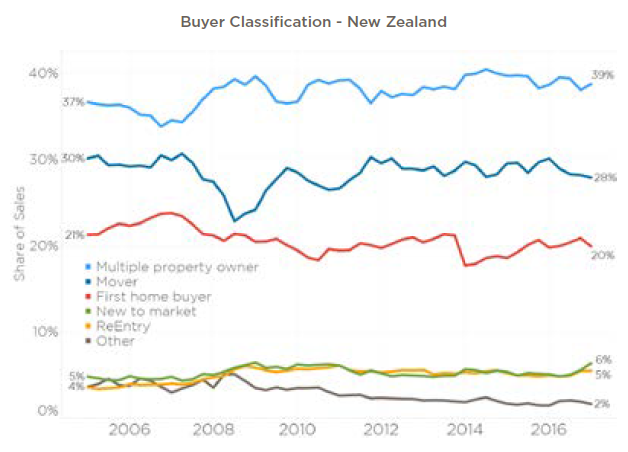
CoreLogic, on the other hand, is telling a rather different story.
As CoreLogic puts it: "...We can see investor activity holding relatively strong while first home buyer share has still slipped from its 2016 strength. The strength in investor activity is being held up by those purchases not requiring a mortgage, while those investors requiring credit have been impacted by the latest round of LVR restrictions. We have also seen that the bigger banks have reduced their lending to investors over the past two quarters."
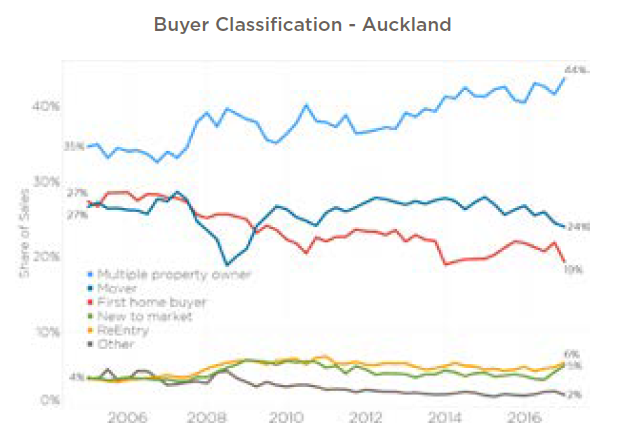
The picture is more exaggerated, and more stark, in Auckland - with investors surging and first home buyers falling to new lows. CoreLogic again: "Investors appear to have rebounded after slipping late last year, however further investigation has revealed this is mainly due to cash investors remaining active, while those requiring a mortgage have reduced their activity. This is probably an involuntary reduction based on not having the required 40% deposit."
So, if I can chip in here; what all this means is that to the extent it can control the market - IE through restricting banks' lending - the RBNZ is currently putting the market in check.
But of course it can't control what cash buyers do.
The presence of apparently cashed up people in the market without need to resort to borrowing will inevitably lead to questions of where the buyers are coming from and where they are getting the cash - all questions we are still not capable of answering due to the dearth of information available on house buyers.
I have been intrigued at how cautious the Reserve Bank has been when commenting on the recent slower conditions in the housing market. It was quite quick to claim credit for the slowdown that occurred after the initial introduction of loan to value ratio 'speed limits' in 2013, but has been reluctant to suggest anything like victory this time around.
The RBNZ in fact makes extensive use of data from CoreLogic, which probably points to the reason for the caution; that is, the RBNZ can see on the one hand that its policy is having an impact where it can have an impact - but those with the cash are carrying merrily on their way.
Personally, I don't think that's a very good sign. It suggests, as CoreLogic implies, that the pullback in borrowing from investors is very much involuntary and that the demand is still very much there. Where there's a will there's a way and if these investors keep seeing cashed up buyers swooping up houses they will feel frustrated and they will find a way of getting the money.
The other point of interest here is the first home buyers in Auckland. As the figures have shown, with the first onset of the new 40% deposit rule for investors there was a surge in buying interest from the FHBs. Does the lull we are now seeing indicate that they suddenly can't get the money to buy, having seemingly previously found a way in the run-up to Christmas? Or is it that they are now taking a 'wait and see' approach amid tales of slower conditions - and hoping that prices might even drop?
The question then is what happens if in a month or two some renewed signs of life, particularly in Auckland re-emerge? Do we get a panicky response from both FHBs and perhaps also investors who have been held back by the 40% rule?
Here's a quote from CoreLogic again in respect to the Auckland market: "High migration, low interest rates, tight listings and a housing shortage are all strong upwards pressure on prices being constrained currently by the latest lending restrictions. We saw a similar slow down last year after the initial investor LVR restrictions in Auckland and we suspect we’ll see a similar trend this time around, with the slowdown not lasting particularly long."
Of the housing market more generally, that is nationwide, CoreLogic's expectation is that the latest lending restrictions "will slow values for a few more months before things pick up again, probably after the election in September".
And that would certainly be my pick too around the country generally, with the possibility that the pick-up happens rather quicker than that in Auckland.
Of course, from the way I'm talking it might seem that I see it as a bad thing that property values go up. No, not at all. The worry is the extent to which property investment dominates all investment in this country, as this graph, again courtesy of CoreLogic, neatly demonstrates:
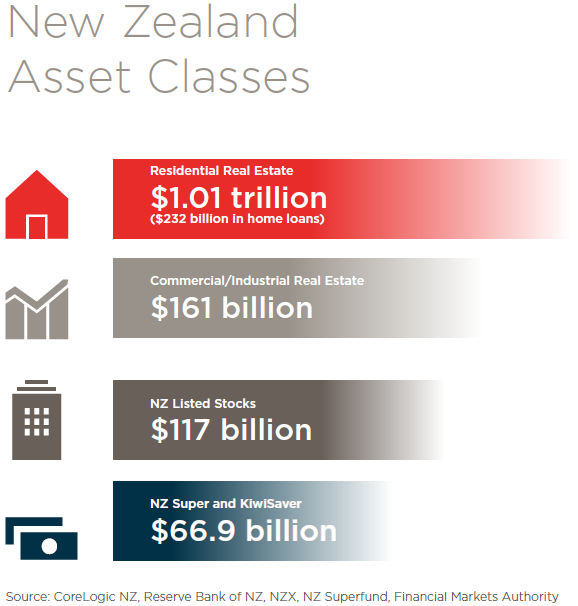
That really is what you call having all your eggs in one basket, or well, certainly A LOT of eggs.
I have said previously that it is a shame, and in fact it is just plain wrong, that this Government got all cute with the Reserve Bank and pushed back (till after the election) on the central bank's hopes of getting debt to income ratios installed as one of the weapons in its macro-prudential toolkit. And that's even after the RBNZ promised it wouldn't use them now.
Ultimately, however, when you look at those cash-fuelled investor figures in Auckland courtesy of the CoreLogic data, then so it becomes ever more apparent that anything the RBNZ can do is only part of the story.
In fact without full Government commitment to stopping boom and bust cycles in our housing market, the RBNZ measures might arguably just lead to distortions - since the RBNZ is acting on parts of the market it can act on, IE borrowers, while others, those fortunates with cash in their pockets are not affected.
So, where does this leave us?
It most definitely means that to ensure a market that is fair and even for all, the Government must use its considerable weaponry and stop being half-hearted and sitting on the sidelines as much as it has.
We need better information on who is buying houses and the method by which they do this. And then we do need to consider measures such as stamp duties and the removal of tax deductibility on investment properties, just so that the investment playing field is levelled.
The way we are going at the moment, if you look at those investor figures in Auckland, the sad fact is that anybody in future who just wants to buy a house to live in better start planning on winning Lotto.
109 Comments
Wow, I'm very impressed you followed my comment in David Chaston's "Fewer Investors get mortgages" not only with a reply but with a whole new article. Awesome, thanks
I think you give too much credit to Corelogic, who continue to believe in a real estate agent's mantra of further price increases are inevitable.
There are a number of fundamental differences this time from the previous RBNZ limitations. Firstly, we are seeing a rapid growth in the stock of property for sale. This increase is moving to very large stock of properties on the market. My common measure is the trademe listing for the auckland region which has moved from 9,000 listings to over 11,000 in only about six weeks.
Secondly, prices just can't keep increasing without a correction. The ratio of income to house price is around 10:1 which is a similar level to the Irish property market collapse, and a similar level to other collapses. In addition, like any bubble every subsequent increase is that much tricker. Another 10% price increase on top of that would move the multiple to 11:1.
Thirdly, I think the mantra that the property increases have been solely driven by immigration is a little thin. If immigration is the cause why haven't rentals also increased at the same ratio? I think what we are seeing is that for small increases in rentals people adapt their living. We have very large houses compared to other cities in the world so an increase in household size from 2.3 people per household to 2.5 people per household is sustainable. This ratio change would result in another 100,000 people being absorbed into the same housing stock. This is probably manifesting itself in; kids staying at home into early adulthood; and students cramming into flats.
What I believe is that much of the investment is on the basis that prices will continue to increase, regardless of the fundamental economics of the investment. When capital gains stop happening people have limited incentive to keep their money in houses and the stock of properties for sale increases. Into this context we should also consider how much of the overseas investment was also grabbing onto price increases and therefore may also exit the market.
I'd be interested in understanding just to what extent Chinese capital outflows have affected Auckland, vs. the likes of Vancouver where it's been more investigated and well-established - and where detached houses have reached even higher.
National will never measure this, though.
Surely, at some point a NZ government will need to decide that houses are about homes for NZers - as they were in the past before politicians had a large overlap with property investors - rather than investments for the globe.
Yes I'd be very interested in knowing that too? Seems to have been quite a lot considering how Auckland sales have dropped off a cliff since late last year judging by the recent auction results.
Bloomberg: China’s Army of Global Homebuyers Is Suddenly Short on Cash
https://www.bloomberg.com/news/articles/2017-01-26/world-s-biggest-real…
You are a cool stream of commonsense
Nice comments. I too question how significant an impact immigration is. Would be very interested to hear where all the Indian students are living. Is it in the cbd, or flatting as homestays with Indian families? Anecdotally not many seem to be taking up many rental properties beyond the cbd so arguably the impact is exaggerated
I feel for them. The rental market is not necessarily easy for them.
Last time I rented a place the property manager was almost falling over me (white guy in a decent suit) while being rather cool toward the Indians checking the place out. Ended up putting me off the place somewhat, actually.
I note some households in my area on the North Shore have a lot of young Indians living in the same house. You see a lot of cars parked outside the home and many are coming and going all the time. It appears there could be 12 - 15 living in some houses. They're mostly male and mostly in their 20s and based on the way they're dressed and the hours they keep it would appear they're students. My best guess is that many are living under the same roof to save on accommodation costs and defray their expenses. I wouldn't like to live with so many in one house but most of them seem happy enough and are usually smiling. There are a few houses in the immediate neighbourhood that appear to be occupied with a large number of young Indian males.
Just on PaulO's comment about Indian students living under the same roof to save rental costs - I have personal experience of this. A one bedroom apartment across the corridor from me in our downtown block had perhaps five or more crammed into it - they got evicted eventually and there were a number of beds in the small living room. And a cockroach infestation traced back to their kitchen... the owner pulled the kitchen apart and uncovered the rather nasty surprise, he replaced the whole kitchen afterwards.
I wondered what was going on when one of them didn't have a swipe tag to get into the building and slipped in sneakily behind a neighbour. I followed him and was surprised to see him vanish into the opposite apartment, which he did have a key to (though I knew he wasn't the tenant). Turned out they were cramming a bunch of their mates into the small unit to save on rent!
As Stephen Joyce suggested, they're here for the world class education that our PTE sector provides.
In fairness, Stephen Joyce did not say it was First World class education...
".......ourse, from the way I'm talking it might seem that I see it as a bad thing that property values go up. No, not at all. The worry is the extent to which property investment dominates all investment in this country, as this graph, again courtesy of CoreLogic, neatly demonstrates:"
We obviously have not learnt from the US caused GFC. If only they encouraged investors to buy (and take the associated business risks that go with any investment) instead of forcing homes down the throats of first home buyers who are probably better off renting until they have gathered a comfortable deposit, assuming they only want to buy and not rent. Apparently we are not far off from getting this opportunity to do so if we vote for a party (housing will be politicised this up coming election to gather votes) who will offer houses to anyone and everyone who wants one-- like the ninja mortgage loans in the US which lead to the GFC. Look no further than some European countries-- there are heaps of people who would rather rent than buy. But no, lets get on and promote owning and bash the investors. Aren't the investors taking risks which ought to be encouraged. We were not happy when they bought with an LVR of 80-95%. We aren't happy now when they are buying with their savings with an associated LVR of 60% and in some cases with zero borrowed funds. Lets bash the investors, change the government and lets create our own version of NZ GFC.
I don't follow your logic.
Firstly the main cause of GFC is sub-prime mortgages, which translates to people with negative equity, who are unable to pay the mortgage repayments.
What will we have if prices drop for any reason, and costs increase? To my eye a pretty big problem. Investors are more at risk here than any other group. As frequently reiterated by the RBNZ.
'Aren't the investors taking risks which ought to be encouraged'
Why? I think this is a pretty lofty assumption.
But the sales volumes are extremely low though. Just by lowering FHB deposit requirement from 20% to 10% would increase the volume and lower the investors’ share of the sales. The prices are already starting to fall and we risk overshooting to crash the market. For the price to take off again you need volume which means you need lots investors that need to take out mortgages as well. I’m guessing a lot of the immigrants (students) that are coming in from India/South East Asia aren’t cashed up, otherwise the sales volume would’ve stayed up. So how would the price take off again if the prices are falling and the only way for a typical investor to get more equity to buy another house is by working a job or waiting a very long time?
NZ / Auckland is a tiny housing market by comparison to the millions of mobile, wealthy, globally motivated individuals/families/businesses who are looking for a peaceful pleasant place ( underpinned by human rights values) to live in now or in the future.
Given that the NZ govt and other govt depts are in denial, what changes or barriers are possible?
Oink, oink , flap, flap
No, they don't make flapping noises. They glide gracefully...downwards.
RFC 1925
(3) With sufficient thrust, pigs fly just fine. However, this is
not necessarily a good idea. It is hard to be sure where they
are going to land, and it could be dangerous sitting under them
as they fly overhead.
Everyone assumes that people such as Chinese house buyers do it simply to make a quick profit but is that really the case? Has anyone actually bothered to ask them or are people just making assumptions?
No they don't.
Most accounts suggest it's to get money out of China, out of the reach of The Party, and into a safe storage / investment vehicle.
(And, for a sub-group, for a nice place to own in the world.)
That's right. Most wealthy Chinese like to have 1/3rd of their wealth outside China. I read the other day that the Chinese have the highest saving ratio in the world. Second homes should be taxed irrespective of colour or creed.
And the reason they want to get their money out of China, is to ensure it maintains it's value. China's government actively manages their exchange rate, and will devalue the currency without hesitation to ensure continued growth.
If the Chinese are as risk adverse as you think, they will rip their way out of the Auckland property market much faster than when they bought in. Any headwind to the Auckland market could result in Bearish conditions, very quickly.
Why would you assume it's an assumption?
Yes I see what you mean. I probably should have written it could be worthwhile doing some deeper investigation into why the Chinese are so keen on property and how they go about acquiring it. Not all cultures are motivated by the same things. Not all cultures do things in the same way. All cultures are the result of a different history. Part of my quest to make people understand that evolutionary forces will be at work in a society made up of different cultures. Many cultures, one resource, one culture will prevail eventually, even if their advantage is only slight.
If by prevail you mean have a moment in the sun then yes. Winston Churchill said that future empires are empires of the mind. What he means is that as time progresses, owning ideas, and intellectual property will be the source of power. Which is truer and truer as time progresses, look at the power of google, or drug companies.
Also most property in China is on a leasehold of around 80 years.
That is a significant for those taking a long term view of things.
Till the govt decides the land is needed for something else and you get chucked out
It would be interesting to hear how many people commenting on here actually know anyone who is Chinese. I have a very good Chinese friend as well as friends from India and the Phillipines. My Chinese friend is a property investor but that is secondary to his work. He has similar values to many New Zealanders about providing for his family and not being a burden on the state. He has always paid tax, what he did take from the system for about a year was approx' $1.50 per week Tax credit because he had a baby. Because of his ethic of working hard that eligibility to family tax credit was soon extinguished.
Robert Meek, if the Chinese community has more members like your friend than another group then the Chinese group will eventually have most of the resources according to evolutionary theory. It's like blackjack where the house has a 1% advantage. This is why many societies have graduated tax systems to even the playing field. Some may find it offensive to ponder these things but governments do it all the time and keep statistics:
http://static5.businessinsider.com/image/523890bd69beddb020d28248-800-/…
It's just science, Mother Nature doing her thing. It just surprises me that the greatest discovery of all time is not given more conscious thought.
Yep, well worth remembering they're not all cashed up gazillionaires with hot money burning a hole in their pockets whilst they look for a bolthole (though I have no doubt that some are).
I work with quite a few Chinese people who have followed the skilled migrant route and are just working hard to try to make a better life for themselves and start a family here.
Immigrants and foreign buyers are a venn diagram, not a single group. I suggest reading up on the role of capital outflows from mainland China in the Vancouver market.
Why do the authorities keep statistics on cultural groups then? I'm not trying to be controversial. I think it is very useful information because often inequality is put down to institutionalised racism when it may just be an outcome of slight behavioral differences over time. The notion is often applied to immigrants as a whole being a group that is more motivated than locals who have grown tired and blasé. That would be a fundamental behavioral difference. Health outcomes, financial outcomes and educational achievement are all behavioral outcomes.
Bla bla bla..... when the CEO of ANZ (David Hisco) said prices were over-cooked in Auckland, that meant the scam was over for this cycle.
Or do cycles no longer exist Mr Hargreaves ?
What I'm struggling to get my head around is how this housing investment 'fad' is ethically or morally sound and supported by government.
In my opinion housing/shelter must be considered to be a basic human right, along with food and water.
Now we have 'housing investors' providing 'shelter' to people in the same manner that supermarkets provide 'food and water' to consumers. Imagine if you could, that all the supermarket providers decided to start tactically increasing the cost of food and water to a point that it was so expensive that the average person could no longer afford it. It would be an absolute outrage - it would be stopped in its tracks.
So how is it any different that we have housing investors, who claim to be providing a service to society, begin out-bidding each other at auctions, buying up houses, artificially increasing their values (primarily for their own benefit), while at the same time causing the price (either in capital value or rent) to increase so it's too expensive for the average person to afford a basic human need. It's morally and ethically outrageous and to me it's ridiculous that no one has stepped in and said enough is enough.
What are the leaders of this country doing?
'leaders'??? Are there any? Or have they all sold their souls? Even the greens are looking decidedly centrist
What are the leaders of this country doing?
Getting paid to look the other way.
That, and they have their own snouts in the trough. Check out their pecuniary interest register. They're definitely growing their own portfolio wealth, even if it sells the next generations of Kiwis down the river.
Back in the real world its not a basic human right, its a user pays society thats why there are hundreds of people living in cars and sleeping rough on the streets and under bridges. The society we live in gives you the freedom to spend or invest you money however you please so if you decide to put it into real estate thats your choice. Face the facts, the rich get richer and the poor get poorer. You reach a certain threshold financially and then you start making money exponentially unless your just no good with money and make poor life choices. Is it really the job of the government to interfere with it ? I think the cost of a new Porsche is too expensive, can the government make the price of these crash please so I can buy one ?
This is just your opinion, and I fundamentally disagree. We live in a country with a welfare system to pick people up when they fall down and to look after those who struggle, usually through no fault of their own.
It is not a fact that the rich get richer and the poor get poorer, this is the opposite of the progress we've seen over the last century and there's no reason for us to backslide into a feudal society. And yes, one of the main jobs of the government is to ensure that all the citizens they are elected to represent can live decent lives with food, water, and shelter.
I will take your Porsche example more seriously when you forego housing and live on the streets for a while and can confirm that not having a Porsche is equivalent to not having a roof over your head.
Were you not born in NZ? Or when did you arrive in NZ?
If you were born here or arrived here in the right decade then you decidedly did benefit from housing affordability achieved in great part through a number of government efforts including multiple large builds.
Do not be under any illusion that you pulled yourself up by your own bootstraps, that you don't stand on the shoulders of others who came before you.
Porsches are crap to sleep in. A roof over your head is a necessity, a Porsche most definitely is not, it is not even something everyone even wants. There is a huge difference between shelter and a car, huge. You can have your free market, but I really think it is not only fair enough, but the duty, of a government to see that its citizens can house themselves. You know, I do not even know how it came to be that housing came to be thought of what it is thought of today. I look at what is going on and all I can think is, there are some people farming a whole lot of other people and it's gross.
"people farming people" is called employment
"unless your just no good with money and make poor life choices..."
The reverse is actually true. Those who took on the most debt and risk ... even the reckless ... have generally been rewarded. Thats what the capital gains PONZI has taught us. If you leveraged up massively (and timed it right ... or fluked your timing) then chances are you think youre good with money. Its easy in hindsight to say one was wise.
But i agree shelter was never a basic human right .. we have just pampered through the cheap energy age into believing this. Now there's 7 billion of us running round decimating resources everywhere, it doesn't hold true. Like a shelter is a basic gorilla right ... until we need the trees
Comment of the day.
Er, just put Auckland rates up 10% a year, that should sort it.
That will happen regardless, the interest on council debt will start cranking in the not too distant future...
Is it a surprise when investing $1.5m foreign capital in NZ residential real estate gets a free ticket to NZ residency?
https://www.newzealandnow.govt.nz/move-to-nz/new-zealand-visa/visas-to-…
Chris I looked at the website and it has a section 'acceptable investments'. It includes property but only new builds.
This link is useful on migration.
http://www.migrationstats.com/nz/appType/Resident
There weren't actually many investor visas granted between Jan 2010 and Jan 2016 - just over 2000.
what I find interesting - and what I think is glossed over by the media - is how very significant students are in terms on immigration.
Could this suggest a mass building of studio apartments could go a long way to addressing the housing issue?
And we don't count houses bought on student or short term visas as foreign purchases.
Well, we citizens might, but the powers that be don't, as it doesn't match their 3% figure.
Spot on Rick the powers at be control the news... #foreignbuyerfakenews
See the definition in Australia of a foreign buyer... and compare than to NZ (non residents only)
http://www.sro.vic.gov.au/foreignpurchaser
Foreign purchasers
You will be a foreign purchaser if you are a foreign natural person, a foreign corporation or a trustee of a foreign trust.
You are a foreign purchaser if you are not:
•A citizen or permanent resident of Australia,
•Or a New Zealand citizen with a Special Category Visa (Subclass 444)
I think studio apartments for students would have done a lot for easing the demand. It is also an interesting example of how council intervention can create problems. They have banned 'micro' apartments as too small without differentiating between a scale that is appropriate to live in for a defined period, such as during an academic year, and a size that someone can live in forever. In reality this is an area where it would have been better to leave to the market.
It doesn't say new builds at all. It say investment in residential development which could be anything including buying 10 existing flats pulling them down and building 2 McMansions ... which actually reduces housing supply...
In fact the favourite seem to be just buying an old cross lease dunger in a central Auckland location and replacing it with a cheaply built McMansion. Doesn't increase supply at all but bumps up prices and puts the "investor" over the $1.5m level. They probably don't end up paying tax on the deal either, since no new title and probably takes longer than 2 years...
I wonder if anyone is desperate enough to get NZ citizenship buy these? http://www.trademe.co.nz/property/residential-property-for-sale/auction…
Looks at least $600k over valued to me!
$10,000 a square metre and on four levels, good exercise I guess. No wonder we're getting so many Auckland refugees up here.
Cash investors are overseas buyers and are part of feel good prosperity of national as are turning NZ for the Rich, By the Rich and To the Rich.
No solution to housing and am not sure who can find solution but knows one thing that who will never find solution and that is National Party - in fact they are the reason and can never be a solution.
Anyone who think of solution has to vote - Vote for change.
Too what Labour/Greens you have got to be joking
Anything would be better than what we have, at least they will start with a cleanish slate, difficult for this current government to change from turning NZ into a South Seas Hawaii where locals cannot afford to live.
You have got to be joking if you think re-electing this do-nothing government is good for the future of NZ.
Corelogic , gives its take on Auckland, 'tight listings' , Cowpat gives her take on Corelogic , not only have listings risen significantly, Auckland's December, January, February sales are the lowest since 2011, and on an adjusted measure lower than 2011. The days to sell ( and this metric is seriously warped ) is the highest in 6 years. In percentage terms, the RBNZ mortgage data mirrors the fall in sales in percentage terms. Investors have not surged in nominal terms, cash buyers as a percentage have risen merely due to replacement . Cash buyers are present in any real estate market, across all levels including FHB, not solely investors. As an aside where does Corelogic collect its data from. If cash only buyers are so prevalent, then our mortgage data is truly of monstrous proportions.
Yes. Good informative article by the way, But I thought that part of the corelogic quote in the article saying "tight listings" required some comment. Doesn't compute with the observations on this site for the last few months.
Quote from CoreLogic ....in respect to the Auckland market: "High migration, low interest rates, tight listings and a housing shortage are all strong upwards pressure on prices being constrained currently by the latest lending restrictions. We saw a similar slow down last year after the initial investor LVR restrictions in Auckland and we suspect we’ll see a similar trend this time around, with the slowdown not lasting particularly long."
If the assertion in this article is correct then its actually not bad for the stability of the banking system. These new investment properties will have very good loan to value ratios. So when they drop in value the loss will be completely to the investor. As opposed to the bank.
NZ has changed - good or for worst under national.
Think and Vote.
Vote for change.
Or vote National and #RentTillYouDie
Its too late to reverse the tide, this has been happening for 10 years plus. The money is already here and parked in real estate. New Zealand is a small country and we have already sold it.It only takes a couple of hundred multimillionaires and a few billionaires to make the radical change in the market we have already seen. We have been letting in thousands and these people and they are now a voting force so certain moves that are perceived to be against them will now be political suicide.
Likely all that's needed is for young Kiwis and renters to realise that National will not act in their interests, but will continue instead to sell New Zealand out from under them.
And maybe for some boomers to realise what's being done to their kids and grandkids. Boomers with one house don't have much to lose, and have plenty to gain for their offspring.
You know there are a few million voters in the country right? A few thousand newbies, many of whom can't vote yet, are not going to be the decisive force in this election. Any party pandering to them over the remaining bulk of the population is going to have problems.
So, I wonder... WHERE is the money coming from?
The only solution is to change this TOXIC government in September.
#GovernmentAintGonnaHelpYouEverSoStopBlamingOthersForYourPoorDesicionsAsNZIsAFreeMarketAndLongMayThatLast
I really question whether New Zealand is a functioning free market in regards to property.
Why has supply not responded to demand for such a long period of time.
We have huge regulation and bureacracy, by way of the consenting process.
As well as this we are a small country so are very prone to monopoly, duopoly, and lack of competition scenarios.
Remember when Alan Greenspan and the fed decided that lack of regulation was equated to efficiency and the Banks would regulate themselves, based on their desire to stay in business?
http://www.economist.com/blogs/economist-explains/2017/01/economist-exp…
Yeah, free market with government enforced supply constraints and tax distortions.
#AFreeMarketisAlmostNeveraFairMarketThereforeRegulationsAreRequiredtoSeeThatitisEspeciallyWhereLocalsTryingtoCompeteWithForeignMoneyGoes
Check out these neighbouring houses in Kohimarama -> MORTGAGEE SALE - HURRY HURRY HURRY. and MORTGAGEE SALE. NOt my cup of tea with no eaves, but even if one did have access to a million dollars they still couldn't afford it as foreign buyers still appear to be running rampant.
David great article.
We should have a stamp duty of 15% on
- all investors,
- foreign buyers (including students & Temp Visa)
This should apply to ALL existing properties and new builds should be exempt.
NZ should follow UK's lead and reduce/eliminate the Investor Interest Tax deductibility.
How are FHB expected to compete with investors who buy houses for a living ? By the time the FHB goes home to think about whether they should put in an offer or not the investor has snapped it up.
FHB often are more emotional about the purchase (which can cause delays in deciding) yet for investors it is just a transaction.
Investors buy up the do ups, fix them and then slap 100/150k on the price. These same do ups are exactly what FHB should be buying however they just cant get a look in with professional investors on the prowl.
Investor's can't be blamed as they are simply playing by the rules. THE BLAME SITS WITH THE CURRENT GOVERNMENT.
Imagine what NZ could do we the proceeds from the stamp duty. Build a decent rail network. Get people out of cars and onto public transport.
I agree Joe Public. The government could have encouraged foreign investment to increase housing supply with the right incentives and disincentivising their purchasing of existing housing stock with taxes.
The fact that they haven't, despite all the world wide media coverage of the housing crisis, is very telling.
What's so stupid about all this is that eventually groups of Kiwis will realise they're not being listened to and no one is interested in their wellbeing, and then what?
They go full Trump? They start xenophobic groups?
Stop the foreign investment in housing and then see what happens!
Anyone, anywhere in the world can purchase up to 5 ha of NZ with or without a house and no data is taken. The 'Overseas Investment Office' is only involved once the property size exceeds 5 ha. (if they declare the purchase)
It is a no brainer that if your money sitting in a European or Chinese or American bank account is collecting less than 1% interest that you will purchase a house in NZ and collect a 3% rent return and capital gains.
yeah..and some nice graphs to play with in the link ..
http://www.economist.com/blogs/graphicdetail/2017/03/daily-chart-6
Highest house price index on the planet. National says there's no problem. National says falling home ownership rates are because people are "choosing" to rent. National says foreign buyers aren't a major factor. National is so convinced that housing is a non-issue that they're getting rid of their minister of housing. I think it's time to get rid of National.
National are clearly either completely incompetent or cynically and absolutely dishonest.
Cash rich investors? Money Laundering?
In fact without full Government commitment to stopping boom and bust cycles in our housing market,
King Canute for PM?
Seriously, anyone that thinks a vote for a Labour/Greens etc. party is going to improve their standard of living has got their heads in the sand.
Labour has stated that they are going to be building these so-called affordable houses for everyone that can't afford one at the moment!
Prey tell how much these houses are going to be and where about are they going to be?
3 hours from Auckland perhaps?
There policies are so airey fairy without any substance!
Yes they will bring in a capital gains tax but it can't be retrospective and prices need to go up for any tax to be collected, which many on here says isn't going to continue.
Capital gains tax on,y increases prices as putting a tax on anything only,increases prices!
Has a capital gains tax worked in our closest neighbour Australia?
Don't beleive it has as Sydney and Melbourne prices are worse than NZ!
Excellent, now I know for sure, they are on the right track, cheers for that
Foreign buyer tax seems to have worked in all the other OECD countries. There are plenty of initiatives that government could have made to prevent the hyperinflation of Auckland house prices and collapse in home ownership rates.
I’m certain that if Labour or the Greens or New Zealand First had have been in power over the last 8 years they would have done more than “nothing“.
Oh please, please, do some research before posting. The Labour party is not saying anything about a capital gains tax, and they've been quite clear that they see it as a reason for losing the last election. It has been ditched. The only related policy is to extend the 'bright lines' threshold from 2 years to 5 years to better identify property traders who should be paying income tax on their gains.
I'm more excited by their actual proposals to look into negative gearing, much better to have an on-going increase in taxes on some property investors.
Oh please, Labour has stated that it is their intention to stop speculators by bringing in taxes on profit from sales of property and lengthening out the bright line test and therefore it is a Flippen capital gains tax!!!
Call it income tax instead of capital gains - if it's income, tax it under the existing legislation. Problem solved.
Of course, given that capital gains are in no way earned by the owner maybe a 100% tax on capital gains is called for and this allows for lower tax rates on labour. Maybe if income earned from labour was enough to live on, enough to provide for ones standard of living we wouldn't need to chase capital gains.
Then there's the greed factor. http://www.thefreedictionary.com/greed Maybe a greed tax is necessary.
Labour are not doing enough. People don't know their policies and they are not too different from Nationals. Too late to be looking into.... heck National have been looking into things for the last 8 years or so. People are sick of politicians looking into things... we need ACTION. Plenty of countries have already done the looking into and we can follow their lead.
People are screaming for change and they are not providing it.
Unless they bring in a Vancouver tax on Investors and Foreign Buyers (students & temp workers included) they can kiss their chances of winning this year good bye.
The Greens did mention about introducing a Foreign Buyers Tax at their meeting a few months about in Mount Albert, hopefully they'll stick to that plan.
Two things are certain: There are millions of wealthy Chinese trying to sneak their money out of the country and that Bill English will never do anything likely to upset them. Therefore whilst we continue to pour people into a city that has proven it cannot accommodate them it is hard to see house prices going down. So only two things can possibly prevent us moving from an unaffordability factor of 10.1 to 14 (ie like Hong Kong). One is a change of Government. The other is FHB's refusing to buy until prices drop. This would also set off a chain reaction resulting in foreign investors selling up in Auckland and reinvesting elsewhere.
There is a third option, that being a general rent strike. So wide spread it canaot be dealt with by tennancy tribunals or otherwise and supported in such numbers that eviction is impossible. Worked for wages all those years ago...and would be massive wake up call for the 'leaders'.
Just need a charismatic social media savvy individual to stand up.
LEAVE THE MARKET TO SORT OUT THE HOUSING ISSUE .
Its well on its way to doing just that ............... no intervention needed
That's what vested interests said in Vancouver too.
Didn't work.
Except that the free market seems to be slowly correcting the housing fiasco in Auckland
Not necessarily at all. Many anecdotal sources on this site and in person have suggested demand from the Chinese mainland has abated (temporarily?) since the Chinese government has started to crack down on capital flight.
That's a government measure, not free market.
Likewise, without any measures to address the role of foreign purchases we could see things take off again - right up to Vancouver levels.
On the other hand, what is the basis for your suggestion that it's the free market that caused the slowdown, with the Chinese clampdown timing being purely coincidental?
No intervention needed .....what were the LVR changes then. Just wait until the Auckland market turns and thousands of voters are sitting on negative equity. The LVR changes will be the first thing to go.
I have written previously; National are building their 'voting bloc'. The more immigrants that arrive under their watch the more their chance of being re-elected, for obvious reasons.
The gold card did it for Winston, WFF for Helen Clark in 2004, so we should not be surprised that National will not adjust the immigration numbers, nor look at the housing issue, as they see these situations if they leave them alone, as beneficial for their re-election chances.
2017 will be a very interesting year!
It's staggering how unimportant New Zealanders (young and upcoming, especially) are to National. Incredible.
That is because young people (NZ citizens born here) perceive National as a party of rich old fogeys!
My children, recently into their 30's, have never voted National. So National don't see them as their target market.
I asked my daughter-in law; "Who will you vote for? Jacinda, of course" was the reply! Personalities matter; National don't have any.
It is to be hoped that young people take a greater interest in this next election, than they have in others in the past.
Absolutely right Zorba. The most important factor keeping National high in the polls is the recent immigrant vote. I am guessing that New Zealanders are becoming increasingly alarmed at the social consequences of National's policies and are turning to other parties. However, their previously pro-National vote is being replaced by new arrivals. Does anyone else think it's wrong that non-citizens who have been here only one year are eligible to vote in the Government of this country?
Who is it that can vote after a year? I came on a work to residency visa and couldn't vote until I had permanent residency (at least 2 years after arriving). I struggle to imagine that the immigrant vote is cohesive and numerous enough to make a significant difference personally (I've been here 3 years and certainly won't be voting National)
Most immigrants want to bring family and friends in so will vote for the immigration friendly party. A lot of immigrants also have invested in realestate and want to keep the housing ponzi scheme going.
Your average kiwi is too busy going to work and raising children to investigate who they vote for so the likes of Mike Hosking and the pro National media also have a huge influence on who people vote for.
Hi mfd Go to the Electoral commission website and check it out. The criteria is 18 years of age and residence here for 12 months.
...and citizenship or permanent residence. I could be wrong but I don't think many people get straight into permanent residence - My occupation is on the skills shortage list, English speaking, job offer while overseas etc. so no problem getting in, but had to wait two years to qualify for permanent residence.
Free market doesnt work well for nz citizens..... government intervention is needed.
We dont want to get to Vancouver levels before taking action.
2 years to gain permenent residency seems light touch. 5 years in the uk is required.
We welcome your comments below. If you are not already registered, please register to comment
Remember we welcome robust, respectful and insightful debate. We don't welcome abusive or defamatory comments and will de-register those repeatedly making such comments. Our current comment policy is here.