

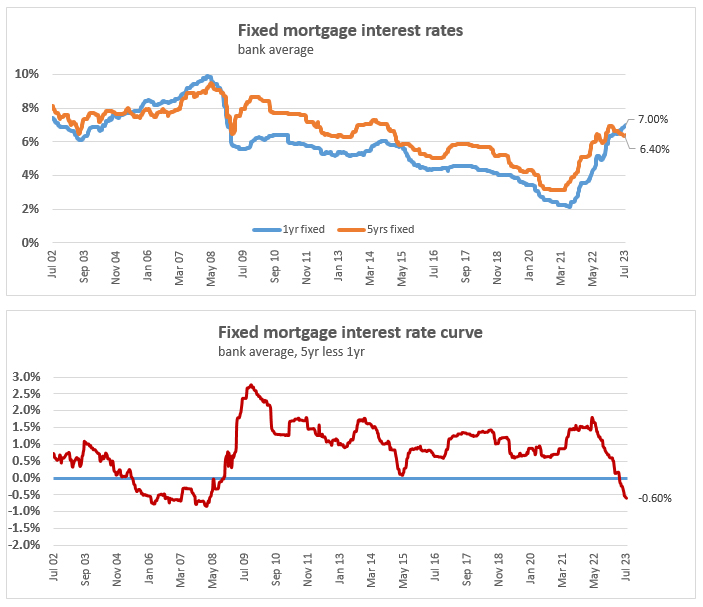
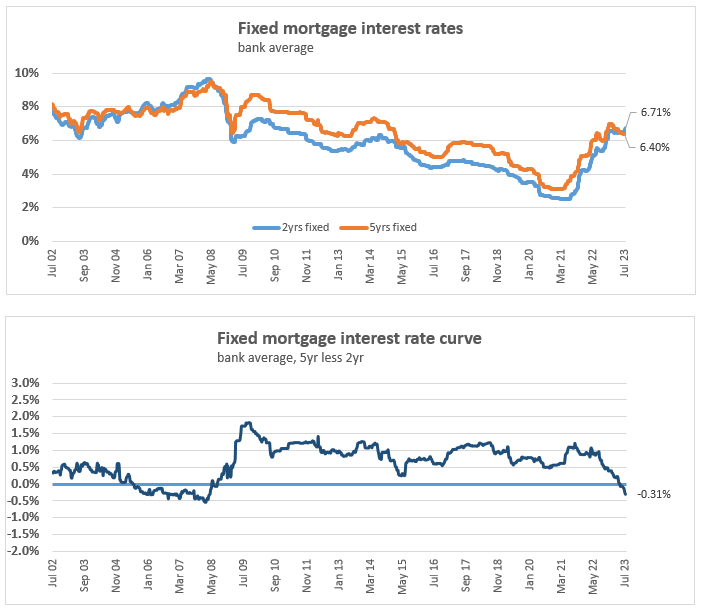
The average bank five year mortgage rate is now lower than both the average one and two year rates.
As the interest.co.nz charts below demonstrate, this hasn't happened since the high interest rate run-up to the Global Financial Crisis (GFC).
At 6.40%, the average five-year bank carded, or advertised, mortgage rate is 60 basis points below the 7% one-year average, and 31 basis points below the average two-year rate of 6.71%.
And at 6.41%, the three year average bank mortgage rate is only just above the five-year average.
So what's going on?
A similar scenario is at play with wholesale interest rates.
At the time of writing the five-year New Zealand swap rate is at 4.78%, with the one-year swap rate at 5.85%, and the two-year at 5.53%. That means the five-year swap rate is 107 basis points lower than the one-year rate, and 75 basis points lower than the two-year rate.
Swap rates & inversions
A swap rate is an interest rate based on what financial markets' participants think interest rates will be in the future. Swap rates allow the likes of banks to manage their interest rate risk by locking in a fixed rate for a set time period. If swap rates rise mortgage lenders typically increase their rates so they won’t lose out. So if swap rates go down mortgage rates normally do too, and if swap rates rise, so generally do mortgage rates.
Inversions, where longer-term interest rates are below shorter-term interest rates, are historically associated with investors believing a recession is coming. The Reserve Bank's changes to and guidance for the Official Cash Rate (OCR), NZ's benchmark interest rate, influence short-term swap rates, while longer term rates take their cue from international influences such as the US Treasury yield curve, which has also inverted.
A similar scenario was at play with wholesale interest rates in early 2008 as financial markets hurtled into what became known as the GFC. At the end of March that year the five-year NZ swap rate was at 7.79%, one-year at 8.61% and two-year at 8.19%. The OCR was then at 8.25%, the highest it has been since its introduction in 1999. (The OCR's currently at 5.50%).
The dilemma
For people taking on or refixing a mortgage, this mortgage rate inversion creates a dilemma. Do they, and/or their advisers, think fixing at a current, lower five-year rate makes more sense than going for a higher shorter-term rate, of say one or two-years? Or choosing a floating rate for a period, with the average bank floating rate currently at 8.48%?
Ultimately it depends on what you think the outlook for interest rates is.
Someone who fixed for five-years in early 2008, when a similar inversion occurred, would've subsequently witnessed mortgage rates fall significantly as the GFC kicked in.
If a similar interest rate scenario to that was to emerge some borrowers fixed via longer term rates, who see lower mortgage rate offers emerge, may then want to break the term of their loan and refix at a lower rate. That would likely mean mortgage break fees come into play.
If mortgage rates were to rise for an extended period from here, someone locking in a five-year rate at the moment might end up thinking doing so was a good move.
See all carded, or advertised, mortgage rates here.
*This article was first published in our email for paying subscribers. See here for more details and how to subscribe.
We welcome your comments below. If you are not already registered, please register to comment
Remember we welcome robust, respectful and insightful debate. We don't welcome abusive or defamatory comments and will de-register those repeatedly making such comments. Our current comment policy is here.