

The cost of living for the average household increased by 7.2% in the 12 months to June 2023, according to new figures from Stats NZ.
These figures are as measured by Stats NZ's quarterly household living-costs price indexes (HLPIs).
The principal difference between these figures and the Consumers Price Index (CPI), which showed annual inflation running at 6.0% for the year to June, is in the treatment of housing.
The CPI measures the costs of building houses (these were up 7.8% over the 12 months) - while the HLPIs measure mortgage interest rate costs, (which showed a 28.8% rise over the year).
The latest HLPIs figure, while higher than the inflation figure as measure by the CPI has still moderated somewhat, down from 7.7% as of the March quarter and from a peak of 8.2% as of the December quarter 2022.
Food prices have been a major contributor to the latest figure.
"Food prices increased by 12.7% for the average household," Stats NZ's consumer prices manager James Mitchell said.
"This was the main contributor to higher living costs for most household groups."
(Stats NZ says The HLPIs measure how inflation affects 13 different household groups, plus an all-households group, also referred to as the average household. The consumers price index (CPI) measures how inflation affects New Zealand as a whole).
"Higher prices for interest payments and grocery food were the biggest contributors to the 7.2% increase," Mitchell said.
"These were partly offset by lower prices for private transport supplies and services, things that keep your vehicle running, such as petrol and diesel."
On July 1, 2023, half-price public transport fares, the cut in fuel excise duty of 25 cents a litre, and the cut in road user charges were removed. Any impact this will have on prices will come through in the September 2023 quarter.
Between June 2022 and June 2023 prices in order of their contribution to the overall movement for:
- interest payments increased 28.8%
- grocery food increased 13.2 %
- private transport supplies and services decreased 9.9%
- rent increased 4.8%
- fruit and vegetables increased 21.2%.
Stats NZ says its two measures of inflation are typically used for different purposes. A key use of the CPI is monetary policy, while the HLPIs is to provide insight into the cost of living for different household groups.
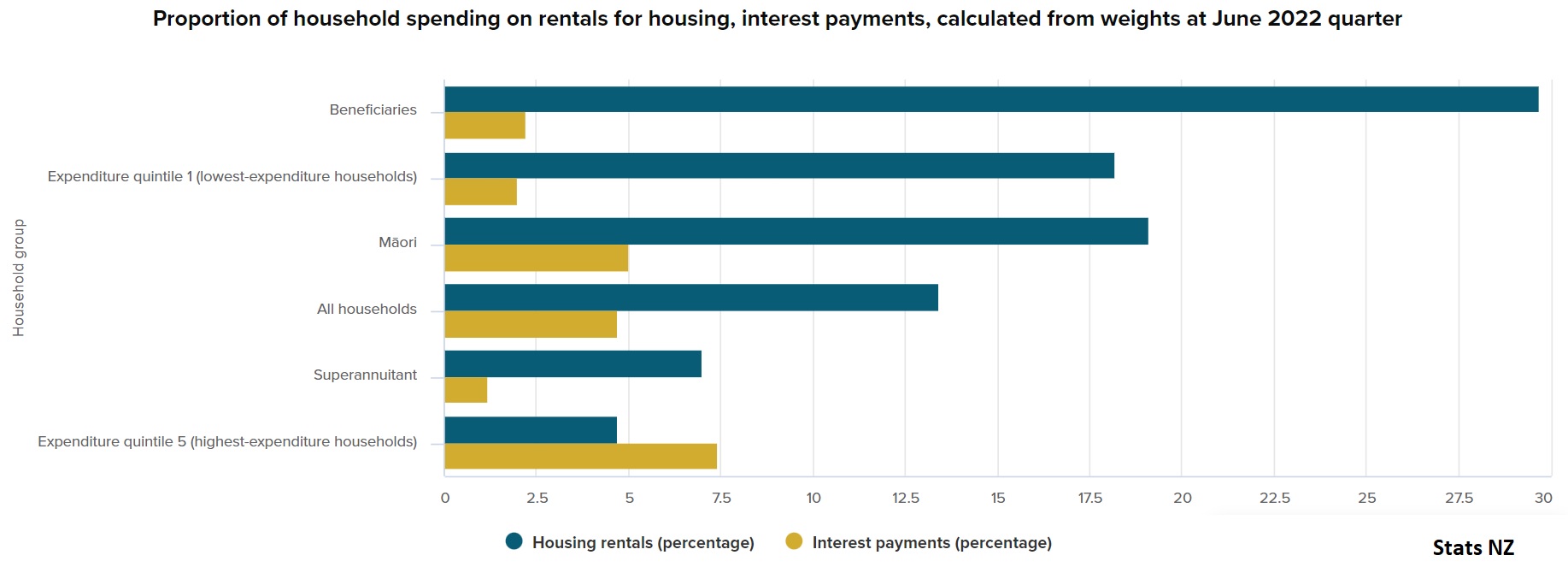
A look at the quarterly breakdown of spending on rent and interest costs shows that beneficiaries (29.7%) spent the biggest proportion of their household spending on rent, while the highest-expenditure households spent the biggest portion of household spending on interest costs (7.4%).
In terms of 'all households' the spending on rent was 13.4% of household spending, while for interest costs it was 4.7%.
We welcome your comments below. If you are not already registered, please register to comment
Remember we welcome robust, respectful and insightful debate. We don't welcome abusive or defamatory comments and will de-register those repeatedly making such comments. Our current comment policy is here.