

Here is a thought experiment for those contemplating what to do when their fixed-rate home loan comes up for renewal.
The issue is this: The highest rates currently are for one year fixed, the lowest for three years (and longer).
Do you buy the idea that because rates will be coming down 'soon', it is better to go short now, so you can catch the even-lower rates coming when the Reserve Bank cuts the Official Cash Rate (OCR)?
That seems to be what an increasing number of borrowers are doing. The one-year fixed term is now the most popular. Curiously, that has moved shorter as the proportion of deals done through mortgage brokers has risen.
But there are two issues here.
First, taking a 7.14% one year rate now, the lowest from a main bank, and forsaking a 6.35% three-year fixed rate, the lowest rate from any bank for any term at Heartland Bank, mean in a year rates will have to drop by 120 basis points just for the borrower to be even, and stay down. Even if they do, the uncertainty risk hardly seems worth it.
The numbers for a $500,000, 30 year mortgage are:
| Repayment | 1yr Fixed |
3 yrs Fixed |
||
| Year 1 | 7.14% | $40,861 | 6.35% | $37,695 |
| Year 2 needs to be | 5.95% | $36,112 | 6.35% | $37,695 |
| Year 3 needs to be | 5.95% | $36,112 | 6.35% | $37,695 |
| ---------- | ----------- | |||
| Total payments | $113,085 | $113,085 | ||
Possible, but risky. You are betting that the Reserve Bank has won its inflation battle in a year and has then cut the OCR by 25 basis points nearly five times.
And you are counting on the international influences on our interest rates not upsetting that expectation. Otherwise you would go for the lower and certain current three year fixed offer on the table now.
Secondly, there is the issue of the historical track record. And we can test that, and by bank.
If you have a $500,000 home loan due to roll over on July 1 this year, and you had chosen the lowest rate for any fixed term in the prior five years, this is what would have happened to your payments:
| Lowest rate available ... | |||||
| 1 yr | 2 yrs | 3 yrs | 4 yrs | 5 yrs | |
| 01-Jul-14 | 5.98% | 6.24% | 6.44% | 6.90% | 7.13% |
| 01-Jul-15 | 4.89% | 4.99% | 5.29% | 5.65% | 5.60% |
| 01-Jul-16 | 4.19% | 4.19% | 4.49% | 4.90% | 4.89% |
| 01-Jul-17 | 4.45% | 4.74% | 5.09% | 5.49% | 5.59% |
| 01-Jul-18 | 4.19% | 4.39% | 4.79% | 5.19% | 5.39% |
| 01-Jul-19 | 3.85% | 3.85% | 4.05% | 4.29% | 4.39% |
| 01-Jul-20 | 2.65% | 2.69% | 2.79% | 2.99% | 2.99% |
| 01-Jul-21 | 1.85% | 2.35% | 2.45% | 3.39% | 3.69% |
| 01-Jul-22 | 4.90% | 5.29% | 5.59% | 6.05% | 6.19% |
| 01-Jul-23 | 6.40% | 6.20% | 5.95% | 6.15% | 5.99% |
| from these banks ... | |||||
| 01-Jul-14 | multiple | multiple | multiple | multiple | multiple |
| 01-Jul-15 | ASB | multiple | BNZ | BNZ | Kiwibank |
| 01-Jul-16 | Kiwibank | BNZ | multiple | Kiwibank | Westpac |
| 01-Jul-17 | ASB | multiple | multiple | ASB | Westpac |
| 01-Jul-18 | Kiwibank | Kiwibank | ASB | Kiwibank | Kiwibank |
| 01-Jul-19 | multiple | multiple | multiple | Kiwibank | Kiwibank |
| 01-Jul-20 | multiple | multiple | Westpac | BNZ | multiple |
| 01-Jul-21 | Heartland | Heartland | Heartland | Kiwibank | Kiwibank |
| 01-Jul-22 | Heartland | Heartland | Heartland | Kiwibank | BNZ |
| 01-Jul-23 | Heartland | Heartland | Heartland | Kiwibank | Kiwibank |
| so the annual repayment cost was ... | |||||
| 01-Jul-14 | 36,262 | 37,247 | 35,358 | 36,714 | 40,807 |
| 01-Jul-15 | 32,119 | 37,247 | 33,609 | 36,714 | 40,807 |
| 01-Jul-16 | 29,586 | 29,586 | 33,609 | 32,156 | 40,807 |
| 01-Jul-17 | 30,515 | 29,586 | 33,609 | 32,156 | 40,807 |
| 01-Jul-18 | 29,586 | 30,300 | 31,751 | 32,156 | 40,807 |
| 01-Jul-19 | 28,391 | 30,300 | 31,751 | 32,156 | 30,300 |
| 01-Jul-20 | 24,369 | 24,498 | 31,751 | 25,477 | 30,300 |
| 01-Jul-21 | 21,867 | 24,498 | 23,730 | 25,477 | 30,300 |
| 01-Jul-22 | 32,156 | 33,609 | 23,730 | 25,477 | 30,300 |
| 01-Jul-23 | 37,893 | 33,609 | 23,730 | 25,477 | 30,300 |
| over ... | |||||
| five years | $144,676 | $146,513 | $134,692 | $134,063 | $151,499 |
| ten years | $302,743 | $310,479 | $302,628 | $303,958 | $355,534 |
| so the penalty over the lowest cost choice is ... | |||||
| five years | $10,613 | $12,451 | $630 | ... | $17,436 |
| ten years | $115 | $ 7,851 | ... | $1,330 | $52,906 |
The above table shows the costs per year in mortgage repayments by sticking to the same term and rolling over at that term.
But you can change when your fixed rate contract ends. The savings grow if you then choose the lowest rate available for any fixed term
For the past five years, you would have been better off choosing the BNZ four year 2.99% fixed rate than any other term from any other bank. The year before making that decision you would have been better off on the one year rate of 3.85% from one of ANZ, BNZ, or Kiwibank. Over the full five years you would have made payments of $130,299 using this "lowest current rate" strategy. That is a $14,377 saving over always going for the lowest one year fixed rate, and a $16,214 saving for always going for the lowest two year fixed rate.
If you extend the analysis to 10 years, a combination of one, two and three lowest rates worked best. It was the BNZ two year rate in 2016, followed by Kiwibank and others for one year options from July 2018 to July 2020, then Heartland Bank's three year rate from July 2021 onward. That combination of always choosing the lowest rate on offer for any term at the time you needed to make a decision would have cost $281,088 over these 10 years, far less than just sticking to the one year minimum rate, and you would have saved $21,655.
Of course, history is no guarantee that the future will repeat. But at least you should be aware of how this strategy played out over the recent past.
The shift in the market to one year fixed rates wasn't a smart choice, this hindsight analysis shows.* It is curious it came as the mortgage broking industry became dominant.
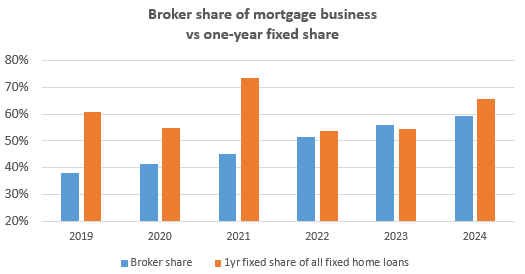
The other point to make is that mortgage brokers get their commissions from most banks, but not all. The best of the scenarios includes Heartland Bank over the last three years of the review. It is doubtful a mortgage broker would have recommended choosing a Heartland Bank mortgage, or even offering it as an option, because they don't pay brokerage. But from an individual homeowner's point of view, you clearly should include them in your assessment if you want to pay off your mortgage at the least cost.
Financial advice can be very useful when dealing with home loans. But that is undermined by the clear conflict of interest brokers have when they are being paid by banks - and they won't even offer options they don't earn brokerage on. Regulator-required "disclosures" are a pointless salve. What is really needed is a mandatory end to the financial conflict of interest.
You can find all current home loan interest rates here. And a full-function mortgage calculator here.
* This analysis compares rate options at the carded levels. Obviously those with good financials should be able to win a discount from carded rates. But be aware that Heartland Bank rates are unlikely to be discounted. Also, the availability of non-rate cash incentives will affect your final assessment as well. These come and go. You can find the current ones listed here. If you use all that cashback money to pay down your mortgage, that will affect your assessment too. Again, Heartland Bank has rarely offered cashbacks, if ever.
We welcome your comments below. If you are not already registered, please register to comment
Remember we welcome robust, respectful and insightful debate. We don't welcome abusive or defamatory comments and will de-register those repeatedly making such comments. Our current comment policy is here.