
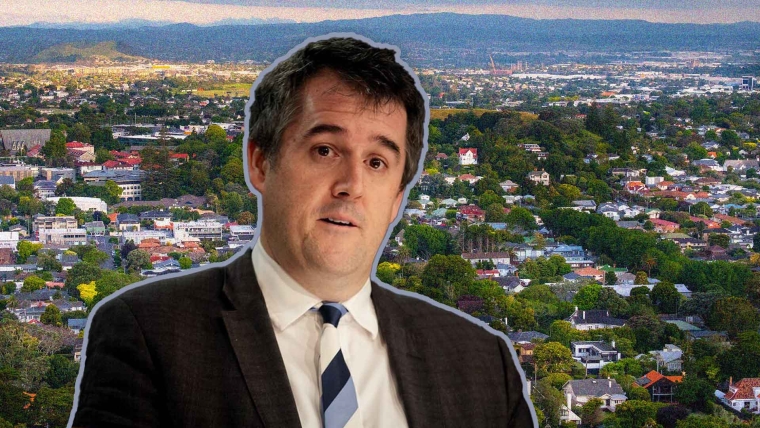
The Government will introduce legislation to alter the Resource Management Act (RMA) so the housing capacity requirement for Auckland’s housing plan can officially be lowered from 2 million to 1.4 million.
Initially this number was 1.6 million but on Tuesday, Housing and RMA Reform Minister Chris Bishop says Cabinet agreed to drop housing capacity to 1.4 million and “our expectation is that this revised capacity number finally brings consensus on this important issue”.
“Aucklanders deserve certainty on this city-shaping plan change,” Bishop says.
Advice from officials estimates that housing capacity enabled by Auckland’s housing plan, called Plan Change 120 (PC120), is still likely to be around 1.6 million homes once mandatory requirements under the National Policy Statement on Urban Development and upzoning around the City Rail Link are taken into account, he says.
“This means Auckland Council will still need to provide for significant housing growth, including upzoning around key transit corridors and town centres.”
Bishop says the legislation also addresses a transitional issue which affects about 400 developers and property owners following the withdrawal of an earlier plan change last year.
“Some people had already started projects under the Medium Density Residential Standards and were left in limbo when those rules were withdrawn.
“This legislation provides certainty. Where approvals were already in place or projects were partway through the building consent process, those projects can continue.”
Bishop says he still plans to investigate planning provisions that may be holding back Auckland’s city centre, “with a view to making regulations under the RMA if the statutory criteria are met".
“If further opportunities for housing development are enabled through this work, they will count toward PC120’s revised capacity requirement.”
Bishop says Auckland Council has a set of guiding principles for it will change the plan when it comes to this new housing capacity number.
This includes:
- Downzoning areas where homes are more susceptible to natural hazards like flooding
- Enabling intensification in mandatory areas including around stations benefiting from investment in the City Rail Link
- Reducing housing capacity in places more than 10 kilometres away from the city centre as a starting point
- Reassessing requirements in places that are not as well-served by public transport
The Government plans to progress this legislation quickly to minimise disruption to the existing PC120 process.
Bishop says PC120 has received over 10,000 submissions and those remain valid.
“Once the new capacity requirement is in place, Auckland Council will decide which parts of the plan change to withdraw or amend.
“If parts are withdrawn, the existing Auckland Unitary Plan zoning will remain in place.”
“For parts that continue, updated provisions and maps will be made publicly available, and Aucklanders will have further opportunities to provide feedback,” he says.
“This process will be transparent, and Aucklanders will be able to have their say.”
Following this, the independent hearings panel will consider submissions and make recommendations before Auckland Council makes final decisions on PC120, Bishop says.
'Let Auckland get on with building Auckland'
Auckland Mayor Wayne Brown says: “This will give Auckland more flexibility to grow into the city it wants to be, a global city, not embarrassingly the world’s biggest suburb."
"It also gives us greater ability to downzone for natural hazards and retains intensification where it makes the most sense - along major transport routes and the CRL (City Rail Link) where we’ve already sunk billions into the pipes, roads, and tracks beneath our feet," Brown says.
“This has been going on for years, over successive governments. If we waited for everyone to agree, we’d never get anywhere. It’s time to stop the talk, for Wellington to get out of the way, and let Auckland get on with building Auckland.”
The plan
PC120 has been an ongoing political issue for the Government.
While Bishop has been a champion of the proposed plan, there was speculation that National’s Auckland MPs were feeling the heat, and former National Cabinet Minister Maurice Williamson warned that it could cost National party votes at the upcoming election.
And Prime Minister Christopher Luxon hinted at changes to the plan following his 2026 State of the Nation address.
David Seymour, Deputy Prime Minister, ACT Party leader and MP for Epsom, has long been vocal about the plan, saying it was flawed and making it clear he would be calling for changes.
The initial target for Auckland Council would have provided housing capacity for two million houses following a change to the RMA.
In a question and answer sheet on the previous plan, Auckland Council says the main changes with this proposed plan was “increased building heights and densities of either six, 10 or 15 storeys” in "walkable catchments from the edges of the city centre zone, metropolitan centre zones, and from existing and planned Rapid Transit Network stops in urban areas”.
An increase in building heights and densities was also proposed for local and town centres as a way to match what commercial and community activities these places offered.
This plan would potentially allow 15-storey buildings around Maungawhau, Kingsland and Morningside train stations, and 10-storey buildings around Mt Albert train station.
As for the two million homes figure, Auckland Council made it clear that this did not mean two million extra houses will be built or needed - this is the “theoretical number of houses that could be built, if houses were built to the full extent across the city within the rule that applied”, it says in the fact sheet.
“What actually gets built is much less."
We welcome your comments below. If you are not already registered, please register to comment
Remember we welcome robust, respectful and insightful debate. We don't welcome abusive or defamatory comments and will de-register those repeatedly making such comments. Our current comment policy is here.