
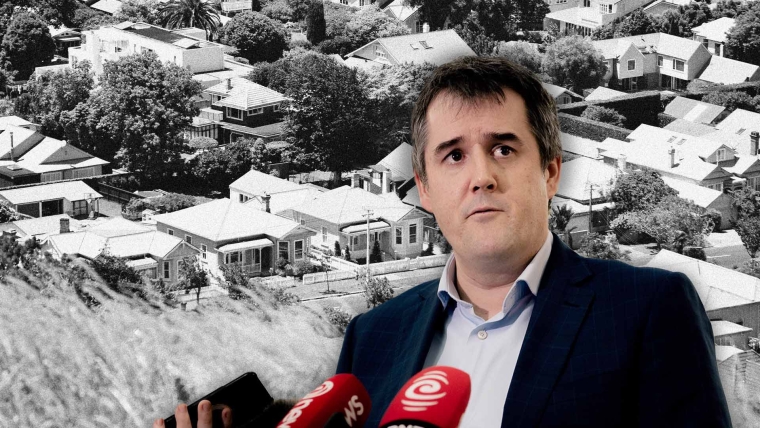
The Government will be softening the housing capacity requirement for Auckland’s housing intensification plan, lowering it from 2 million to 1.6 million.
Alongside this, Housing Minister Chris Bishop says the Government believes there is still significant, unrealised potential in the city centre - and he will investigate the “planning provisions that are holding back Auckland’s city centre, with a view to making regulations under the RMA (Resource Management Act)”.
Bishop made the announcement on Thursday, as he delivered a speech at an event hosted by the Committee for Auckland. Earlier, interest.co.nz reported a decision was expected and it was understood that changes would be a pragmatic middle ground.
He told the audience the Government had heard Aucklanders’ feedback and had answered. “Softening the housing capacity requirement strikes an appropriate balance between those Aucklanders concerned about densification, and those who wish to see more growth.”
While ACT leader David Seymour has called this "good news", Labour's Auckland spokesperson Carmel Sepuloni called it a "humiliating backdown" for Bishop.
Sepuloni said Bishop had spent months talking up housing reform "only to be forced into swallowing a dead rat when Christopher Luxon threw his plan under the bus", while Greens co-leader Chlöe Swarbrick, who is also the MP for Auckland Central, said Aucklanders deserve better.
The plan
The plan, called Plan Change 120 (PC120), had become an ongoing political issue for the Government. The target for Auckland Council would have provided housing capacity for two million houses (a number that people have been hung up on), following a change to the Resource Management Act.
In a question and answer sheet, Auckland Council said the main changes with this proposed plan was “increased building heights and densities of either six, 10 or 15 storeys” in "walkable catchments from the edges of the city centre zone, metropolitan centre zones, and from existing and planned Rapid Transit Network stops in urban areas”.
An increase in building heights and densities was also proposed for local and town centres as a way to match what commercial and community activities these places offered.
This plan would potentially allow 15-storey buildings around Maungawhau, Kingsland and Morningside train stations, and 10-storey buildings around Mt Albert train station.
As for the two million homes figure, Auckland Council said this does not mean two million extra houses will be built or needed - this is the “theoretical number of houses that could be built, if houses were built to the full extent across the city within the rule that applied”.
“What actually gets built is much less,” Auckland Council said in a fact sheet.
‘Determined to put this issue to bed once and for all’
Bishop said Cabinet has agreed to legislate this housing capacity softening.
Currently, the Auckland Unitary Plan (AUP) enables capacity for 1.2 million extra homes.
Bishop said: “The Government’s view is that 1.6 million is the midpoint between the 1.2 million housing capacity enabled by the AUP, and the 2 million that would have been enabled by PC120 (as currently notified).”
“Going from at least two million to at least 1.6 million does reduce minimum housing capacity by around 20%, but this is in the context of a stronger Plan Change that could see a 20% increase in planned housing turning into real housing.”
Bishop said PC120 is a stronger plan compared to previous ones because the Government and Auckland’s “shared objective of upzoning around key CRL (City Rail Link) stations, and shared commitment to the NPS-UD (National Policy Statement on Urban Development)”.
“We are not backing away from these bottom lines.”
Cabinet has asked for a summary of the provisional changes the Council would make once the Government started legislation.
“And once we legislate the lower housing capacity number, the rest is in Auckland Council’s hands," Bishop said.
“The Council will determine which parts of Auckland they wish to downzone in PC120. They can then formally withdraw parts of PC120 from the Plan Change, except for those parts needed to implement the NPS-UD or to upzone around key City Rail Link [CRL] stations.”
“We are legislating in the middle of a plan change process that is already underway, so it is quite legally complicated, but we have devised a way through that will allow Aucklanders to see the areas that will be removed from PC 120 and provide another opportunity for Aucklanders to have their say – including those who have already submitted on PC120 and others who would like to join.” Bishop said.
“I want to stress that I am determined to put this issue to bed once and for all. Auckland has been struggling with an update to the AUP since 2021.”
“I accept Parliament hasn’t helped, but it’s now 2026,” he said. “I think we’ve now got the balance right.”
Bishop said the new plan would mean more growth around areas that make the most economic sense and where there is the most support. This includes CRL stations, rapid transit stations and metropolitan centres.
“And it means more flexibility for Auckland around suburban Auckland.”
‘Significant, unrealised potential’
Bishop said the Government believes there is still significant, unrealised potential in the city centre.
Existing provisions such as setback requirements, tower dimension controls and height limits constrain development, he said, and should be revisited.
“Enabling more growth in the city centre will unlock productivity and increase the benefits of CRL even further.
“However, for largely unfathomable Resource Management Act legal reasons, the City Centre Zone is not included in PC120, and the Council does not have a simple mechanism to unlock this potential.”
“Therefore, Cabinet has agreed that I will start an investigation into these planning provisions that are holding back Auckland’s city centre, with a view to making regulations under the RMA,” Bishop said.
His intention was that any extra housing capacity enabled in the city centre would count towards the 1.6 million housing capacity figure.
So, what does this look like?
Bishop said it would likely mean less growth enabled in suburbs while keeping capacity enabled around CRL stations, other train stations, busways, metro centres and the city business district.
“The evidence is clear – well connected growth drives productivity.”
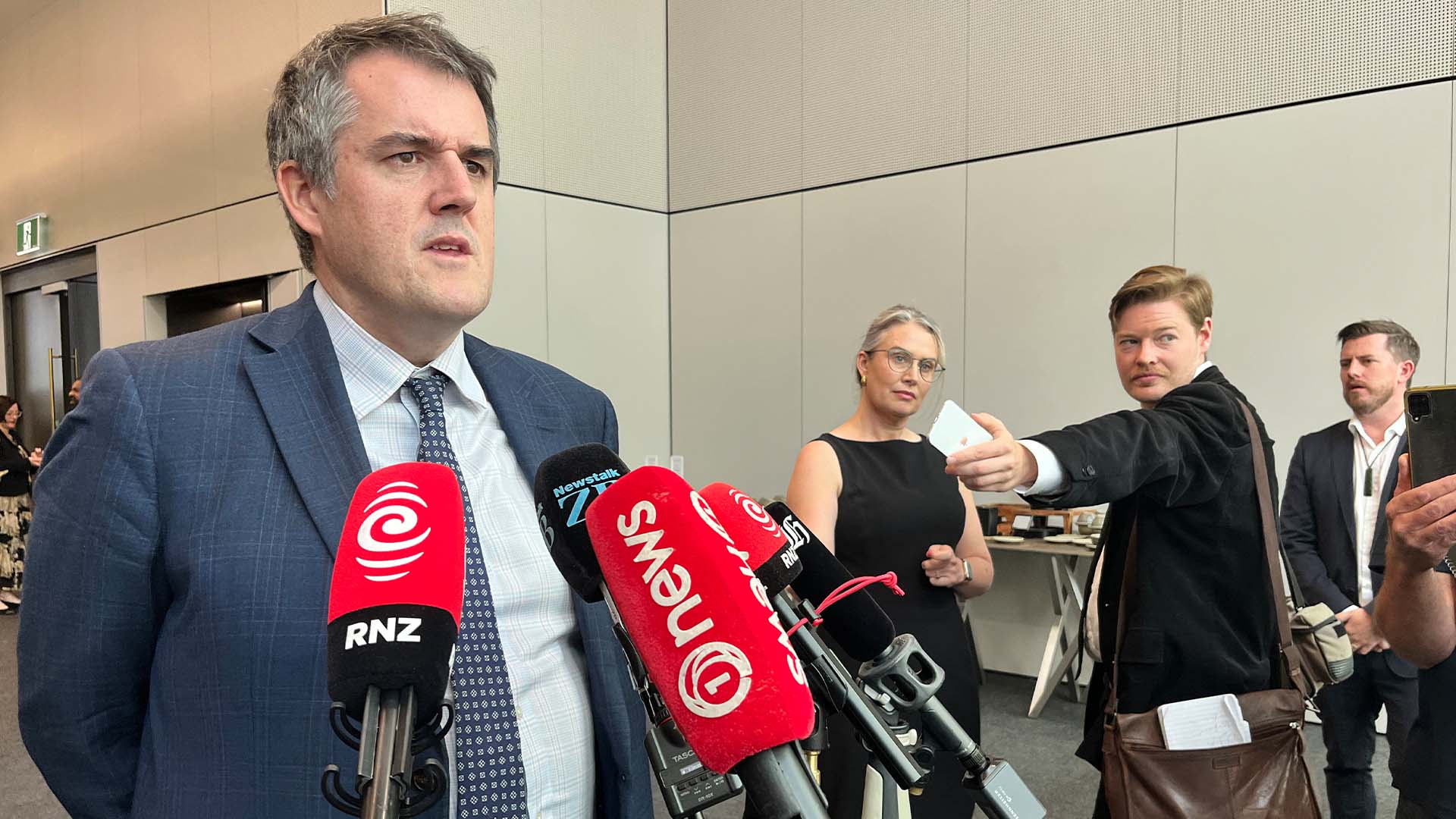
“I’m grateful to have an advocate of housing and urbanism in Mayor Wayne Brown who backs density like I do,” Bishop said.
“And that’s important because ultimately, PC120 is Auckland’s Plan – not the Government’s.”
Bishop said: “We set the guardrails, and – rightly – Auckland Council largely decides where and how growth occurs.”
He said some people will think this doesn’t go far enough to protect their suburbs while others will think there’s been a step back on housing affordability.
“But I’m sure we can all agree that Auckland could debate this question – and this number – for a lifetime and get no closer to a remotely agreed-on decision.”
Bishop said at some point, someone needs to make a call and move forward.
“It’s my strong view that if we can fix housing there is nothing, nothing that we can’t fix together as a country.”
'The worst of all worlds'
David Seymour, Deputy Prime Minister, ACT Party leader and MP for Epsom, has been vocal about the plan, saying it was flawed and making it clear he would be calling for changes.
In a statement, Seymour said it was good news the Government was making changes to PC120 by reducing housing capacity.
"Zoning is important for coordinating growth with infrastructure. No matter how much of a free marketeer you may be, there is not a competitive market for sewers, roads, or water pipes. They are natural monopolies, so it makes sense to coordinate around them," Seymour said.
"The previous plan pursued an arbitrary number rather than coordination, creating the worst of all worlds."
Seymour said: "There will be some who see this as limiting housing supply. A few points about that. If you are concerned about zoned capacity, it will increase by around 25% under the new target."
"But, there’s a more important point when it comes to housing supply. I talk regularly to people who are involved in developing homes. Zoned capacity is rarely their main concern. They are being held back by slow consents, expensive development cost charges, and slow and expensive connection to pipes and infrastructure."
He said the Government was addressing those things with its RMA reforms.
On Thursday's announcement, Seymour said the Government took a "big step to a better Auckland for home owners and home buyers alike".
'Politics ahead of solving the housing shortage'
Labour's Auckland spokesperson Carmel Sepuloni told reporters that she thought Bishop would be very disappointed.
"He's been pushed to do this by the likes of his leader, who clearly has undermined him as the Minister in charge of housing, but also David Seymour, perhaps Simeon [Brown] as well.
"I feel like there's a little bit of self-interest here with some of the MPs concerned with their own leafy suburbs and perhaps some of the feedback that they've been getting from their constituents."
Sepuloni said: “This is a huge blow for Auckland families who already are struggling to cope with the high cost of living, and are looking for affordable homes. Aucklanders deserve certainty on what the Government’s plan is to address the city’s housing shortage."
“Everyone can see what’s really going on here: David Seymour is pulling the strings to pull housing projects from the suburbs, Christopher Luxon is doing as he’s told, and Chris Bishop is caving."
Labour's housing spokesperson Kieran McAnulty said: “Unfortunately, National's U-turn puts politics ahead of solving the housing shortage and will mean hundreds of thousands fewer homes for families who desperately need them".
“The Auckland Council has acted in good faith based on clear direction from central government, only for National to change the rules halfway through the process. That kind of chaos creates uncertainty, delays investment, and puts infrastructure planning at risk.
“It just shows Luxon lacks the courage to do what’s needed to fix the housing shortage, and succumbed to political pressure instead of working in good faith to get more houses built."
'Cities are not museums. They need to house people'
Asked about her thoughts on the housing changes, Greens co-leader Chlöe Swarbrick said: "I would say it's embarrassing if it just wasn't harmful. We've been having this debate for longer than I have been in politics".
"Aucklanders and New Zeaalnders deserve far better. I find it profoundly ironic at a point in time where just this week we've seen the Infrastructure Commission release their report which speaks to the need for clear-eyed, evidence-based criteria for development in this country, that we now have a Government that's deciding to once again, capitulate to those who own at the expense of everyone else."
"Will Chris Bishop show a spine? Will he do the things that he says that he believes in? I think that if there is discontent within Cabinet about this decision then there really is a question for why all of us are involved in politics," Swarbrick said.
"Surely, it's addressing the housing crisis, the climate crisis, and it just seems as though this Government will stop at nothing when it comes to just trying put their fingers in the air, see which way the wind is blowing and grab the votes."
"We need density done well ... We don't need to be having this fight. We can have an evidence-based approach to ensure that we do density well, that we scale up around our transport hubs ... Cities are not museums. They need to house people," Swarbrick said.
She said the Greens would be campaigning on; "sensible evidence-based policies that house everybody in this country, that provide us with power, that bring down bills, and also improve the quality of life".
'There will need to be some changes'
Prime Minister Christopher Luxon has previously hinted at watering down PC120, telling reporters after his 2026 State of the Nation address: “We said very clearly before Christmas that we were monitoring the issue very closely … Clearly there’s been a huge amount of feedback. Clearly things are going to need to change in our response as well.”
“Ultimately, the feedback is saying things are going to need to change and there will need to be some changes.”
While Bishop has been a champion of the proposed plan, there’s speculation that National’s Auckland MPs have been feeling the heat, and former National Cabinet Minister Maurice Williamson warned that it could cost National party votes at the upcoming election.
And when it comes to the politics of housing - Bishop and Luxon have been out of sync when it comes to house prices.
Luxon previously told RNZ he wanted to see “modest” and “consistent” house price increases while Bishop said average house prices in New Zealand were too expensive.
“We’ve got to decouple the idea that the economy is linked to house price growth,” Bishop said.
Last year, there were murmurs of a leadership “coup” by Bishop. Asked about this by Newstalk ZB’s Mike Hosking in November, Luxon said he did not think it was the case and that Bishop was a good minister and a good friend.
And when asked if he would lead the party in the 2026 election, Luxon said “absolutely”. Bishop has denied a leadership challenge.
Additional reporting by Anna Whyte.
We welcome your comments below. If you are not already registered, please register to comment
Remember we welcome robust, respectful and insightful debate. We don't welcome abusive or defamatory comments and will de-register those repeatedly making such comments. Our current comment policy is here.