

ANZ economists have weighed into the debate over whether it's currently better for borrowers to fix their home loan or punt for a floating rate, suggesting there's merit in splitting a mortgage into three to four tranches through a mixture of fixed and floating rates, thus receiving both flexibility and certainty.
The ANZ team - chief economist Cameron Bagrie, senior interest rate strategist David Croy, interest rate strategist Carrick Lucas and economist Steve Edwards - are cautioning people against jumping into a fixed-term home loan, noting that eventual rate rises are likely to be gradual meaning borrowers have time on their side. They suggest that if you do crunch the numbers, you're likely to conclude the six month, one year and two year rates offer the best breakevens. See all advertised bank mortgage rates here.
In an article entitled Fixed vs Floating the ANZ team notes they've lost count of how many times "unnamed economists" have pulled out the same arguments highlighting the Official Cash Rate (OCR) is heading higher and the gap between fixed and floating rates is low, meaning fixed rates are cheap thus making fixed-term borrowing appealing.
"Three years on since the global financial crisis, it is worth bearing in mind that the floating rate has by far and away been the most attractive," Bagrie, Croy, Lucas and Edwards point out.
"This does not mean this will continue but we are drawn to the historical evidence that shows the average recovery time following a financial crisis has been seven years, which is later than the typical cyclical recoveries."
"An economic view that interest rates will eventually move up is insufficient reason to take the fixed lending option," the ANZ team says. "You need to look at the breakevens, crunch the numbers and see how things stack up."
In contrast Westpac chief economist Dominick Stephens recently suggested fixing was better value than floating. Among other things Stephens said it was "better to pay a little extra now, sleep easy, and be absolutely sure of beating the crowd." Also see Bernard Hickey's guide to fixed v floating where an array of economists give their views including BNZ's chief economist Tony Alexander, who suggested there was little reason for those wanting to fix to hold off.
Four factors to consider
The ANZ team cites four broad things to consider for borrowers considering fixing, staying floating or going for a combination of the two.
Firstly, is personal circumstances. Here they note you should consider how much certainty you need, whether you plan on selling your house, upsizing or making early repayments.
Secondly, cost. Here they say the decision to fix for most people is based solely on price, ie seeing the lowest mortgage rate as the best rate, whatever its term. Although this isn't necessarily a bad strategy, some number crunching can be beneficial. And although there has been much focus on the potential cost of not being fixed if rates rise, they point out that what if you decide to fix and then watch the economic outlook worsen?
Thirdly, is fees and discounts.
Bagrie, Croy, Lucas and Edwards note that fees can make a big difference. If moving to a fixed-term rate, borrowers should be aware of a lock fee of say NZ$250 representing 0.4% on a NZ$125,000 mortgage over six months, or 0.1% on a NZ$125,000 mortgage over two years. Such costs should be added to the fixed rate for the purpose of comparability and breakeven analysis.
"Breaking a fixed rate mortgage contract can also be an expensive proposition. Recall in 2008 and 2009 when the Reserve Bank cut its OCR from 8.25% to 2.5%. Those locked into double digit five-year fixed rates were forced to pay significant break fees in order to move onto much lower floating rates."
And fourthly, the benefits of swimming with the tide.
"Indeed, the more borrowing that is on floating, the more 'punch' monetary policy packs, and hence the less active the Reserve Bank needs to be," the ANZ team says.
Based on Reserve Bank figures, NZ$105.587 billion, or 61.6%, of home loans were on floating rates at the end of January. That's the highest level since the Reserve Bank bank began keeping records on fixed versus floating in June 1998. On top of this a further NZ$39.872 billion was fixed for less than a year, giving NZ$145.459 billion worth of mortgages, or 84.9%, either floating or fixed but up for renewal within 12 months. These figures are the culmination of a big switch by borrowers to floating mortgages in recent years with 87% of home loans by value on fixed-term rates as recently as January 2008.
Take a look across the ditch
The ANZ team notes it's worth looking at the experience in Australia over the past decade, where most borrowers have been on floating mortgages all along.
"Interest rates have been tweaked now and again, and what has happened has been two-fold. First, they've had to be tweaked less often and second, they haven't gone up as far."
Bagrie, Croy, Lucas and Edwards suggest ultimately there's no right answer between fixing and floating.
Although fixing provides cash flow certainty, it often comes at a cost, they note. For example, at the moment fixing for three to five years costs more than floating or fixing for between six months and two years. And fixing can also be expensive if you need to sell your house and break your mortgage. Whereas floating gives flexibility, is often cheaper, allows you to wait for a better fixed rate should one emerge, and gives the flexibility of making bigger lump sum repayments.
"In practice we think there is merit in splitting your mortgage into three to four tranches, and then choosing a mixture of fixed and floating that offers you a suitable mix of flexibility and certainty," the ANZ team suggests.
"Such a strategy also means you are likely to avoid getting exposed to 'rate shock', which is the risk that when your fixed term rolls off, interest rates have increased dramatically, although this sometimes works the other way."
They also point out that by choosing a combination of fixed and floating rates a borrower can smooth out their interest rate expense.
"This is important, because the reality is, over the long term, you won't be able to get your timing right in every decision."
Crunch the numbers on a breakeven analysis
They note that breakeven analysis is a useful tool for highlighhting the tradeoffs between different fixed-rate terms. By analysing where rates need to be in the future - the breakeven rate - and comparing them with expectations and forecasts, you are able to make a more informed decision.
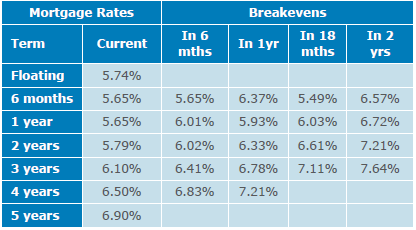
As an example, the ANZ team looks at someone considering fixing for three years because they're worried interest rates may rise. There are several options with the most obvious being fixing for three years. But you could also fix for one year and then fix for a further two years in one year's time.
"The question is: where does the new two year rate need to be in one year's time for the latter 'split' strategy to be the better one? This is the breakeven rate, and as in the table below the answer is 6.33%. That is, if you fix for one year today, so long as you can fix for two years in one year below 6.33%, then you'll be better off doing that than just fixing today for three years at 6.10%."
"The question then becomes 'with the two year rate now at 5.79%, do you expect that to move up beyond 6.33% in the next year?' It could, but it's a line call when we compare it to our forecast."
What about the economy?
When making your decision about fixing or floating, it's also important to consider the economy's prospects. On this front the ANZ team says the economic outlook continues to be dominated by the "complex interaction" of significant shocks.
"We are facing a deleveraging imperative, the need to balance the books (earn more and spend less), global wobbles, an income shock, and the consequences of a natural disaster. Given this combination it is only natural to see mixed economic signals."
They suggest the outlook is one of "grumpy growth" with a key assumption being that we are witnessing a structural change in behaviour. A period of deleveraging should continue to delay and temper any significant recovery in household spending and potential for housing to truly lead the economic recovery, the ANZ team says.
The Reserve Bank is forecasting the OCR to peak at 3.5%, up from its current 2.5%, in early 2015, with ANZ suggesting it'll go a bit higher, to 4%.
"Should the Reserve Bank interest rate track come to fruition, floating rates could rise from 5.7% to around 6.6% over the next three years with an average of 6.1%. Coincidentally that corresponds to the current three year rate of around 6.1%."
'Our Achilles' heel'
The ANZ team does acknowledge they're presenting "a hope all goes well scenario" heavily premised on voluntary structural deleveraging continuing. This depends on the housing market not getting up an "excessive" head of steam.
"There is also an involuntary scenario that involves the forced realignment of monetary conditions - a lower currency and higher interest rates - the endgame if New Zealand's borrow and spend habits have not been curbed."
For now, the ANZ team concludes it's reasonably, but not completely certain to conclude we are in a rising interest rate environment. That said, the Reserve Bank doesn't need to increase the OCR until much later this year and, with so many borrowers on floating rates, the central bank won't need to do much to have an impact.
"On its own, expecting interest rates to rise is a good reason to contemplate fixing. But it is not a good enough reason in itself to actually do so," ANZ says. "Instead it makes sense to crunch the numbers, whereupon you are likely to conclude that the six month, one year and two year rates offer the best breakevens."
We welcome your comments below. If you are not already registered, please register to comment
Remember we welcome robust, respectful and insightful debate. We don't welcome abusive or defamatory comments and will de-register those repeatedly making such comments. Our current comment policy is here.