
By Chris Trotter*
I don't blame Simon Bridges for quitting. Seeing the people who toppled him from National’s throne positioning themselves alongside the man now sitting on it didn’t leave much room for doubt. Time to go.
But if Bridges is now free to pursue new opportunities and spend more time with his young family, the National Party itself cannot feel so sanguine. Putting aside the fact that Bridges was one of the very few members of National’s front bench with senior cabinet experience, he was also the leader of the party’s conservative faction.
While Bridges held the Finance Spokesperson’s role, National’s conservatives could tell themselves they possessed a powerful friend at the court of King Christopher. It’s hard to engage in serious political planning without the money-spinner in attendance. The conservatives may have been down, but they weren’t out.
Well, they’re out now.
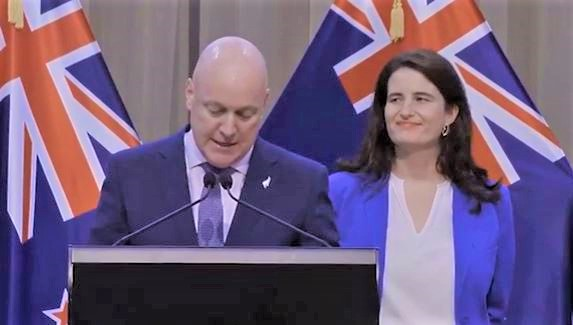
Clearly, Bridges had been coming out of National’s inner circle feeling less and less like a man who was being taken seriously. Yes, he was there at Luxon’s side, but the person whose ideas were really influencing National’s new leader was the same person who had steered John Key towards victory in the run-up to the 2008 General Election – Nicola Willis. Put that together with Luxon being Key’s protégé, and it’s not hard to see why Bridges might feel he’d become more Ludo token than chess piece.
And now Willis is both the Deputy-Leader of the National Party and its Finance Spokesperson. At No. 3 we find another fierce liberal, Chris Bishop. Notwithstanding his conservative Christian beliefs, Luxon should, henceforth, be seen as a liberal leader. National is coming for Auckland, and Auckland cannot be won by a scary social-conservative.
It’s the strategy Willis sold Key when she was his “Special Adviser” back in 2008, and it is the strategy she is selling Luxon now. It’s a good strategy. New Zealanders are not extremists. They actually like messing around with Mr In-Between.
Which just leaves the conservatives.
For a long time now, National’s biggest political problem has been the uneven speed at which New Zealand’s population has embraced the social changes of the past forty years. There are parts of New Zealand – the inner suburbs of Auckland and Wellington, for example – where social-liberalism is so deeply entrenched that an openly conservative candidate standing for either major party would have little chance of winning an electorate seat. In provincial and rural New Zealand, however, the “wokeism” of the latte-drinkers of Wellington and Auckland Central is despised.
It’s a circle which National is finding it increasingly difficult to square.
The scale of National’s problem is dramatically demonstrated by dividing the post-war period into roughly equal halves. The first half is distinguished by the enormous difficulties Labour experienced in winning elections. Between 1949, the year the First Labour Government fell, and 1984: a period of three-and-a-half decades; Labour held office for just six years.
The median New Zealand voter of that era tended to be materially comfortable and determinedly risk-averse. The country’s social values were conservative and not subject to serious challenge. Yes, there was a “Youth Revolt”, but it made little impression electorally. Older New Zealanders were unimpressed.
That first half was also the era of the Cold War. A time when even Labour’s “democratic socialists” struggled to shake off the suspicion that they were far too close to “communists” for the country’s comfort. (Is that why, after 1984, so many Labour MPs happily jettisoned democratic socialism for “Rogernomics”?)
Certainly, things changed radically for the National Party after 1984. Gone were the days when National could reasonably describe itself as “the natural party of government”. In the 38 years between 1984 and 2022, Labour has held office for twenty years, and the National Party for eighteen.
This roughly equal alternation is illustrative of just how dramatically New Zealand has been changed by the events of the latter half of the post-war period. The stolid, conservative New Zealand, with its widely shared values (and prejudices) has not disappeared entirely, but it is now too small – especially in the context of the MMP electoral system – to serve as the foundation of a successful mainstream party.
Following its disastrous 2002 defeat, National’s solution to this problem was to persuade its hardcore conservatives to hold their noses and stick with the only party capable of holding the line against the increasingly radical social policies of the Labour Party and the Greens. Critical to this task was the below-the-radar support of the conservative Christian churches and the Maxim Institute. They shepherded their flocks into National’s sale-yards: helpfully dissuading them from diluting the right-wing vote by wasting conservative support on parties unlikely to crest the 5 percent MMP threshold.
It is even possible that the quid-pro-quo for this unheralded support was a quiet undertaking to select conservative Christian candidates for safe National seats, thereby baking-in the Christian Right’s political agenda where it mattered most – National’s parliamentary caucus.
As solutions go, this one was obviously short-term. Too many conservative Christians in National’s caucus, especially Christians determined to give legislative effect to their beliefs, and the party would become unelectable. But not before it had torn itself to pieces internally.
Throw into this dangerous god-spell the global impact of Brexit and Trump – both made possible by the even more dangerous sorcery of the Internet and its social-media wizards. The resulting global surge towards right-wing populism called into serious question the despised centre’s ability to hold. For good measure, Mother Nature then conjured-up a global pandemic. Once that happened, it was just a matter of sitting back and waiting for things to fall apart – all over Parliament Grounds.
Last week a group of rural-provincial blokes – looking for all the world as if they’d just stepped off the set of Fear The Living Dead – took to social media with a heartfelt appeal for their fellow blokes to stand up and fight back (presumably electorally) against the horrors of “Jabcinda” and her tyrannical government. At the same time, the anarchist editor of The Daily Blog, Martyn Bradbury, venturing boldly into the wilder realms of speculation, was inviting his readers to ponder the consequences of a Winston Peters-Judith Collins-led NZ First. One can only imagine how Act would react to that!
Too few to win, too many to die: it is looking more and more as if the National Party’s conservative falcons can no longer hear the falconer.
Nicola Willis’s plan for containing National’s Christian conservatives worked like a charm for John Key in 2008, but can she and Christopher Luxon truly control the rough right-wing beasts that are already slouching towards the 2023 election to be born?
*Chris Trotter has been writing and commenting professionally about New Zealand politics for more than 30 years. He writes a weekly column for interest.co.nz. His work may also be found at http://bowalleyroad.blogspot.com.
We welcome your comments below. If you are not already registered, please register to comment
Remember we welcome robust, respectful and insightful debate. We don't welcome abusive or defamatory comments and will de-register those repeatedly making such comments. Our current comment policy is here.