
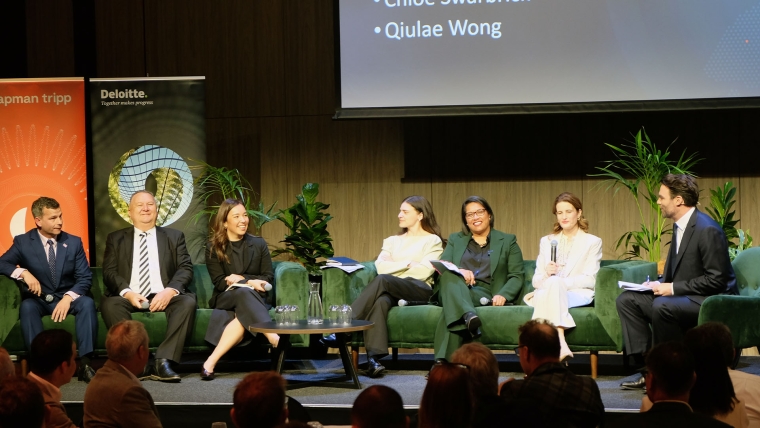
Leading up to the election, politicians have been hitting up the conference scene - taking part in panels, dropping policy hints and facing off over KiwiSaver and tax.
And Tuesday morning’s economy panel at BusinessNZ’s election conference was no different, with National finance spokesperson Nicola Willis telling the audience her party would wait until the pre-election fiscal update to make a specific announcement on the research and development tax incentive (RDTI).
The research and development (R&D) tax incentive is a tax credit, which incentivises businesses and individuals who take part in R&D activities. Currently, there is a 15% tax credit available for eligible R&D.
Speaking at Wellington’s Tākina convention centre, Willis said: “I’ve got a newsworthy thing to say which is when it comes to the tax system, I’ve been very impressed by the BusinessNZ manifesto, which clearly says the RDTI tax credit is a success.”
“It’s something businesses value. It’s getting them investing in more research, development, innovation and science. And so we will wait until after the pre-election fiscal update to make a specific announcement, but that’s the next cab off the rank for me.”
Pressed on this more by MC Ryan Bridge, Willis said she thought increasing the research tax credit made sense but would not say by how much.
Alongside Willis, the panellists included Labour finance spokesperson Barbara Edmonds, Green Party co-leader and finance spokesperson Chlöe Swarbrick, Opportunity Party leader Qiulae Wong, New Zealand First deputy leader Shane Jones and ACT Party leader David Seymour. Te Pāti Māori was not represented at the panel.
Bracket creep
Asked if anyone was going to address bracket creep (this is when inflation bumps up nominal wages which leads to people being placed into higher income tax brackets even though they haven’t had an increase in purchasing power), Willis swiftly put her hand up.
She said if elected back into government, National’s position was that if it can keep to its 'Budget Responsibility Rules', “then priority should always be adjusting tax settings so that working people on average wages aren’t being slapped with bigger and larger effective taxes every year.”
“After the post-election update, we will have more to say.”
But Jones told the audience every dollar that we restore back into the economy is a choice.
“Do we use bracket creep? Do we use other ways of using the tax system? And look, be very careful, given the challenges that we’ve already got as to how much revenue you take out of the revenue line, if in actual fact, you can’t deliver the reductions,” he said.
Seymour said the priority was to get on top of debt and when you moved brackets, you erode the base and don’t face up to the real problem.
“We have an extremely progressive income tax system, we’re paying almost four times the rate at the top that you are at the bottom, and you don’t delve into those higher rates just because of inflation.”
If we wanted to solve this problem, we could move the bracket slightly or “start using any extra revenue we have to flatten the rates, which would be far preferable for simplicity, for incentives,” Seymour said.
Willis said there were other ways of adjusting tax settings besides shifting the current brackets such as looking at rates and looking at which thresholds can be moved
“Because you should always be trying to reduce the effective marginal tax rate, so that working people on average wages, working full time, aren't facing punitive tax levels when they get a promotion,” she said.
Labour says employees need flexibility 'to contribute as they can'
Asked by a member of the audience about total remuneration, Willis said she has previously stated there would need to be a move away from total remuneration, but the details of that transition needed to be carefully consulted on.
Total remuneration packages are when employers place their KiwiSaver contribution as part of a person’s salary. This means that employer and employee contributions are coming out of an employee's salary.
“I agree that total remuneration does not make sense once you have universal KiwiSaver,” she said, and people would still be able to stop contributions for hardship reasons.
Asked by a person on the floor about Labour’s “aversion to compulsion”, Edmonds said her party wanted to make contributions compulsory for the employer while providing flexibility to employees by not making contributions compulsory for them.
“I know what it’s like to be on less than $40,000, to have a family and want a home. The priority was to get security of tenure as opposed to saving for my retirement because ultimately, I knew security of tenure would give me an asset which I could dispose of at a later date to help towards retirement.”
Edmonds said she got into KiwiSaver when the financial circumstances were right for her family.
“Ultimately most people who opt out of KiwiSaver now are those that earn less than $40,000 and that's just the realism of it, is that if you can't afford it, you won't be in the system."
“So both major parties have that element of compulsion. But what we're saying for the employee is that life happens ... We're saying that you need the flexibility to contribute as you can,” Edmonds said.
‘If you keep your head in the sand, you’re liable to get your butt kicked’
It’s no secret that National and ACT both want to raise the age of superannuation to 67 while NZ First, Labour and the Greens do not want it to change.
Asked the age-old question of whether they wanted to raise the age of superannuation entitlement, Willis said: “My view is that, responsibly in the past when National has campaigned on this issue of raising the age, that has been the right thing to do.”
“Unfortunately, it has led to serious scare campaigns. So the opportunity for the country is to come up with something that is enduring and sustainable,” Willis said, saying the question on raising the age of super was around the timing, the transition and how to prepare people for it in a way that endures.
Edmonds said Labour had no intention to change the age and to shift the age of eligibility, there needed to be a strong mandate from the public.
“And if you've ever been in a community meeting, you will see the polarisation of views between those that don't want it changed and then younger people saying, ‘actually, what's going to be in it for me when I turn 65’ so it's not just around superannuation.
“It's not just about KiwiSaver. It's around housing, the decumulation that we need to do for KiwiSaver now that we're starting to get some lump sum savings in there. Also, what do we do around retirement villages and the aged care sector, etcetera."
“You need to look at it as a retirement scheme, and I'm willing to have those conversations with other parties. But there needs to be a strong [public] mandate if you want to change it,” Edmonds said.
Wong said Opportunity was fully supportive of moving towards compulsory KiwiSaver and once that was in place, then we could take a look at what we do about superannuation.
“Public mandate on this is really important because there's no clear answer. It's not black and white. There's no easy solution. Whether we raise the age or means test, there are trade-offs," said Wong.
“So something like a citizens' assembly to get the public engaged on this topic and get some mandates so that we don't see a flip-flopping on this policy when we have governments coming and going is going to be really, really important.”
Swarbrick said this conversation needed to be had with a broader ecosystem of what it was that New Zealand wanted to achieve with its economy.
Jones said: “Under no circumstances whatsoever will any government that we’re privileged to serve in, be ever getting our support to change the age of eligibility, or indeed any significant elements of criteria pertaining to Super regulation.”
Seymour said: "I guess the problem is, you keep your head in the sand, you're liable to get your butt kicked. And it won’t actually be us, it will be the New Zealand taxpayer.”
The numbers were inescapable, he said.
"People live longer but we also have fewer children, and so the ratio of taxpayers who remain to support Super changes. And the only change that logically fixes that is to raise the age of entitlement in a gradual and predictable and well suitable way," Seymour said.
“I cannot ignore that the future of our country requires us to be leaders and to make this change in a gradual, signalled way.”
We welcome your comments below. If you are not already registered, please register to comment
Remember we welcome robust, respectful and insightful debate. We don't welcome abusive or defamatory comments and will de-register those repeatedly making such comments. Our current comment policy is here.