
The Reserve Bank (RBNZ) says banks can’t use higher bond yields globally and domestically as an excuse to not lower lending rates.
Speaking to media after releasing the RBNZ’s quarterly Monetary Policy Statement on Wednesday, Governor Adrian Orr recognised improved growth and inflation outlooks around the world were contributing to rising yields.
The worry is that if banks’ funding costs go up, they’ll pass that cost onto their customers by charging them higher lending rates.
Yet with the RBNZ making up to $28 billion of cheap funding available to banks through its Funding for Lending Programme (FLP), Orr said: “They can’t just point to the rising wholesale interest rate to explain why they are not passing through the rates.”
Since the onset of COVID-19, the RBNZ has thrown a lot at lowering interest rates to try to boost inflation and employment. It has cut the Official Cash Rate to 0.25%, committed to buying up to $100 billion of mostly New Zealand Government Bonds on the secondary market via its Large-Scale Asset Purchase Programme (LSAP), and offered to lend banks newly created money at the OCR through its FLP.
A difficult balance
Assistant Governor Christian Hawkesby said the RBNZ couldn’t “completely stand in the way” of the factors driving up long-term interest rates.
He and Orr recognised the optimism underpinning rising bond yields was a good thing.
The RBNZ revised up its CPI inflation and Gross Domestic Product forecasts fairly substantively since its last Monetary Policy Statement in November.
Yet Orr said if monetary conditions tightened “unnecessarily”, the RBNZ would act.
“What we’ve talked about very openly there is we expect more pass-through from the banks because of our Funding for Lending Programme,” Orr said.
“And of course, as I mentioned before, the Official Cash Rate can go lower.”
Orr also noted banks are no longer as reliant on wholesale funding from offshore. Unlike before the 2008 Global Financial Crisis, a higher portion of their funding now comes from customers’ deposits.
“We have a lot more optionality to achieve, or sustain, the conditions necessary to meet our remit,” Orr said.
Banks lower deposit rates more than lending rates
Since the RBNZ started aggressively loosening monetary policy last year, banks have lowered term deposit rates more than they’ve lowered mortgage rates.
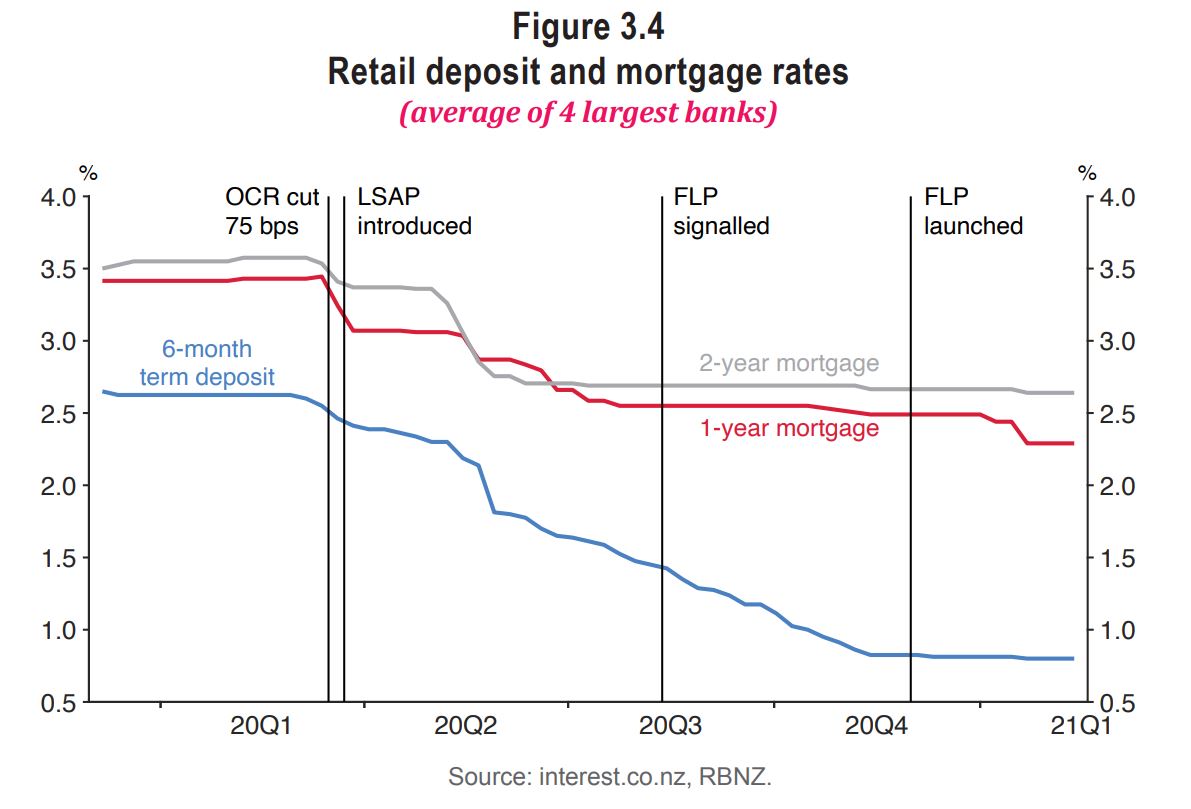
The RBNZ explained in its Monetary Policy Statement: “Mortgage rates fell immediately following the reduction of the OCR to 0.25 percent, and have continued to drift lower in response to further monetary easing. Lending rates to businesses have also declined.
“Deposit rates fell steadily throughout the second half of 2020.
“Declines in deposit rates partly reflect the anticipation of the FLP, consistent with international evidence that monetary policy has significant ‘announcement effects’. That is, market participants react to the prospective implementation of a policy before it is operational.
“More recently, there have been small declines in mortgage rates. Declines have been most prevalent in the 1-year mortgage rate, for which competition between banks appears to be strongest.
“Strength in the housing market led to record volumes in new mortgage commitments in late 2020, which may have dampened competitive pressure for further reductions in lending rates.”
“With highly accommodative financial conditions expected to remain for some time, we expect banks will pass through lower funding costs to lending rates over time.”
Hawkesby told media he wasn’t surprised uptake of the FLP had been “modest” to date, at $1.14 billion.
Orr added: “The mere fact it’s in the room, changes behaviours. And that’s what we will be watching.”
Asked whether he was satisfied banks were passing lower costs on to businesses - not just property buyers - Orr said there was more banks could do.
Yet he reiterated what the RBNZ has said in the past - that it can’t control who banks lend to. In other words, whether they choose to lend more to property buyers than to businesses.
Orr also noted the RBNZ can’t make businesses want to borrow.
A matter of bedding in inflation
Orr said the RBNZ didn’t provide more explicit forward guidance in the Monetary Policy Statement, as its counterparts overseas have, around future OCR movements.
He said the RBNZ couldn’t pinpoint a date when it believed “confidence will magically arise”.
He stressed the RBNZ’s view that it would take time to attain and sustain this confidence.
*This article was first published in our email for paying subscribers. See here for more details and how to subscribe.
We welcome your comments below. If you are not already registered, please register to comment
Remember we welcome robust, respectful and insightful debate. We don't welcome abusive or defamatory comments and will de-register those repeatedly making such comments. Our current comment policy is here.