

The Reserve Bank is proposing to introduce debt-to-income (DTI) ratio restrictions on banks' home lending, and loosen loan-to-value ratio (LVR) restrictions on their low equity mortgage lending.
DTI restrictions limit the amount of debt borrowers can take on relative to their income.
In a new consultation paper the Reserve Bank says it's proposing initially setting the DTI policy to allow banks to lend:
- 20% of their residential loans to owner-occupiers with a DTI greater than six; and
- 20% of their residential loans to investors with a DTI greater than seven.
It's proposing easing the LVR settings at the same time as activating DTIs allowing:
- 20% of owner-occupier lending to borrowers with an LVR greater than 80%; and
- 5% of investor lending to borrowers with an LVR greater than 70%.
Current LVR limits set a 'speed limit' on how much new low-deposit lending banks can do. At the moment the Reserve Bank policy classifies investor loans as high-LVR if they are more than 65% of the property’s value, and restricts high-LVR lending to no more than 5% of a bank’s total new investor lending. Owner occupier loans are deemed high-LVR if they are more than 80% of the property’s value, with banks' high-LVR lending restricted to no more than 15% of a bank’s total new owner occupier lending.
DTI proposals 'would not bind currently'
The Reserve Bank says in October last year lending above its proposed DTI thresholds was 10% for owner-occupiers and 8% for investors. It says its proposed 20% speed limit "would not bind currently but would constrain lending in a scenario similar to the 2021 house price boom."
This, the Reserve Bank says, reflects its "approach of calibrating DTI restrictions, so they act as guardrails – in which they are binding during booms but minimally binding during other times."
"We also considered a single threshold for all borrowers (i.e., one setting for owner-occupiers and investors) which would be simpler. However, we were not comfortable this sufficiently addressed the differences in borrower types such as that investors tend to borrow at higher DTI ratios than owner-occupiers. This means that a single threshold that would be binding during a house price boom for investors may not be binding at any time for owner-occupiers, while imposing higher efficiency costs on investors. Therefore, we considered this option did not meet our policy goal of applying DTI restrictions to all borrowers," the Reserve Bank says.
Subject to feedback to its consultation, the Reserve Bank says it will activate DTI restrictions in mid-2024. However, as noted above they'd likely not restrict lending initially.
"Activating DTI restrictions at this time, rather than waiting until we see a build-up in risky lending, means that they are more likely to be in place when they are needed given that it takes time to activate the DTI restrictions. We expect, following activation, DTI restrictions to be binding when financial stability risks are elevated, but minimally binding at other times."
"By activating the DTI restriction, we aim to improve financial stability by a. reducing the probability of a systemic wave of mortgage defaults (or financial stress) and, b. reducing housing market cyclicality, while also minimising the efficiency costs of restraining lending to otherwise creditworthy borrowers," the Reserve Bank says.
"Estimating the exact impact of DTI restrictions on house prices is difficult, particularly given that DTI restrictions have not yet been used in New Zealand. Our previous experience with LVR restrictions shows that they have a relatively small impact on house price growth. As such, we expect that the proposed loosening of LVR restrictions will only impact house prices at the margin."
The Reserve Bank goes on to say it doesn't expect its proposed DTI restrictions to have a significant impact on house prices in the short-term, given the calibration wouldn't be binding given current market conditions and flows of high-DTI lending are low and expected to remain below the proposed speed limit in the near term.
"Our view is that DTI restrictions can help to support sustainable house prices at the margins in the medium- to long-term by preventing house prices reaching unsustainably high levels in booms."
The Reserve Bank's current assessment is house prices "are within the range we estimate to be sustainable, with a lower risk of a house price correction than in recent years."
Risks of boom & bust credit cycles 'significant'
In a statement Reserve Bank Deputy Governor Christian Hawkesby says the financial stability risks of boom and bust credit cycles are significant, so it’s important to have appropriate policies in place to manage them.
"DTI restrictions, which set limits on the amount of debt borrowers can take on relative to their income, will complement other tools we use to support financial stability, including LVR restrictions on residential mortgage lending," Hawkesby says.
"While the LVR tool is aimed at improving the resilience of the financial system by reducing potential losses when households default on their mortgage, the DTI tool is aimed at reducing the probability of a systemic wave of households defaulting. We believe introducing DTI restrictions will reduce financial stability risks, support house price sustainability, and fill a gap that is not covered by existing policies."
"Introducing DTI restrictions will also allow us to loosen LVR settings without increasing risks to financial stability. Working together, these tools enable us to more efficiently target financial stability risks," says Hawkesby.
DTI of five previously viewed as 'pretty high'
The Reserve Bank says its modelling suggests when interest rates are high financial stress begins to be felt at DTI ratios of six and seven. That's higher than in 2017 when the then-Reserve Bank Deputy Governor Grant Spencer said a DTI ratio above five was "pretty high."
"We think if we get up over five that's pretty high. And it tends to be the area where potential stresses are going to emerge if there's a shock to interest rates or incomes," Spencer said in 2017.
However, in 2021 the Reserve Bank said a continued decline in interest rates meant almost 60% of new lending was taking place at a DTI above five, with about a third at DTIs above six.
"We do not consider it appropriate to calibrate DTI restrictions in a way that would capture a very large share of lending at current levels. This could create a shock for the housing market and the potential for unintended adverse outcomes, e.g. disintermediation," the Reserve Bank said in 2021.
Potential of banks losing business to non-bank lenders played down
Meanwhile, the Reserve Bank says it's aware the more macro-prudential restrictions, such as DTIs and LVRs that are placed on banks, the greater the chance of disintermediation - or loss of customers - to non-bank lenders.
"However, the risk is reduced by the easing of LVR restrictions and the non-binding level of the proposed DTI calibration. Therefore, large scale disintermediation is unlikely during most of the credit cycle but may be more likely at the peak of the credit cycle when DTI restrictions become more binding."
"Non-bank lenders are currently a very small share of the residential mortgage lending market. We do not foresee DTI restrictions causing disintermediation of the scale necessary to be a concern. However, we will monitor this and can move to address disintermediation if it occurs. Additionally, we will consider how macroprudential policy operate across all types of deposit takers as part of the upcoming DTA standards consultation," the Reserve Bank says.
A long time coming
The Reserve Bank has wanted to have the option of using a DTI tool since at least 2016 but struggled to secure government support from firstly the National-led government and then the Labour government due to concerns about the potential impact on first home buyers. It finally gained support from the then-Finance Minister Grant Robertson in June 2021.
Introduction of the tool has also been opposed by banks, with bank lobby group the New Zealand Banking Association maintaining "there's a real risk of adverse customer impact" if the Reserve Bank introduces a DTI tool.
In a consultation paper in November 2021, the Reserve Bank assessed the impacts of introducing a DTI cap for borrowers of six or seven times gross income and a test interest rate floor for bank lenders of 7% or 8%, but stressed these were merely illustrative models. It also talked down the potential impact of DTIs on first home buyers.
In its new consultation paper, the Reserve Bank says currently about 10% of first-home buyer lending is above a DTI of six. This is similar for owner-occupiers, without investment collateral, which will be included in the owner-occupier group along with first-home buyers for the purposes of the DTI restriction.
"Therefore, the proposed DTI calibration for owner-occupiers would not be binding given current conditions in January 2024," the Reserve Bank says.
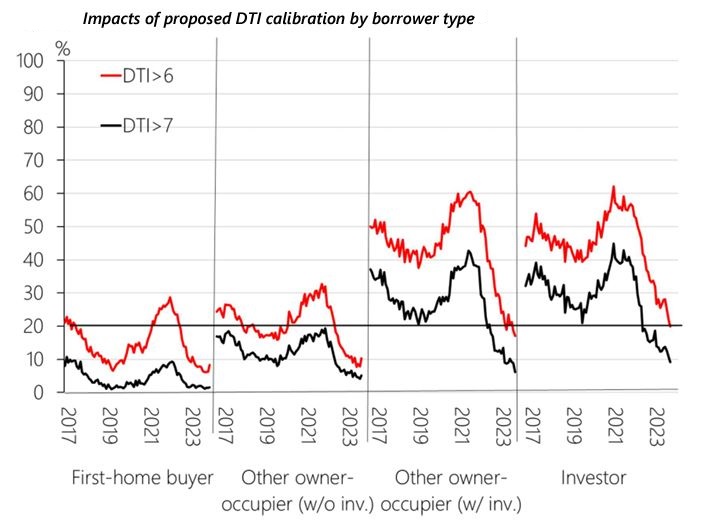
*The chart above comes from the Reserve Bank.
International comparison; Reserve Bank proposals not 'unnecessarily restrictive relative to international benchmarks'
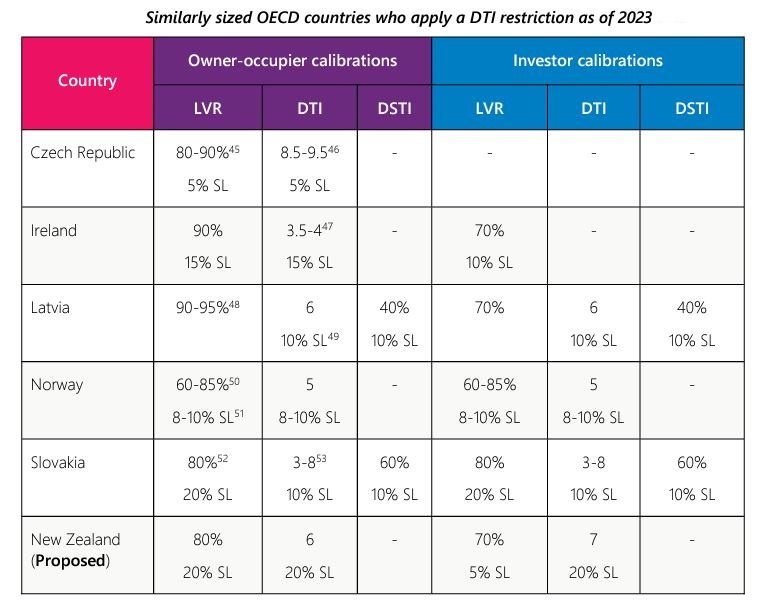
The Reserve Bank's consultation paper also includes an international comparison, via the table below. It says this suggests its proposals aren't "unnecessarily restrictive relative to international benchmarks."
The regulator highlights "numerous factors" contributing to the differences in DTI restrictions across different countries. These include differences in how central banks define debt and income. For example the Reserve Bank says Ireland uses a loan-to-income (LTI) tool that only accounts for a single mortgage loan and excludes other types of debt. The Reserve Bank uses a household’s total debt in NZ.
"Our existing LVR policies are slightly different to some comparator countries. Therefore, given the interactions between DTI and LVR restrictions, it is reasonable to design the DTI restriction slightly differently than in other jurisdictions, the Reserve Bank says.
"New Zealand’s housing market is different to many comparator countries. Borrowers will traditionally borrow at higher DTI ratios than comparable jurisdictions, suggesting that a looser calibration relative to other countries would be consistent with a strategy of only being binding in house price booms," the Reserve Bank says.
"In addition, the role of investors in New Zealand is different than in many other countries – with fewer institutional investors and more small scale household investors."
The Reserve Bank notes the table below focuses on countries with a DTI tool, but says a Debt-Servicing-to-Income (DSTI) restriction is more common internationally than the DTI.
Although DSTI restrictions operate in a similar way to DTI restrictions, a DSTI is a limit on how much debt a borrower can take on beyond a given share of their income that can be used to service debts and not a ratio of indebtedness to income like DTI restrictions.
"For example, a DSTI of 40% would mean a maximum of 40% of a borrower’s qualifying income can be used to service qualifying debt. In November 2021, the Reserve Bank consulted on the potential implementation of different debt serviceability restrictions, including a DSTI tool. We considered the DSTI to be too complex to implement and administer in New Zealand’s context."
It notes Australia doesn't have a DTI restriction but banks there must use a test interest rate tool when testing borrower affordability.
"Again, we considered the viability of a similar test interest rate tool in the November 2021 consultation, and we deemed the DTI tool to better support our financial stability objectives while also minimising efficiency costs," the Reserve Bank says.
NZ banks set the interest rates they use to test borrowers' ability to repay their loans themselves.
Decisions due in late June
The Reserve Bank is consulting on the proposed settings for DTIs, as well as proposed easing of LVRs. Consultation will close on March 12. Hawkesby says the Reserve Bank will then consider feedback and "decide on the activation and initial settings of the DTI tool." It expects to communicate decisions by the end of June.
If it decides to activate DTI restrictions, the Reserve Bank says it'll seek feedback from banks on changes to their conditions of banking registration before activating the policy.
"We intend to review DTI and LVR restrictions settings after 12 months if we activate DTI restrictions. Beyond that, we intend to review macroprudential settings every 12 months, although we will review them more frequently if circumstances warrant it," the Reserve Bank says.
It has previously given banks 12 months to prepare their systems for the possible activation of DTI restrictions.
We welcome your comments below. If you are not already registered, please register to comment
Remember we welcome robust, respectful and insightful debate. We don't welcome abusive or defamatory comments and will de-register those repeatedly making such comments. Our current comment policy is here.