

By Gareth Vaughan
The Reserve Bank (RBNZ) proposals to significantly increase bank capital requirements are sensible given New Zealand's unique market structure, say banking analysts from Deutsche Bank.
In a report on the RBNZ proposals, Deutsche's Australian-based analysts Matthew Wilson and Anthony Hoo note the NZ banking system is highly concentrated with four foreign (Australian) owned banks controlling 88% of system assets.
"This unique market structure, we are yet to find another one, generates oligopoly-like returns. The four banks print an average return on equity of 15% and remit 65%, or NZ$3.25 billion, of earnings back to the parents as dividends," Wilson and Hoo say.
They go on to say each time the big Australasian banks - ANZ, ASB's parent Commonwealth Bank of Australia, BNZ's parent National Australia Bank and Westpac - confront an external threat to the industry structure they use alarm as a point of negotiation.
"E.g. may cause funding problems, may lead to credit rationing and may de-stabilise the economy. We heard this in the lead-up to the Murray Inquiry, in response to its key final 'unquestionably strong' [capital] recommendation and in the lead-up to, and during, the more recent Hayne Royal Commission. The same tactic is being used in response to the RBNZ call," say Wilson and Hoo.
They estimate the RBNZ proposals would cut the big banks' return on equity by about 300 basis points. To hold return on equity steady Wilson and Hoo suggest the banks would need to increase their margins by 50 basis points, but note "you can only charge what a market is willing to bear."
Thus in response the Deutsche analysts suggest the big four banking groups will transfer what excess common equity tier one capital they have in Australia to NZ. Additionally they will "more sharply manage" the shape and size of their NZ balance sheets, consider a partial NZ share market listing of the NZ subsidiaries, and cut their "unsustainably high" dividend payout ratios.
"Whilst a partial listing would likely be welcomed by NZ investors and the broader NZ economy, it creates some capital/tax inefficiencies for the parent and thus may not be the most preferred outcome," Wilson and Hoo say.
The Deutsche analysts also note changes by the Australian Prudential Regulation Authority (APRA) to its related parties framework, prudential standard APS222. This restricts exposures between the big Aussie banks and their related entities. Currently the standard sets the restriction at an aggregate exposure limit into each subsidiary, whether debt or equity, of 50% of the Australian parent's level 1 tier 1 capital. However, in July last year APRA released a discussion paper proposing to lower the requirement to 25% of the Aussie parent's level 1 tier 1 capital.
Wilson and Hoo point out this increases the sensitivity of related-party investments.
"We expect the major banks to actively consult with APRA on this proposal...at level 1, the New Zealand major banks are deconsolidated and the capital investments into these subsidiaries risk weighted at 400%. This is particularly relevant when dividends are upstreamed and then reinjected as equity capital in the subsidiary."
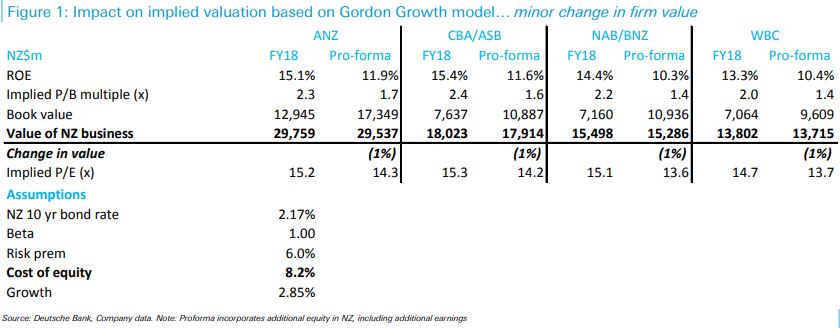
By Wilson and Hoo's estimate the increased capital requirements would reduce the big four NZ banks' valuations by just 1% (see table below). Given the entire value of share market listed NZ equities is NZ$130 billion, the Deutsche analysts suggest only a partial listing of the big four banks would be digestible. A partial NZ listing of certain banks might be a "sensible and well received outcome," they say, adding weight and certainty to the NZ equity market plus creating a vested interest in a bank's customer base.
NZ banks must currently meet a minimum total capital ratio of 10.5% of their risk weighted assets. The RBNZ is proposing to increase this to 18% for banks identified as ‘systemically important’, ANZ, ASB, BNZ and Westpac, and 17% for all other banks. Within this proposed increase from 10.5% to 18%, it's proposing to increase the minimum capital requirement for tier 1 capital from 8.5% to 16% for systemically important banks and 15% for all other banks. The RBNZ additionally has a minimum capital requirement of 2% for tier 2 capital. However, the RBNZ is questioning whether this lower quality Tier 2 capital is needed.
Also see interest.co.nz's three part series on bank capital here, here, and here, plus our video interview with RBNZ Governor Adrian Orr on bank capital here, The deadline for submissions on the RBNZ proposals is Friday, May 3. The RBNZ then expects to publish final decisions in the third quarter of 2019.
*This article was first published in our email for paying subscribers early on Tuesday morning. See here for more details and how to subscribe.
We welcome your comments below. If you are not already registered, please register to comment
Remember we welcome robust, respectful and insightful debate. We don't welcome abusive or defamatory comments and will de-register those repeatedly making such comments. Our current comment policy is here.