

Talk of a stronger-than-expected economic recovery prompting the Reserve Bank (RBNZ) to hike interest rates as early as next year has been making headlines.
But the thing financial markets will be looking for when the RBNZ releases its quarterly Monetary Policy Statement (MPS) on February 24, is signalling around the pace at which the central bank will keep buying government debt from banks and other investors via its quantitative easing or Large-Scale Asset Purchase (LSAP) programme.
The RBNZ in August 2020 said it would effectively create money to buy up to $100 billion of mostly New Zealand Government Bonds on the secondary market by June 2022.
This $100 billion is a cap, not a target. It agreed to buy no more than 60% of the New Zealand Government Bonds on issue to avoid becoming a disproportionality large player in the market. To date, the RBNZ has bought $44.6 billion of New Zealand Government Bonds.
The point of purchasing these bonds is to lower interest rates in order to help the RBNZ boost inflation and employment in line with its mandate.
A positive side-effect of making these purchases is that it supports smooth market functioning at a time the Government is issuing a whole lot more debt than usual.
However, because the economy is performing better than expected, Treasury hasn’t been issuing as much debt as both it and the RBNZ initially expected.
Having said it would largely front-load its response, the RBNZ has also been slowing the rate at which it’s buying bonds:
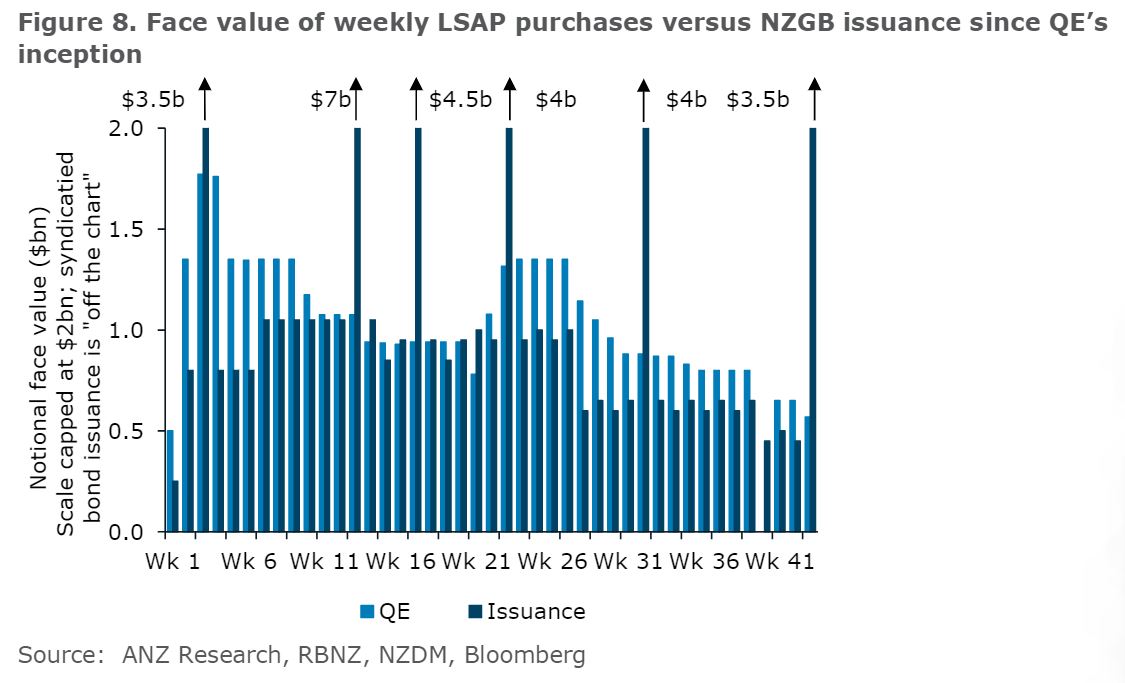
ANZ senior strategist David Croy would like it to clearly communicate at the next MPS the pace at which it’s going to continue buying bonds at.
He notes the RBNZ hasn’t been clear whether it has slowed the pace because Treasury has been issuing fewer bonds, or because it believes it doesn’t need to provide as much stimulus.
Croy would like the focus to shift from the size of the LSAP to the pace of purchases. Why? Certainty.
Croy, as well as ANZ chief economist Sharon Zollner and ANZ senior economist Liz Kendall, maintain the RBNZ will extend the LSAP by six months until the end of 2022, essentially enabling the RBNZ to continue buying bonds at a slower pace, but over a longer period of time.
“Eventually, the RBNZ will look to reduce the amount of overall asset holdings by letting bonds mature and not fully (or partially) reinvesting the proceeds. This is likely to be a very gradual process,” they say.
Croy, Zollner and Kendall say the RBNZ could theoretically start hiking the Official Cash Rate (OCR) during any phase of the LSAP tapering, but will most likely wait until it stops buying bonds.
They characterise LSAP tapering as the “first cab off the rank” in terms of a return to “normality”.
They believe the OCR might start being gradually lifted in mid-2023.
The Funding for Lending Programme (FLP), which has seen the RBNZ make up to $28 billion of funding available to banks to borrow at the OCR (which is currently 0.25%), will keep ticking along.
Once again, the aim of this is to enable banks to lower interest rates. $1.14 billion has been drawn down via this programme to date.
“We expect the RBNZ will let the FLP reach its planned end from the middle of 2022. This will provide a liquidity backstop but is expected to largely operate in the background and then naturally come to an end, rather than being a key moving part in the tapering process,” Croy, Zollner and Kendall say.
But before embarking on “normalisation”, they expect the RBNZ will want to see employment, inflation and inflation expectations at, or close to, target.
“The lesson from recent history seems to be this: don’t hike too soon or your half-baked cake will collapse in on itself and you’ll have to start again,” they say.
“While formulated for slightly different reasons (ie primarily the balance of risks around impacts of the pandemic), that thinking is at the nub of the RBNZ’s “least regrets” policy. Better to run the oven hot and burn the edges of the cake slightly, the thinking goes; it’ll still be edible.”
The trio concludes: “A faster-than-expected return to inflation and employment targets would of course be welcome, but would bring its own headaches, particularly for the bond market.
“It’s a lot easier to get into unconventional monetary policy than out of it.”

We welcome your comments below. If you are not already registered, please register to comment
Remember we welcome robust, respectful and insightful debate. We don't welcome abusive or defamatory comments and will de-register those repeatedly making such comments. Our current comment policy is here.