

The Reserve Bank (RBNZ) is conceding that the current inflation pressures could have been lessened if it had tightened monetary policy earlier last year.
This is one of the findings in an extensive five-year review - a 'report card' of the RBNZ's monetary policy that was released by the RBNZ on Thursday. The report has identified nine technical areas for improvement.
The RBNZ says the review has found that the easing in monetary policy during the Covid-19 pandemic was "warranted and worst-case economic scenarios were avoided".
However, it says while monetary policy decisions have been consistent with the economic data available at the time, "with the benefit of hindsight, it appears that monetary policy should have been tightened earlier in 2021".
"For example, the [RBNZ Monetary Policy] Committee could have supported an earlier tightening in monetary conditions by explicitly endorsing a lower volume of weekly asset purchases, reducing the overall size of the LSAP [large scale asset purchase] programme, and/or stopping the programme earlier.
"Likewise, in hindsight, the Committee could have raised the OCR [Official Cash Rate] earlier.
"Importantly, however, beginning the monetary policy tightening earlier in 2021 would not have fully offset the strong inflationary impulse stemming from a series of supply shocks, including Russia’s invasion of Ukraine."
The National Party's finance spokesperson Nicola Willis was scathing in her assessment of what she described as "the Reserve Bank's marking of its own homework".
"The report, written by the Bank’s own staff, hints at mistakes that have worsened price increases and the cost of living crisis, but fails to say whether those mistakes were avoidable and if so who should be held accountable for them?
"Those mistakes include over-doing the scale of money-printing, not lifting interest rates earlier and designing the Funding for Lending Programme so badly that commercial banks are still receiving ultra-cheap money when that no longer makes any economic sense." Willis's full statement is attached below.
The review said that during the first half of 2021, the MPC considered that inflationary pressures emerging from international sources "were likely to be transitory".
"For much of 2021, central banks globally struggled to determine whether global inflationary pressures were likely to be transitory or more persistent. This assessment was complicated by repeated pandemic-related shocks and the repercussions of the war in Ukraine in 2022.
"Like the Reserve Bank, none of the other main forecasters in New Zealand foresaw the strong inflation increases that have occurred since early 2022.
"As early as May 2021, the Committee began reporting on the risk of relative price changes leading to persistent inflation. This was earlier than most other agencies that made similar assessments.
"However, the Committee only stopped assuming inflationary pressures would be temporary in November 2021, and explicitly stated that price pressures were expected to persist in February 2022."
The RBNZ also says the funding for lending (FLP) programme giving banks access to billions of dollars of cheap funding, which was introduced in late 2020 could have been done with more flexibility.
"Recognising the importance of being credible and consistent, the Committee kept the FLP in place as a source of funding for commercial banks until December 2022, as originally specified," the RBNZ says.
"However, because economic activity improved faster than anticipated, in hindsight, the FLP could have been designed with more flexibility.
"For example, the inclusion of an early termination clause with reasonable notice in the event of changed economic conditions could have been included, although such an amendment could potentially reduce the effectiveness of the FLP."
The review also estimates the impact of the deployment of the so-called 'additional monetary policy tools', or AMP. These included the LSAP and FLP programmes. The estimates suggest these tools have had an upward effect on inflation.
It suggests that AMP tools had "a peak impact" on interest rates equivalent to a cut in the OCR of around 90 basis points.
"Simulating the effects of a 90 basis point cut in the Reserve Bank’s core macroeconomic model gives an approximate indication of the macroeconomic impacts of AMP tools," the review says.
"Within this model, with all else equal, the peak impact of a 90 basis point cut in the OCR would: increase the output gap by around 0.6 percentage points, increase annual CPI inflation by around 0.5 percentage points; and reduce the unemployment rate by around 0.3 percentage points."
The review also talks about the 'neutral' interest rate (most recently identified by the RBNZ to be about 2%), which is perceived as a rate that is neither stimulatory nor contractionary. The review suggests that going back several years the RBNZ's view of 'neutral' was too high and this led to our interest rates being kept higher than they should have been, leading to lower inflation levels than would have been the case otherwise.
"The Reserve Bank’s tendency to over-estimate short-term interest rates may reflect uncertainty in calculating the neutral interest rate. As noted above, the neutral interest rate is the rate at which monetary policy is neither expansionary nor contractionary," the review says.
"It is determined by inflation expectations, and long-run global savings and investment behaviours.
"The neutral rate is not directly observable and estimates are prone to uncertainty and revisions in light of new data. If, while easing the OCR, the Governor or the Committee perceived the neutral interest rate to be higher than it actually was, then monetary policy settings would likely be less stimulatory than intended.
"While the OCR remained below neutral from 2016, there were times – particularly during 2017 and 2018 – when ex-post analysis indicates that the neutral OCR was falling further than policy-makers believed to be the case at the time. As a result, monetary policy was, in effect, somewhat tighter than intended. This may have contributed to the subdued inflation that New Zealand experienced through the first half of the review period."
The report briefly refers to the RBNZ's decision to remove the loan-to-value-ratio (LVR) restrictions as of May 1, 2020.
It said that in December 2020, "as house prices accelerated and financial stability again appeared under threat", the Reserve Bank began consulting about re-instating loan-to-value ratio (LVR) restrictions on high-risk lending. These restrictions came into effect from 1 March 2021.95 Soon after, the Committee stopped increasing monetary stimulus, beginning with a halt on further LSAP purchases in July 2021.
Separately, it says that in the early stages of the pandemic, the Reserve Bank and most other forecasters expected house prices to fall.
"On balance, lower growth in the population and in household incomes was expected to outweigh the effects of lower interest rates, an easing of loan-to-value ratio restrictions, and weaker construction activity. At the beginning of the pandemic, the Reserve Bank’s baseline scenario was that house prices would fall by around 9% over 2020. Instead, house prices increased 17% during 2020."
These were the nine areas identified for improvement:
Monetary policy formulation
1. Develop broader insight into the impacts of supply shocks on inflation
2. Develop new sources of data for economic monitoring
3. Develop better measures of ‘neutral’ interest rates
4. Understand the future role of fiscal policy instruments in managing economic shocks
5. Refine the measure of ‘maximum sustainable employment’
6. Use LSAPs to mitigate financial market dysfunction
7. Be cautious in providing forward guidance in uncertain times
Monetary policy implementation
8. Maintain the OCR as the preferred tool for setting monetary policy
9. Maintain operational readiness for AMP tools
The main review document is here.
This is the statement issued by the RBNZ:
The Reserve Bank’s review of its monetary policy decisions for the period 2017-2022 was published today, including reports from two independent international experts.
Reserve Bank chairman Professor Neil Quigley says the report is robust, identifying what went well and where there are lessons for the future. “In publicly holding ourselves to account in this review we’re continuing in our tradition of learning as an institution. I would like to thank our international peer reviewers, who also provided a critical and independent assessment to ensure our lessons are robust.”
RBNZ Governor Adrian Orr says “the period reviewed was uniquely challenging, with the global economy responding to globalisation and more lately fragmentation, technological change, declining global interest rates, plus the COVID-19 pandemic and war in Ukraine.
“I am extremely proud of the dedication the team at Te Pūtea Matua displayed, and the outcomes achieved. There is much for us to learn from the conduct of monetary policy during this period, and the review identifies nine areas of focus for improvement, which the Reserve Bank is progressing.”
The review finds that monetary policy decisions were consistent with the data available at the time. The easing in monetary policy during the COVID-19 pandemic was warranted and worst-case economic scenarios were avoided.
Reserve Bank Chief Economist Paul Conway says “the current heightened level of inflation could have been lessened at the margin by an earlier tightening in monetary policy in 2021. However, while we are facing some serious economic challenges, the New Zealand economy has weathered the economic storm created by pandemic and war relatively well. Inflation and unemployment are both low compared to the vast majority of OECD countries.”
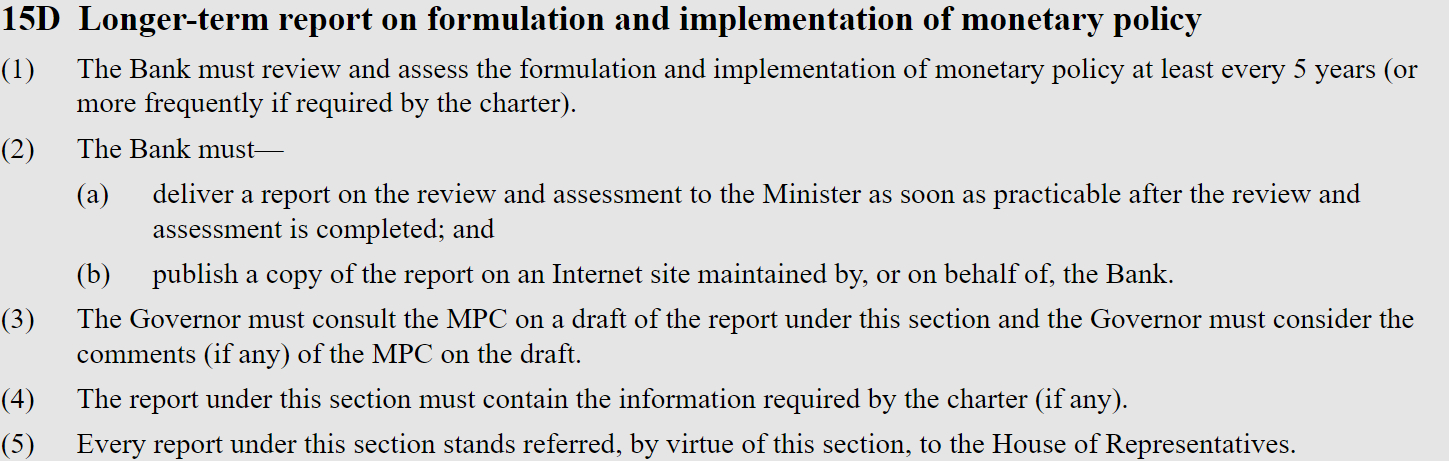
Officially called the Review and Assessment of the Formulation and Implementation of Monetary Policy (RAFIMP), this is a five-year review about how the RBNZ has made decisions about monetary policy in the past five years and how those decisions were brought into effect. This is the first such five-year report since it became a legal requirement with amendments to the Reserve Bank Act in 2018.
This is a link to the RAFIMP page on the RBNZ website.
The RBNZ describes RAFIMP as "a detailed report card on what the Monetary Policy Committee (MPC) decided to do, what worked, what we could have done better and how we can learn from our experience".
"RAFIMP is a review of how we have made decisions about monetary policy in the past five years and how those decisions were brought into effect. This is the first time we have done this review — after it became a legal requirement in 2018. However, we have been carrying out regular reviews of monetary policy to hold ourselves accountable for our actions."
A detailed outline of what's required from RAFIMP, taken from the RBNZ legislation, is appended at the bottom of this article.
Two international independent experts on monetary policy have peer-reviewed RAFIMP. These experts are, and with links to their reports:
- Warwick McKibbin — Professor at the Australian National University
- Lawrence Schembri — former Deputy Governor of the Bank of Canada.
This first report has arguably taken on more significance than might have been expected back in 2018. That's because of the extraordinary measures - stimulatory measures - that the RBNZ has been involved in since the onset in 2020 of the Covid pandemic.
While RAFIMP covers the Monetary Policy Committee’s decisions on the Official Cash Rate (OCR), it also includes new Additional Monetary Policy (AMP) tools that were introduced during the pandemic. These of course include the Large Scale Asset Purchase Programme (LSAP) through which the RBNZ ultimately bought about $53 billion of government bonds and the Funding for Lending Programme, which to date has provided the banks with $16.4 billion of cheap money priced at the level of the OCR.
Extra significance still has been given to the report by the fact that Finance Minister Grant Robertson just this week has re-appointed the polarising figure of Adrian Orr as Reserve Bank Governor, something that prompted howls of protest by the opposition who were against Orr getting another five year term ahead of next year's election. The believed he should have been re-appointed (after his current term expires in March 2023) for just a year, so, that an incoming government next year could choose a new governor.
This is the statement from Nicola Willis:
The Reserve Bank’s self-assessment of its own performance fails the credibility test, says National’s Finance spokesperson Nicola Willis.
On Thursday, the Bank released Review and Assessment of the Formulation and Implementation of Monetary Policy.
“Predictably, the Reserve Bank’s marking of its own homework pulls its punches and fails to deliver any accountability for mistakes in the management of the New Zealand economy,” Ms Willis says.
“The report, written by the Bank’s own staff, hints at mistakes that have worsened price increases and the cost of living crisis, but fails to say whether those mistakes were avoidable and if so who should be held accountable for them?
“Those mistakes include over-doing the scale of money-printing, not lifting interest rates earlier and designing the Funding for Lending Programme so badly that commercial banks are still receiving ultra-cheap money when that no longer makes any economic sense.
“These errors matter to every New Zealander. When the Reserve Bank gets it wrong, we all pay, with inflation and interest rates being higher for longer than they might otherwise have been.
“Kiwi families – already struggling with runaway inflation – are now being squeezed by hundreds of dollars a week in higher mortgage payments. We need to know whether that pain could have been reduced.
“This report could never answer the most vital questions because it was written by the people responsible. In fact, the Minister of Finance reappointed the Reserve Bank Governor for another five years even before publishing this report.
“National again repeats our call for an independent inquiry into the monetary policy response to COVID-19. This is about learning lessons for the future and upholding basic standards of accountability. New Zealanders deserve no less.”
The legal requirements for RAFIMP:
We welcome your comments below. If you are not already registered, please register to comment
Remember we welcome robust, respectful and insightful debate. We don't welcome abusive or defamatory comments and will de-register those repeatedly making such comments. Our current comment policy is here.