

By David Hargreaves
The Reserve Bank says it is "not sufficient" to look at inflation outcomes alone when evaluating monetary policy, and central banks cannot "nor are they expected to" have "perfect foresight".
These comments from the RBNZ are in the bank's November 2015 Bulletin in an article headed: Evaluating Monetary Policy. The article, which comes in the wake of increasing comments and concerns being expressed in the marketplace about the RBNZ's inability to hit its officially mandated 1%-3% (with explicit 2% mid-range inflation target), says: "It is not expected that the Bank will always get its forecasts right", but it is important that the Bank learns from its forecast errors. The article was written by Dean Ford, Elizabeth Kendall and Adam Richardson from the RBNZ's policy analysis team.
The article also looks at the RBNZ's decision to hike interest rates in 2014, which has been viewed widely retrospectively in the marketplace to have been a mistake - though the RBNZ has refused to term it as such.
"When evaluating monetary policy, it is not sufficient to look at inflation outcomes alone. There are two reasons for this. Firstly, unanticipated events can affect how inflation outcomes evolve over the medium term and central banks cannot, nor are they expected to, have perfect foresight. Secondly, flexible inflation targeting gives central banks discretion in regards to the speed at which they aim to return inflation to target, to avoid unnecessary instability in the economy," the article says.
A large part of the article is also devoted to the decision-making process, with a special break-out 'box' article devoted to this. The decision on whether or not to move official interest rates is the sole responsibility of RBNZ Governor Graeme Wheeler. This too has been the topic of some discussion in the wider public, with some suggesting a committee-based decision process like those of many overseas jurisdictions might be a better way to go.
Wheeler himself raised this issue after the September Official Cash Rate decision was announced and gave a detailed explanation of how the decision-making processes actually worked within the RBNZ.
The latest RBNZ bulletin goes into yet more detail on this, saying that while the RBNZ has a legislated single decision-maker structure, where the Governor is solely responsible for monetary policy and other decisions regarding statutory functions of the Bank, "in practice, however, the Bank uses committees in its formulation of monetary policy to improve the decision-making process".
"Using committees as part of the decision-making process has advantages over a pure single decisionmaker model. In particular, it allows for a wider set of information to be considered and encourages deeper debate," the article says.
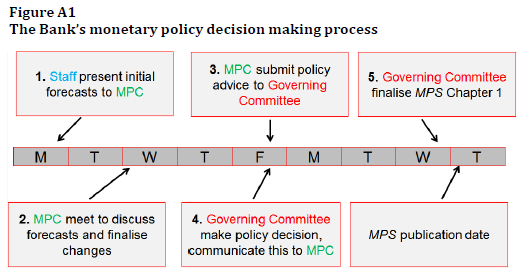
It says the Bank’s monetary policy decision-making process, which occurs in the lead-up to a Monetary Policy Statement, has five stages. The Bank’s OCR reviews use a scaled down version of this process. Three major groups of people are involved, including: "A wide array of Bank staff", the 13-strong Monetary Policy Committee (MPC), (made up of senior staff from the Bank’s policy departments, two external advisors, and the Governing Committee), and then finally the Governing Committee itself, which consists of the Governor, two Deputy Governors and the Assistant Governor. The diagram below demonstrates how these various inputs occur in the days leading up to a decision.
Going back to the main RBNZ bulletin article, it says that the Bank’s focus on medium-term inflation requires it to make many judgements about the future when conducting policy.
"Given the uncertainties, it is not expected that the Bank will always get its forecasts right, but that it will respond in a reasonable manner as new information becomes available, especially if this new information differs from earlier expectations."
Responding reasonably requires the Bank to continually assess the importance of new data and events, and determine whether they warrant a change in the stance of monetary policy. Doing so should result in better decisions and economic outcomes in the future, and enhance the credibility of the Bank’s framework, the article says.
The Bank’s accountability documents, speeches, and analytical papers should help the public to assess the responsiveness of the Bank to new information. In addition, the Bank periodically releases analysis of its forecast performance. If the Bank is responding to new information effectively, then there should be no systematic biases in its forecasts and the accuracy of its forecasts should compare well to those of other forecasters. How the forecasts have evolved should provide evidence of learning.
The article says it is important that the Bank communicates effectively.
"The Bank uses its Statements, speeches and analytical papers to communicate its judgements, interpretation of new information, changes in policy stance, and how it is likely to react to new developments. If communication is effective, the market will understand the Bank’s reaction function and how it is likely to respond to new information. Market pricing will adjust accordingly as developments unfold. This will help improve the efficacy of monetary policy."
A "key conclusion" is that it is not sufficient to look at inflation outcomes alone when making such an assessment.
"The Reserve Bank operates policy to achieve price stability over the medium term and unexpected events can cause actual inflation to temporarily deviate from the medium-term target. New Zealand’s flexible inflation targeting framework also gives the Bank discretion as to how quickly it should seek to return inflation to target, to avoid unnecessary instability in the economy."
The article says that "based on its interpretation" of the Policy Targets Agreement between the Governor and the Minister of Finance, the RBNZ conducts policy such that future inflation is typically forecast to be comfortably within the target range in the latter half of the three-year projection period.
"But how quickly this occurs depends on prevailing circumstances. When conducting monetary policy, the Bank focuses on returning inflation to the midpoint of the target range. This midpoint focus helps anchor inflation expectations near 2%, making the outlook more resilient to temporary deviations of inflation from the target band."
When evaluating monetary policy, inflation outcomes are assessed, but how the Bank has responded to new information and forecast errors is also very important, the article says.
"An ex-post [after the event] assessment should consider whether the Bank responded reasonably to new information; whether these developments were communicated effectively; and, whether the credibility of the monetary policy framework has been maintained. While it is not expected that the Bank will always get its forecasts right, it is important that the Bank learns from its forecast errors. Continuous learning about the state of the economy is important to ensure that monetary policy is set appropriately."
Another break-out 'box' illustrates "how the ex-post criteria for assessment outlined here might be applied", using material from the RBNZ's September 2015 Monetary Policy Statement.
"In March 2014, the Bank began to increase interest rates, increasing the OCR by 100 basis points from March to July that year. The outlook for the New Zealand economy was very positive; consumer price inflation was expected to begin rising and it was judged prudent to lessen the degree of monetary stimulus to keep future inflation contained. The Bank and markets expected that the OCR would need to increase by more than 200 basis points in total," the article says.
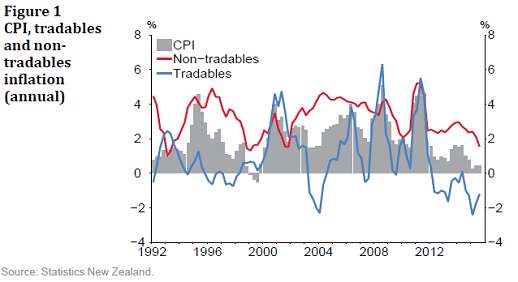
"However, several unforeseen circumstances led to inflation being weaker than expected – including significant falls in the prices of oil and our commodity exports, a stronger-than-expected exchange rate, weaker-than-expected capacity pressures, and weaker-than-expected non-tradables inflation. The Bank used its Statements, speeches and analytical papers to discuss these developments.
"The first criterion for ex-post assessment is whether the Bank responded reasonably to this new information. While the Bank could not have foreseen these developments, it progressively eased its tightening bias as evidence of weaker inflationary pressures developed . This easing started with the Bank scaling back the extent of its projected monetary tightening from the June 2014 Monetary Policy Statement.
"Subsequently, the Bank cut the OCR by 25 basis points for its June, July and September 2015 OCR decisions.
"The second criterion for ex-post assessment is whether the Bank’s communication of these developments was effective. The change in monetary policy outlook (along with other factors) contributed to a fall in retail interest rates from July 2014, leading to easier monetary conditions. Wholesale interest rates also declined in anticipation of the Bank’s response to new information.
"The third criterion for assessment is whether the credibility of the monetary policy framework has been maintained. Medium-term inflation expectations have fallen over the past six months, but are currently near the 2% target midpoint. External forecasters also expect inflation to return to target over the medium term."
We welcome your comments below. If you are not already registered, please register to comment
Remember we welcome robust, respectful and insightful debate. We don't welcome abusive or defamatory comments and will de-register those repeatedly making such comments. Our current comment policy is here.