
By David Hargreaves
Economists at the country's biggest bank ANZ are expressing concern at the blow-out of household debt levels, which has seen household debt-to-disposable income rising to a record high of over 167%
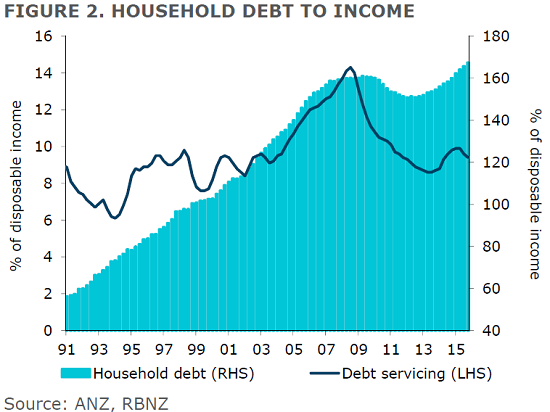
To put this into some perspective, the ratio of debt to income, according to Reserve Bank figures, was just over 100% at the start of the 2000s. During the early to mid-2000s housing boom this blew out rapidly, peaking at just over 160% by the time of the Global Financial crisis in 2008.
Subsequent to that, there was a period of saving and consolidation, which saw the ratio dip as low as 151% by 2012. Since then, however, it's been rising again and tipped over the 167% mark as of December. And putting that into dollars and cents, the RBNZ figures show that for the year to December there was $144.869 billion of household disposable income against $242.421 billion of household debt - the latter figure having risen by over $16 billion during 2015.
In their weekly Market Focus the ANZ economists said that in New Zealand there has been "a clear deterioration in the structural side of the equation".
"Household saving has dipped and people are re-leveraging. The Auckland property market has everyone scratching their heads. Updated household debt-to-income figures show that borrow-and-spend style growth has returned. We knew that; it partly reflects monetary policy at work. We just didn’t realise that credit growth had accelerated and disposable income revised such that the ratio is now over 167% – some 7% pts above where it peaked in 2009," the economists said.
"Now, we never rely too much on individual statistics, but that got us musing. Many regional housing markets are now booming. Credit appetites look pretty good. And monetary policy is still easing. It’s not driving general inflation but it sure is lifting asset price inflation and appetites to borrow."
The economists said there was "the conciliatory rhetoric", namely:
- bank stress tests look okay;
- supply shortages are driving the housing market ("a partial truth");
- the debt-servicing burden still looks fine ("though looking at that in isolation is daft; it’s fine simply because interest rates are low"); and
- there is strong deposit growth too ("it’s when credit growth outstrips deposit growth that the net external debt position can deteriorate sharply"). And of course, a host of other structural indicators are still in a good position. The fiscal accounts are strong and we have a much lower net external debt position, with the latter expected to be evident in this week’s current account figures.
"So we can discount the household debt figures to some degree, looking at the broader picture," the economists said.
"Nonetheless, the data got us musing about policy trade-offs; cutting the [Official Cash Rate] further in this environment is not a free lunch; it’s called debt and it will need to be paid back! Debt levels are now in uncharted territory, at least in terms of the share of income (if not serviceability). The current price of credit does not appear to be an impediment to borrowing."
The ANZ economists said that "to be fair", monetary policy always comes with trade-offs "and no doubt the RBNZ’s macro-prudential and financial stability teams are on top of things. It’s just that we’re simply becoming more prickly and watchful over these issues now, relative to normal".
They said that it is then, "with a sense of trepidation and with a nervous eye over one shoulder" that they forecast the OCR heading lower still from the record low of 2.25% it hit after last Thursday's cut by the RBNZ.
In a world where China "issues" look set to persist, all central banks are struggling to hit inflation mandates (at least excluding the [US] Fed!), local interest rate cuts are not being passed on fully given international funding pressures, and currency markets are misaligned, there will be more pressure for the OCR to move down.
"All these factors will manifest into inflation and growth outcomes. We’re just not sure we like the end game, given re-leveraging behaviour in combination."
We welcome your comments below. If you are not already registered, please register to comment
Remember we welcome robust, respectful and insightful debate. We don't welcome abusive or defamatory comments and will de-register those repeatedly making such comments. Our current comment policy is here.