

Sentiment in the construction sector has plummeted to its lowest level since 2009, according to the latest ANZ Business Outlook Survey.
And elsewhere in the economy things are not looking so flash either, with most of the indicators in the survey heading down.
The survey's main indicator, 'headline business confidence' fell 6 points to a net -44%.
In the arguably more significant (and less susceptible to 'political influence') measure of firms’ views of their own activity, this fell 3 points to +5%, the lowest read since August last year. Other activity indicators were also weaker.
The dire readings of future prospects for the construction sector come just one day after building consents figures showed strong activity in the past year and a record in Auckland. But such figures of course measure past activity. And economists generally think that activity is close to its peak now.
The significance of the latest survey is that it again shows a very weak picture of forward economic activity, just a week out from when the Reserve Bank has to make a decision about whether or not to cut the Official Cash Rate again in an attempt to stimulate the economy. It's widely expected that the RBNZ will cut again (to 1.25%) - and the ANZ for one is picking that it will need to cut again on top of this before the year is out.
ASB's also picking two cuts to the OCR before the end of the year, but in reaction to the latest ANZ survey, ASB senior economist Mark Smith said on Wednesday that the persistently weak business sentiment and a weak economic backdrop "provide growing risk that the trough in the OCR is below 1% in the current cycle".
ANZ senior economist Miles Workman said that in the latest Business Outlook survey most activity indicators fell to weak levels.
"The main theme this month was a sharp deterioration in sentiment in the construction sector across a wide range of indicators," he said.
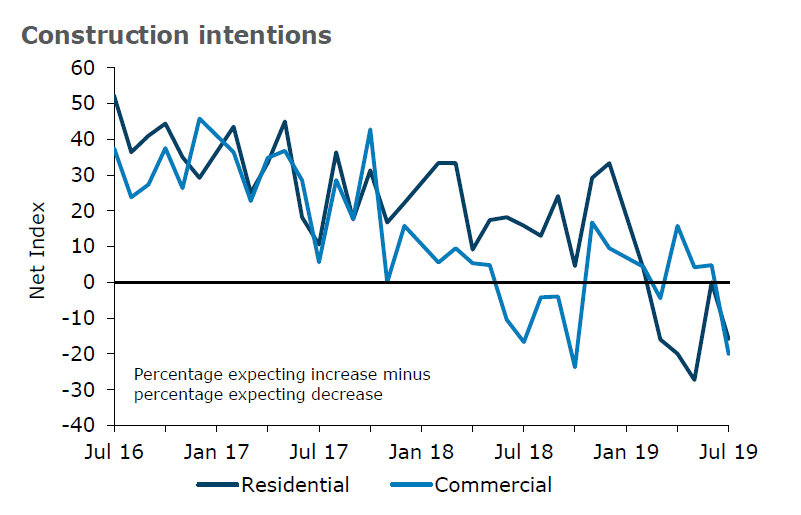
“Residential construction intentions fell back into negative territory. Employment intentions and profitability expectations for the construction sector plummeted to the lowest since 2009.”
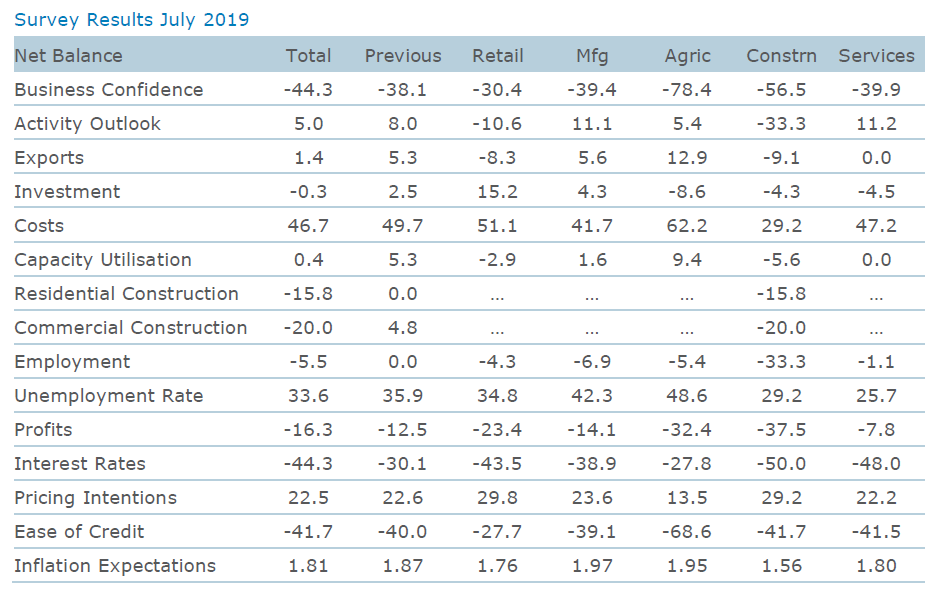
Here's some of the key stats from the latest survey:
• Employment intentions fell from 0 to a net 6% of firms expecting to cut jobs. Investment intentions fell 3 points to flat. Capacity utilisation, which has one of the most reliable correlations in the survey to annual GDP growth, fell 5 points to 0, its lowest read since 2009.
• Profit expectations fell 3 points to a net 16% expecting profitability to decline.
• A net 42% of firms expect it to be tougher to get credit, down 2 points to a fresh record low since the series began in 2009. Agriculture fell to -69%.
• Firms’ pricing intentions were unchanged at a net 23% of firms expecting to raise prices. A net 47% of firms expect higher costs, down 3. Inflation expectations eased 0.1%pts to 1.8%.
• Commercial construction intentions plunged 25 points, while residential intentions fell back into negative territory at -16%. Signals out of the construction sector are deteriorating rapidly.
'A bit worse for wear'
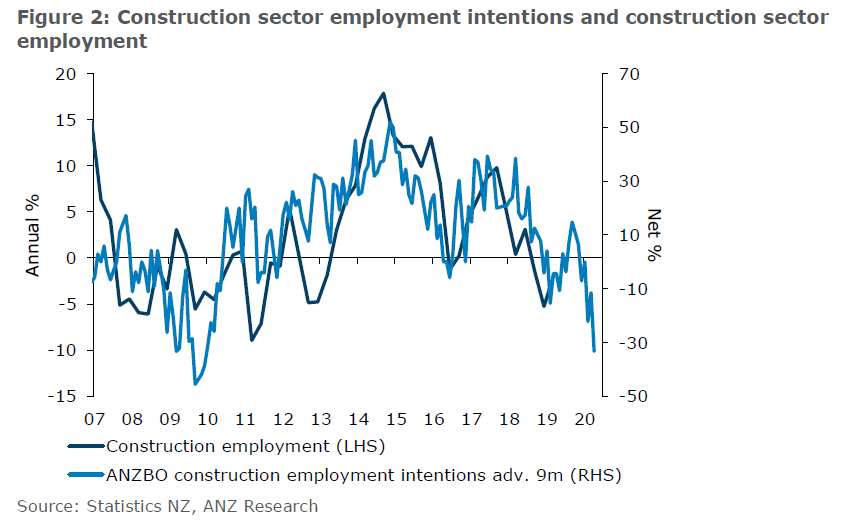
“Construction indicators look a bit worse for wear, including net 33% of firms in the construction sector are intending to cut jobs," Workman said.
"The construction sector currently employs 240,000 people, some 9% of total employment, making it a meaningful driver of broader employment trends."
But it's not just construction. Workman says the outlook for the broader labour market is also deteriorating. Although the construction sector is far more negative than the rest, employment intentions are now negative in every sector. The services sector was "the last domino to fall"; the net -1% this month is the lowest since late 2009.
“The outlook for the economy is deteriorating. Despite generally good commodity prices and interest rates at record lows, the headwinds of a global slowdown and credit and cost constraints appear to be winning out. With the inflation outlook not consistent with the target midpoint we expect two more OCR cuts this year, helping the economy to find its feet once more," Workman said.
We welcome your comments below. If you are not already registered, please register to comment
Remember we welcome robust, respectful and insightful debate. We don't welcome abusive or defamatory comments and will de-register those repeatedly making such comments. Our current comment policy is here.