

The Reserve Bank wants to get more hands-on with our cash.
It has issued a consultation paper in which it has outlined proposals take on "a stewardship role" in the cash system, providing system-wide oversight and coordination. It also proposes:
- The Reserve Bank be given the power to set standards for machines that process and dispense cash.
- The Reserve Bank Act set out regulation-making powers that enable the government and the Reserve Bank to require banks to provide access to cash deposits and withdrawals.
RBNZ Assistant Governor Christian Hawkesby said in releasing the new consultation document on Wednesday that the changes proposed "would have significant consequences for all participants in the cash system".
“These proposals are not the complete answer, but they would help create a foundation for the Reserve Bank to be more than the issuer of notes and coins when it comes to how we use cash which is an important component of our social and economic activity,” Hawkesby said.
"Banks, cash-in-transit providers, independent ATM operators, and the broader retail sector would likely be particularly affected. We want to continue to hear views and feedback from everyone about the purpose and desired attributes for the mechanics of the cash system, and how we could collectively improve it."
The RBNZ says the purpose of any new powers given to it would be to ensure that the cash system supports an appropriate level of access to cash deposits and withdrawals, for as long as those services are needed, in order to protect those who rely on cash most heavily.
"If such powers were included in the Reserve Bank Act, we would not intend to use them in the near future, or indeed at all, unless we observed a significant failing in the ability of the system to meet the needs of the public."
These proposals are the latest step in work the central bank has been undertaking on the future of cash as society moves more and more towards a cashless system. Public submissions are being sought on the proposals and these close on November 6.
In a previous paper on the subject released earlier this year the RBNZ warned that if cash becomes less accepted and available as a means of payment then Kiwis that are already "left out" of the banking or digital worlds may be "severely disadvantaged".
That earlier paper said that the number of people currently "excluded" from the banking system in New Zealand was "small but not zero".
"The World Bank estimates that only 1% of the population in New Zealand does not have a bank account," it said.
The key participants in the cash system in New Zealand are banks, the Reserve Bank, cash-in-transit operators (specialist cash transport and management services), and non-bank ATM operators.
The consultation paper says that currently the Reserve Bank has "very limited" oversight of the system that supplies cash to the public, and no influence over the quantity of cash in circulation.
"We simply sell and buy back cash to and from our wholesale customers on request. The number of banknotes and coins that enter circulation, the distribution of cash throughout the country, and the number of places where people can access cash are determined by public demand and the response of private businesses to commercial incentives.
"No single organisation has system-wide oversight of the cash system or a formal role to support it," the RBNZ says.
It also says that while the banks and other cash system participants have been willingly and actively engaging with the RBNZ work on the future of cash "there is no formal mechanism to promote cooperation and coordination across the cash industry".
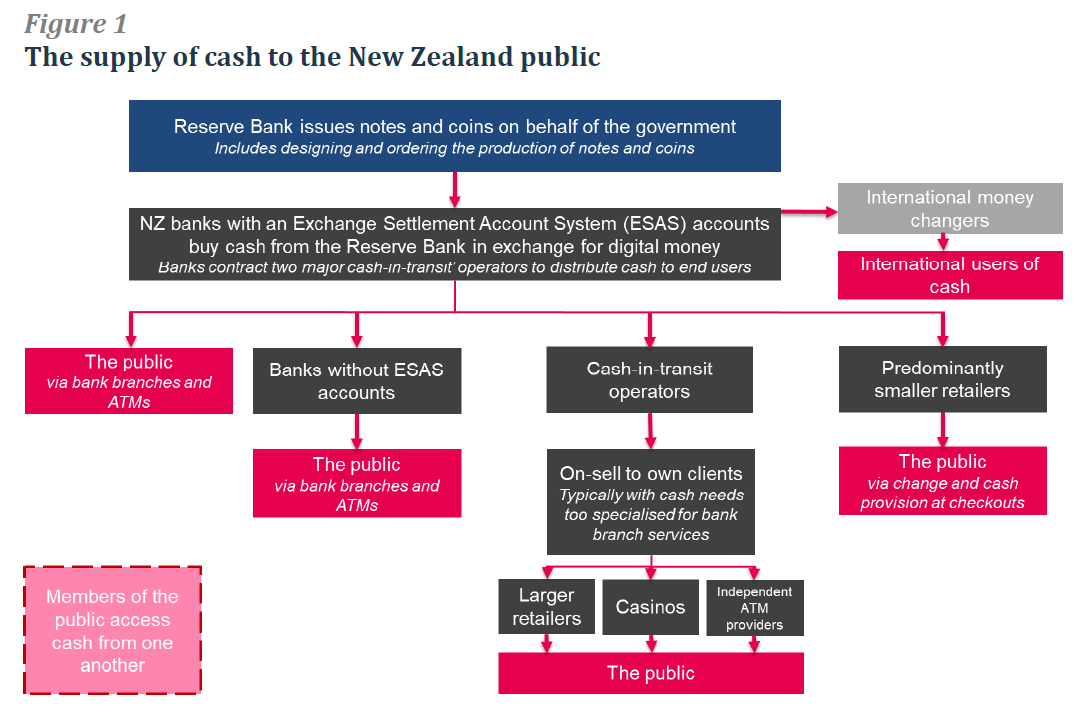
The RBNZ consultation paper says that the cash system is costly to run.
"It requires costly infrastructure in the form of vaults and depots, armoured trucks, ATMs, and cash-processing machinery. It also incurs high running costs, such as those of fuel, drivers, bank branch staff, and insurance and security. It also contributes to greenhouse gas emissions."
The costs of running the cash system are shared by the main players: banks, the Reserve Bank, cash-in-transit operators, and independent ATM operators. Cash-in-transit operators and independent ATM operators are commercial entities that deal in cash for profit, so their costs are passed on directly to users. Cash-in-transit operators recover their costs by charging commercial banks and retailers for their services, while independent ATM operators recover their costs by charging people directly to use their machines. The Reserve Bank’s costs are recovered when the banks purchase the notes at face value. The income the Reserve Bank makes from selling banknotes and coins is called seigniorage, and provides "a significant proportion of the Reserve Bank’s funding".
"The consequence of the current cash system structure is that most of the costs of the supply of cash to the public are borne by the banking sector. The extent to which these costs are passed on to the end users is uncertain. Many cash services are currently provided by banks for free, particularly for individual customers. However, banks may recover some of their costs indirectly from customers by charging for other services."
The RBNZ says if the current level of cash access is to be sustained then considerable innovation and efficiency improvements will likely be required within the industry.
It says further changes to the cash system may stem from the Reserve Bank itself, as it looks to modernise its own vaulting and distribution systems.
"Our bank vaults in Wellington are ageing and we think the current arrangement is sub-optimal, with the Reserve Bank holding a large proportion of the country’s banknotes and coins in Wellington. The Reserve Bank is currently exploring a range of cash vaulting and distribution options with the banking industry and key stakeholders, and these options imply varying levels of innovation and system change. We will continue to work closely with stakeholders in the coming 12 to 18 months to reach a decision and to develop a plan to update and upgrade the current Reserve Bank vaulting system and associated commercial arrangements."
We welcome your comments below. If you are not already registered, please register to comment
Remember we welcome robust, respectful and insightful debate. We don't welcome abusive or defamatory comments and will de-register those repeatedly making such comments. Our current comment policy is here.