
Independent economic researchers Capital Economics now forecast the global economy will meet the 'old' IMF description of a recession next year - while the NZ economy most definitely will tip into a recession - and our current house price fall will extend as far as 25% from peak to trough.
Capital Economics says global growth next year is set to be - apart from during the Global Financial Crisis and the start of Covid - the slowest in four decades.
The economists have dropped their forecast for global growth next year to just 1.7%. Formerly the IMF had described global growth under 2.5% as a recession.
Earlier this month the IMF itself downgraded its forecast for economic growth next year to 2.7% and said "for many people 2023 will feel like a recession".
Capital Economics concurs, and goes further.
It says persistently high inflation and more aggressive monetary policy tightening "now seem set to do serious damage to the world economy".
"While we had previously anticipated contractions in several economies, the gloom has spread such that we now see global GDP rising by just 1.7% next year."
For this part of the world, Capital Economics expects the Reserve Bank of New Zealand (RBNZ) to hike the Official Cash Rate to 5.0% (currently 3.5%) "as inflationary pressures are pervasive".
"That will push the [NZ] economy into recession next year."
The economists think, however, that Australia will "narrowly avoid" a recession as the Reserve Bank of Australia (RBA) "should get on top of inflation before long".
Capital Economics had previously forecast NZ house prices to drop 20% from their peak (which was November 2021), but have now increased that pick to 25%. At the moment house prices here are down around 10% from the peak.
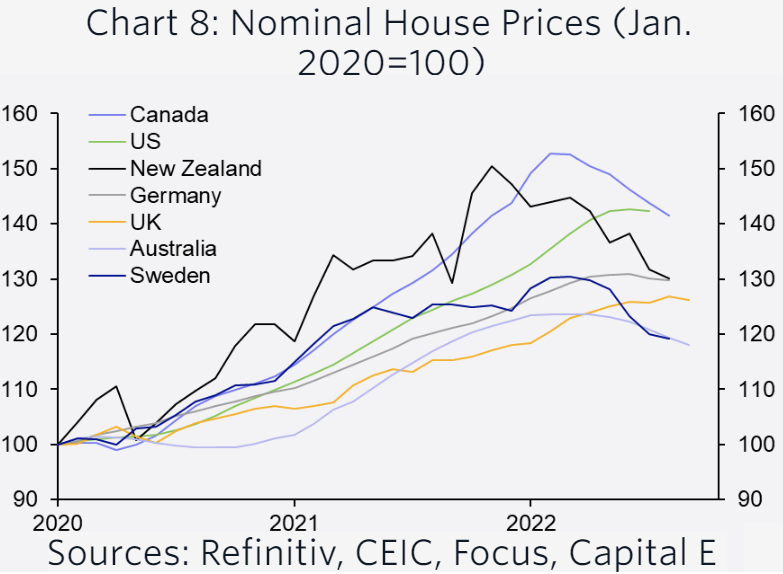
"We ultimately expect house prices to fall by 15% from their peak in Australia and by 25% in New Zealand.
"That underpins our forecast that residential investment will fall by around 20% from peak to trough in both countries, though the resilience of homebuilding in New Zealand means the risks there are tilted to the upside. The upshot is that GDP growth will slow to just 1.2% in Australia and to 0.3% in New Zealand next year, which is about 1%-pt weaker than most anticipate."
Back on the global economy, the Capital Economics economists say they have become more pessimistic about most economies over recent months, "but the downgrades to our forecasts have been largest in advanced economies".
"We now think that rising interest rates and particularly large terms of trade shocks in the euro-zone and UK will send both economies into deep recessions. Meanwhile, even more aggressive policy tightening than we had previously anticipated means that several other advanced economies – including the US – will experience mild recessions. And in China, zero-COVID and weak external demand will also weigh on growth next year. Apart from India, our forecasts now lie below both the consensus and the IMF’s across all regions."
If that all sounds a bit grim, the economists have a further caution:
"But even our new, downgraded forecasts are subject to downside risks. The first is that central banks will have to tighten policy more than we envisage to dampen demand and drive inflation out of the system. The second is that higher interest rates might cause problems in the financial system which then seep into the real economy. Those risks are greatest in economies where asset prices – particularly housing – increased substantially during the low-rate era, where the shadow banking sector is relatively large, and where interest rates are now moving up sharply."
The economists say high inflation and interest rates will affect households’ consumption patterns.
"Survey indicators suggest that global demand for tradeable goods has already weakened markedly. This will be especially damaging to trade-dependent economies in emerging Asia including China.
"We now expect world trade to fall outright next year."
But there is a consolation:
"One consolation is that easing inflation and weakening economic activity should convince central banks to start cutting interest rates before long. Tightening cycles have already peaked in some emerging markets and we suspect that the US Fed will start to cut rates in the second half of 2023. This should mean that the global recession is a relatively short one."
We welcome your comments below. If you are not already registered, please register to comment
Remember we welcome robust, respectful and insightful debate. We don't welcome abusive or defamatory comments and will de-register those repeatedly making such comments. Our current comment policy is here.