

A new report largely exonerates New Zealand businesses from causing inflation by pushing up profits.
The report by consultancy Sense Partners was commissioned by business lobby group Business NZ.
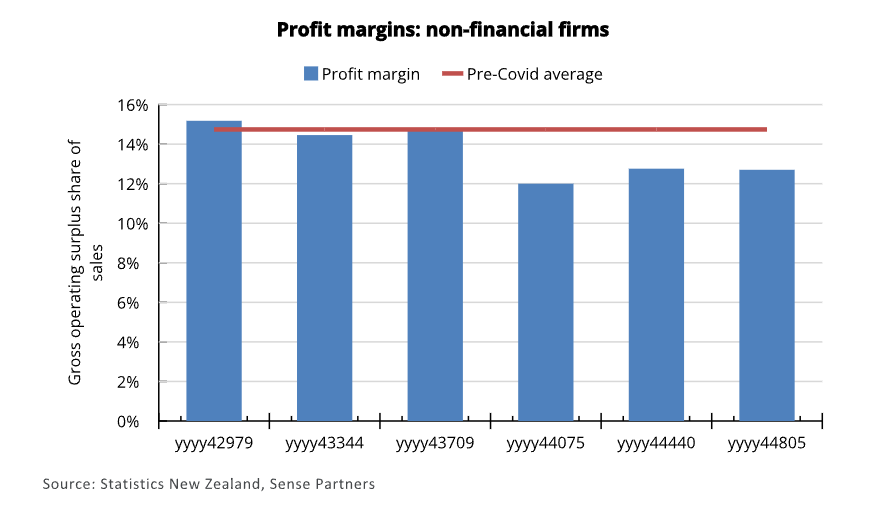
Business NZ says it wanted to know if so-called profit margin-led inflation, sellers' inflation or greedflation was a problem for NZ. The team used data from Statistics NZ and found that instead of rising, profit margins are generally lower than in pre-Covid levels.
According to the theory, businesses can use existing inflation and disruptions as cover to raise their prices even further than necessary, thus making inflation worse and boosting their margins.
In a stubbornly high inflationary environment this argument has gained traction overseas, especially in Europe and North America, including with academics, economists, political leaders and even some central bankers such as European Central Bank President Christine Lagarde.
The Bank of Canada said last week in assessing the dynamics of core inflation it will be evaluating whether "the evolution of excess demand, inflation expectations, wage growth and corporate pricing behaviour" are consistent with achieving its inflation target. And the Reserve Bank of Australia says it's paying close attention to "both the evolution of labour costs and the price-setting behaviour of firms."
'Evenly split between wages & profits'
Sense Partners' report says 75% of NZ inflation in the three years to 2022 came from the increase in the cost of inputs, with the remainder evenly split between wages and profits.
“We found no evidence of widespread increases in profit margins driving up inflation in New Zealand. (Greedflation) is an imported narrative not supported by the evidence.”
The Sense Partners team say actual figures prove that.
They say profit margins for the measured non-financial sector averaged 14.7% before Covid and were 12.7% in the 2022 calendar year.
The team then go on to look at it another way. They examine price increases over the three years from the December quarter 2019 to the December quarter 2022.
They say that over those three years, prices rose by 14%, at an average of 4.6% per year.
But 71% of that price increase comes from higher input costs, while 15% stems from increased labour costs and 14% from higher gross profits.
“International experiences of increasing profit margins through increased mark-ups are not well supported in the New Zealand experience,” Sense Partners says.
“This indicates caution in importing international narratives without local context.”
How Sense Partners did it & why banks were excluded
In explaining their methodology, the Sense Partners team say they did not look in detail at particular companies, but instead looked at the economy sector by sector. In total, 14 industries were examined, such as agriculture, mining, construction, healthcare and retail.
The team looked at these sectors using a tool supplied by Stats NZ known as Infoshare. This enables researchers to drill down and acquire quite detailed information at a sectoral level, covering things like sales, wages, and purchases.
The survey excluded the financial sector based on advice from the Sense team, which says other sectors can have their sales data backed up by checks against GST returns, but this is not possible with banks, as financial services to not incur GST.
"We can't include the financial sector because that is not how it works and we don't have the information," says the chief researcher for this project, Shamubeel Eaqub.
The Reserve Bank recently said the strong profits of NZ's banks put them in a good position to earn their social licence by supporting customers through taking a long-term perspective in times of stress in their lending books.
Greens' Julie Anne Genter sceptical
But not everyone is happy with this verdict. Green Party finance spokesperson Julie Anne Genter says many sectors such as banks and supermarkets and fuel companies are making huge profits.
“It’s a moot point whether it is deliberate or not. The point is that during this time of inflation, some corporates are making record profits,” she says.
“There is a case then to make sure that some of this excess profit comes back to the public good.”
Genter adds in some cases, companies might have expected their input costs to rise quickly, and put up their prices in anticipation of this, only to find inputs levelling out, leaving them with higher profits at the end of the day.
Genter goes on to cast doubt about the latest study.
“Of course, Business NZ are going to say it is nothing to do with them. They always point the finger and blame government, but that is because they are quite happy to keep making as much profit as they possibly can.
“It is our job as representatives of the people to change the system to make sure that it works for everyone.”
And she says there are credible reports coming out of the US, the UK and Australia, that corporate profits have been a driver of some of the inflation that we have seen."
What does the RBNZ say?
Genter says she asked the Reserve Bank to look into this, and got a favourable response.
Asked about this issue last month, Reserve Bank Governor Adrian Orr said the data on this matter was "as poor as ever."
The bank's chief economist Paul Conway then explained further.
"We have had a good poke at the risks of a profit-price spiral," he said.
"At the aggregate level, we don't see any evidence of an increase in profits feeding into inflation. It doesn't rule out the possibility that there are markets in New Zealand which do suffer from a lack of competition, where profits are above normal levels.
"But we haven't seen that increase at the aggregate level and where there are markets that suffer from a lack of competition, the Commerce Commission are into that sort of space."
Genter’s reference to supermarket profits is partly supported by the Commerce Commission, which found they appear to be making higher profits than expected and prices seem to be high by international standards.
But the main thrust of the Commission’s report was aimed at roadblocks to proper competition, such as restrictive covenants.
Various responses are underway to that report, such as requiring unit pricing at supermarkets and installing a code of conduct.
We welcome your comments below. If you are not already registered, please register to comment
Remember we welcome robust, respectful and insightful debate. We don't welcome abusive or defamatory comments and will de-register those repeatedly making such comments. Our current comment policy is here.