
Deputy Prime Minister Winston Peters has uncharacteristically cited ANZ New Zealand CEO David Hisco’s comments on the bank posting a near $2 billion annual profit… approvingly.
While Peters has previously slammed banks for making exuberant profits, he on Wednesday pointed to Hisco in part attributing the bank’s performance to the strength of the economy, as a comeback to attacks from the Opposition on business confidence remaining low.
During Question Time in Parliament, Peters asked Finance Minister Grant Robertson: “On this issue of perpetual gloom, what did David Hisco… put down to the success of the ANZ current profit?”
Robertson responded: “Mr Speaker, what he said – I happen to have that with me – was that the continued strength of the economy is down to strong exports, a tourism sector, continued demand for housing, and growth in household incomes.
“And he said the Government's investment in major infrastructure across the country and trade achievements are providing jobs and fuelling consumer spending and saving.”
Increasing its profit by 12% from the previous financial year, Hisco did in fact say the ANZ NZ's result reflected these factors, as well as credit quality improvements and the bank's focus on "digital innovation and customer service".
Hisco went on to tell interest.co.nz: "I think [business] confidence is more about decisions today that may affect the future.
“But what's going on right now, there's plenty of momentum [in the economy] and plenty of work to be done. Plenty of hospitals to be built, schools to be built, houses to be built, and that's providing plenty of things to do."
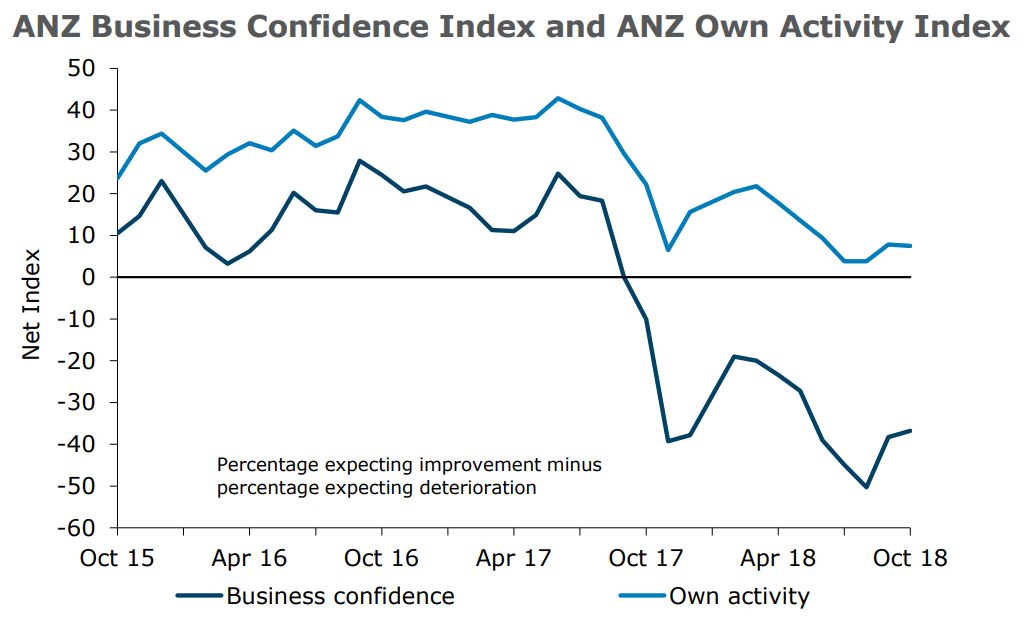
According to ANZ’s latest Business Outlook Survey, headline business confidence only lifted 1 point in October, with a net 37% of respondents reporting they expect general business conditions to deteriorate in the year ahead.
Firms’ perceptions of their own activity prospects eased 1 point to a net 7% expecting an improvement.
Hisco told interest.co.nz: "These surveys are probably just reflecting some businesspeople that wouldn't mind a little bit of clarity around the Government's policy musings at the moment, and hoping that they can be articulated soon so people can be clear about their business decision making."
Asked whether ANZ shared these concerns, he said: "At our level we talk with the Government a lot... We've given them our views on things like OIO [Overseas Investment Office] rule changes, submitting things on the Tax Working Group.
“And I guess standing back in totality for a lot of businesspeople, they just see that there's a lot of new things and a lot of things that are up in the air. And I think they have a desire to see those things land with some clarity, so they can make some decisions to move on."
When National Finance Spokesperson Paul Goldsmith asked Robertson whether he took responsibility for low business confidence, Robertson stuck to the line the Government has been using.
He said: “There is a long-run historical trend to the perception survey that the member refers to, and I think he should focus more on real data in the economy, for instance, the words this week of ASB: “So far we have yet to see a smoking gun that would point to actual activity slowing. Indeed quite the opposite has been true.””
Goldsmith went on: “Does he understand the consequences of low business confidence take time to flow through to GDP figures, and is he saying that low business confidence will be without consequences?”
Robertson responded: “I look to historical evidence in this regard. When the Labour Party was last at the core of a Government, business pessimism was in place for 82 of 99 months, and across that period there was an average annual growth of 3.2%.”
Peters said no more during this part of Question Time.
We welcome your comments below. If you are not already registered, please register to comment
Remember we welcome robust, respectful and insightful debate. We don't welcome abusive or defamatory comments and will de-register those repeatedly making such comments. Our current comment policy is here.