

The Bank for International Settlements (BIS), the central banks' bank, is putting the boot into the struggling cryptocurrency sector and making the case for central banks and central bank money to retain their pre-eminence in an evolving world.
In a chapter entitled The future monetary system in its annual economic report, the Basel, Switzerland-based BIS argues recent events reveal a gulf between a crypto vision of freedom and escaping the oversight of central banks and governments and reality. Reading the chapter, the German word "schadenfreude" springs to mind.
Coindesk reported this week that data from analytics firm Glassnode shows investors exited bitcoin positions worth a record US$7.3 billion over the past few days, amounting to the biggest US dollar denominated losses in the asset’s history. At the time of writing the bitcoin price was at US$19,897, way down from its record high north of US$68,000 last November.
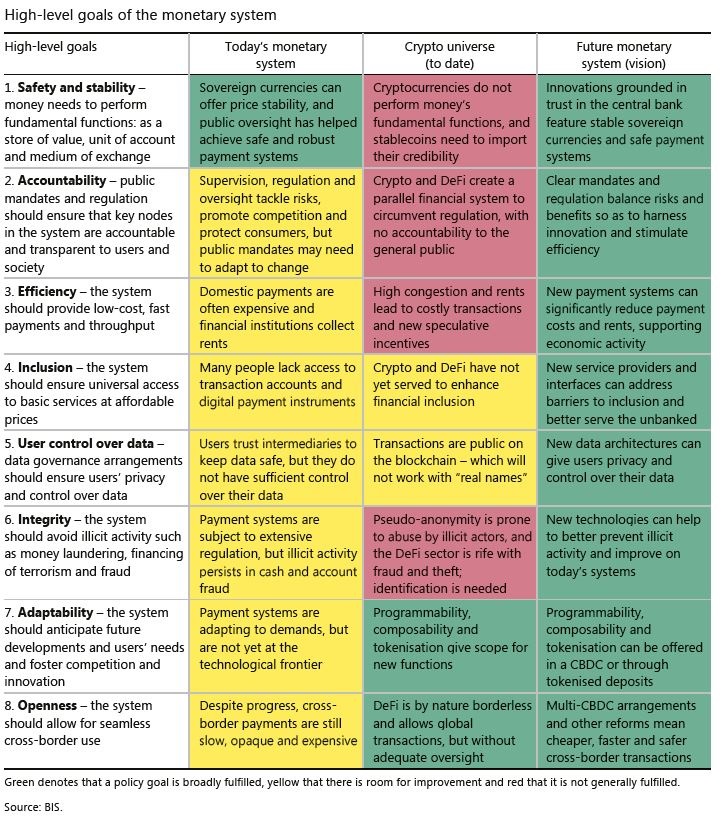
To ensure the safety and stability of the system, BIS argues money needs to fulfil three functions. These are; being a store of value, a unit of account and a medium of exchange. Cryptocurrencies, it argues, don't, and stablecoins need to import their credibility.
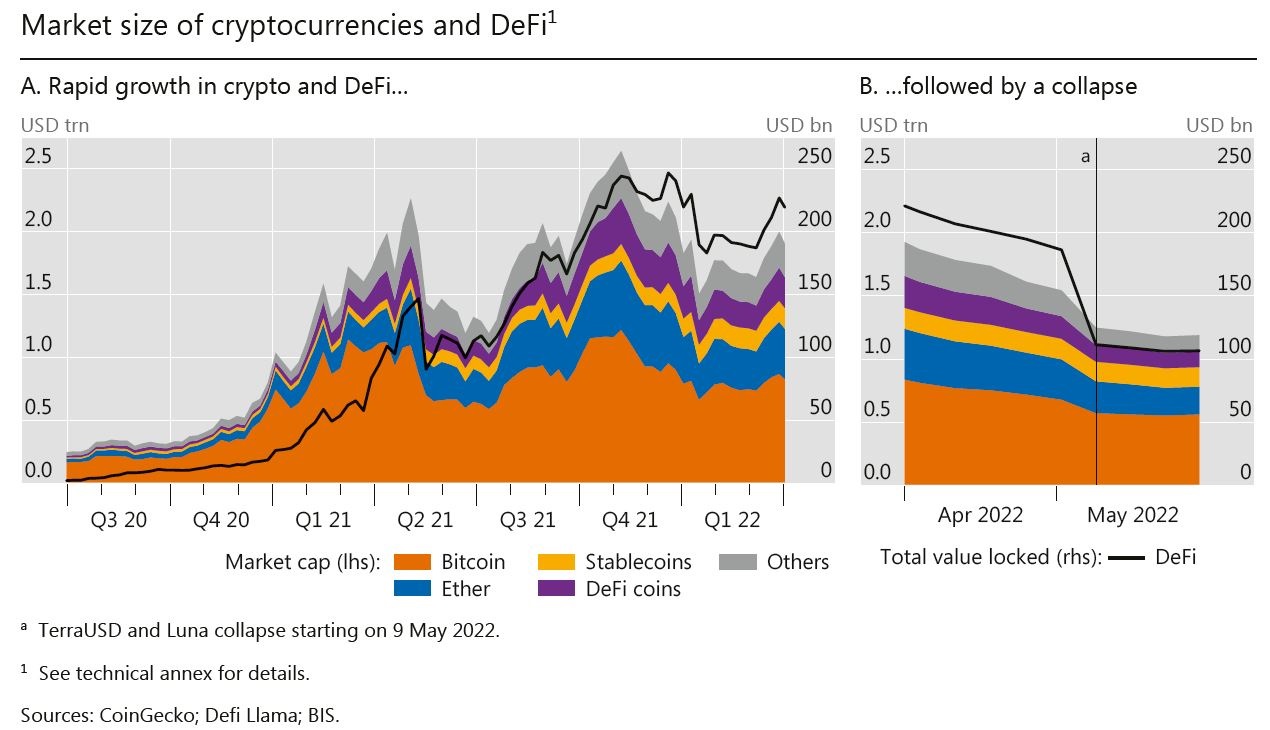
"The implosion of the TerraUSD stablecoin and the collapse of its twin coin Luna have underscored the weakness of a system that is sustained by selling coins for speculation. In addition, it is now becoming clear that crypto and DeFi [decentralised finance] have deeper structural limitations that prevent them from achieving the levels of efficiency, stability or integrity required for an adequate monetary system," BIS says.
"In particular, the crypto universe lacks a nominal anchor, which it tries to import, imperfectly, through stablecoins. It is also prone to fragmentation, and its applications cannot scale without compromising security, as shown by their congestion and exorbitant fees. Activity in this parallel system is, instead, sustained by the influx of speculative coin holders."
"Finally, there are serious concerns about the role of unregulated intermediaries in the system. As they are deep-seated, these structural shortcomings are unlikely to be amenable to technical fixes alone. This is because they reflect the inherent limitations of a decentralised system built on permissionless blockchains," says BIS.
Threat receding?
BIS has previously highlighted the threat to central banks from stablecoins and cryptocurrencies. Last September, for example, the head of the BIS Innovation Hub, Benoît Cœuré, urged central banks to crack the whip on the development of central bank digital currencies (CBDCs).
"We should roll up our sleeves and accelerate our work on the nitty-gritty of CBDC design. CBDCs will take years to be rolled out, while stablecoins and cryptoassets are already here. This makes it even more urgent to start," said Cœuré.
Reserve Bank of New Zealand (RBNZ) Director of Money and Cash Ian Woolford recently outlined the RBNZ's thinking on a CBDC in an interview for interest.co.nz's Of Interest Podcast. Among other things he said the RBNZ considering launching a CBDC is in part a defensive move to protect it and NZ's monetary sovereignty from private forms of digital currency and/or big technology firms.
A CBDC is the digital form of a country’s fiat currency. That means an RBNZ issued CBDC, like the physical NZ dollar, would be a liability of the RBNZ, backed essentially by trust in the Government and its institutions. By law the RBNZ is the sole supplier of NZ banknotes and coins, with this being a key raison d'être for the central bank.
According to think tank the Atlantic Council, 10 countries have launched a CBDC, 15 have pilots underway, and dozens of others are exploring the concept of a CBDC.
A tree metaphor
Not surprisingly BIS sees a future monetary system with central banks in the middle. In fact it says the metaphor for the future monetary system is a tree whose solid trunk is the central bank. From this base innovative private sector services can be securely rooted in the trust provided by central bank money, BIS argues.
BIS says fundamental roles of central banks include issuing central bank money to serve as the unit of account in the economy, being the trusted intermediary to debit the account of the ultimate payer and credit the account of the ultimate payee, support the smooth functioning of the payment system by providing sufficient liquidity for settlement, and safeguarding the integrity of the payment system through regulation, supervision and oversight.
BIS very much outlines a case of back to the future, with new capabilities of central bank money and innovative services built on top of them thrown in.
"The future monetary system builds on the tried and trusted division of roles between the central bank – which provides the foundations of the system – and private sector entities [such as financial institutions and fintechs] that conduct the customer-facing activities," says BIS.
BIS argues that new private applications won't be able to run on stablecoins, but they will be able to run via the likes of wholesale and retail CBDCs, and through retail fast payment systems that settle on the central bank balance sheet. It also highlights tokenisation, distributed ledger technology and application programming interfaces, or APIs. Decentralisation, BIS argues, can be achieved without the structural flaws of crypto.
"Because central banks are mandated to serve the public interest, they can design public infrastructures to support the monetary system’s high-level policy goals from the ground up," says BIS.
'Deep structural flaws'
Crypto, meanwhile, has "deep structural flaws" making it unsuitable as the basis for a monetary system that serves society, BIS argues. Stablecoins cop an ongoing serve.
"The prevalence of stablecoins, which attempt to peg their value to the US dollar or other conventional currencies, indicates the pervasive need in the crypto sector to piggyback on the credibility provided by the unit of account issued by the central bank. In this sense, stablecoins are the manifestation of crypto’s search for a nominal anchor. Stablecoins resemble the way that a currency peg is a nominal anchor for the value of a national currency against that of an international currency – but without the institutional arrangements, instruments, commitments and credibility of the central bank operating the peg."
"Providing the unit of account for the economy is the primary role of the central bank. The fact that stablecoins must import the credibility of central bank money is highly revealing of crypto’s structural shortcomings. That stablecoins are often less stable than their issuers claim shows that they are at best an imperfect substitute for sound sovereign currency," says BIS.
"Stablecoins also play a key role in facilitating transactions across the plethora of cryptocurrencies that have mushroomed in recent years. At the latest count there were over 10,000 coins on many different blockchains that competed for the attention of speculative buyers."
Nonetheless BIS acknowledges crypto offers "a glimpse of potentially useful features" that could boost the capabilities of the current monetary system.
"These stem from the capacity to combine transactions and to execute the automatic settlement of bundled transactions in a conditional manner, enabling greater functionality and speed. Thus, one question to consider is how the useful functionalities of crypto can be incorporated in a future monetary system that builds on central bank money."
BIS says that, as issuers of the settlement currency, central banks can support the tokenisation of regulated financial instruments such as retail deposits.
"Tokenised deposits are a digital representation of commercial bank deposits on a distributed ledger technology platform. They would represent a claim on the depositor’s commercial bank, just as a regular deposit does, and be convertible into central bank money, either cash or retail CBDC, at par value," says BIS.
"Depositors would be able to convert their deposits into and out of tokens, and to exchange them for goods, services or other assets. Tokenised deposits would also be protected by deposit insurance but, unlike traditional deposits, they would also be programmable and 'always on' (24/7), thus lending themselves to broader uses in retail payments – eg in autonomous ecosystems."
"This way, they could facilitate tokenisation of other financial assets, such as stocks or bonds. This functionality could allow for fractional ownership of assets and for the ability to exchange these on a 24/7 basis. Crucially, this could be done in a regulated system, with settlements in wholesale CBDC," BIS says.
A public-private partnership
Eyeing its own version of utopia, BIS talks of a public-private partnership to help make the monetary system more adaptable and open across borders, with central banks in the middle.
"A decade hence, users may take real-time, low-cost payments for granted, and payments across borders may be as seamless as the cross-border exchange they support. Consumer choice in financial services should be increased, and innovation will continue to push the frontiers of what is possible."
"In all of this, innovation must start from an understanding of the concrete needs of households and businesses in the real economy – and of the policy demands they put on a monetary system. While decentralised technologies such as distributed ledger technology offer many possibilities, users’ needs should stay at the forefront of private innovation, just as the public interest remains the lodestar for central banks," BIS says.
"In both the design of new infrastructures and in regulation, there is an ongoing need for global cooperation between central banks, and indeed a wide range of new stakeholders."
We welcome your comments below. If you are not already registered, please register to comment
Remember we welcome robust, respectful and insightful debate. We don't welcome abusive or defamatory comments and will de-register those repeatedly making such comments. Our current comment policy is here.