

 By Roger J Kerr
Why the NZ dollar has ended the year pushing 0.8500 rather than falling below 0.8000 (which was my preferred scenario) can be put down to two major factors:
• The absence of a further European financial/investment market blow up over recent months.
Since the GFC hit in March 2009 we have been on a regular six-month cycle of European sovereign/bank debt pressure points sending global markets into downspins, which in turn has caused bouts of weakness in a growth/commodity currency like the Kiwi dollar.
The last European blow-up was back in June and the Kiwi dropped to 0.7600. We were due for another bout in December; however it was never likely to happen. The European economic and financial risk intensity has been relieved over recent months by the ECB’s “whatever it takes” approach with monetary policy accommodation.
The hedge fund speculation against European sovereign debt markets and banking stocks has ended.
• The actions of the US Federal Reserve under their dual inflation/growth mandate to add extra monetary stimulus with QE3.5 as they fret that their unemployment rate is not falling fast enough.
Linking the continuation of additional monetary measures to future unemployment levels, rather than a time scale is a bit of a master stroke; that is, if the Fed have underestimated the strength of the US economy and unemployment reduces at a quicker rate than what they are currently forecasting, they reduce the risk of inflation running away from monetary conditions being too loose for the economic environment.
US economic data continues to improve; therefore the chances are that the extreme monetary stimulus will be removed somewhat earlier in 2013/2014 than what most people think.
The latest US monetary stimulus actions have weakened the US against all currencies (except the Yen) on the global stage.
Looking forward into to next year, on the proviso that the US economy continues its recovery and European numbers are downright dreadful, the greater probability is that the US dollar itself will appreciate as the FX markets price-in (well in advance) the ending of US monetary stimulus.
Coupled with inevitable further interest rate cuts by the ECB in Europe, it is really difficult to see the EUR/USD exchange rate remaining at $1.3175. A return to the low $1.20’s continues to be more likely than staying above $1.30 for the Euro, therefore the global currency market influence on the NZD/USD rate from 0.8460 has to favour down over further gains.
Domestically, the focus this week will be on Thursday’ GDP growth numbers for the September quarter. Weaker than expected retail sales and employment figures initially suggested a quarterly change of 0.00% to +0.20%. However, stronger primary manufacturing, construction and export data since then have lifted forecasts to the +0.30% area.
A GDP result on Thursday well below +0.3% would exert downward pressure on the Kiwi.
To me it was entirely coincidental that the US Fed Reserve were adding monetary stimulus at the same time the Aussies cut interest rates in early December. Therefore, the expected AUD weakness due to lower interest rates did not materialise.
Add on the RBNZ effectively ruling out OCR cuts at their MPS last week and we have a temporary situation of the Kiwi pluses outweighing the minuses.
The pattern over recent years has been for the Kiwi dollar to appreciate strongly in early January as global equity markets roar into the New Year with gusto.
My bet is that this year we will see the opposite, given the gains local and most international share markets have already made in 2012.
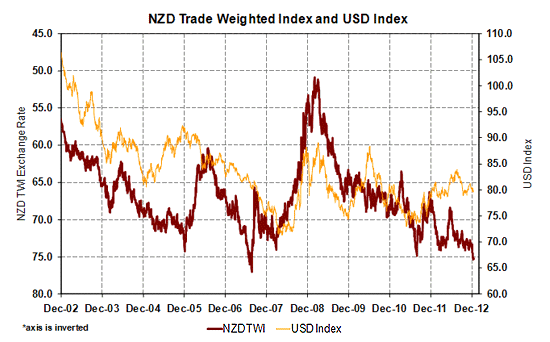
The big surprise is that the US fiscal cliff uncertainties have not caused increased financial/investment market volatility, perhaps it is still to come. Given the recent rapid gains for the Kiwi dollar from 0.8200 to 0.8460, the risk/reward equation favours a pull-back ahead of further gains above 0.8500. Exporters should be patient or hedging with purchased NZD call options only in this current environment. The gap the NZ dollar Trade Weighted Index (TWI) has put over the general USD currency value (USD Index) is now at the most extreme in 10 years.
If our export commodity prices were hitting record highs the superior NZ dollar performance would be justified, however the reality is that our commodity prices have returned to long-term average levels. The NZ economy has performed relatively well, but not that well. If the USD Index lifts to 85 or 90 next year, the NZ dollar TWI will not be staying at the 75 highs.
------------------------------------------------------------------------------------------------------------------------------
To subscribe to our daily Currency Rate Sheet email, enter your email address here.
------------------------------------------------------------------------------------------------------------------------------
Roger J Kerr is a partner at PwC. He specialises in fixed interest securities and is a commentator on economics and markets. More commentary and useful information on fixed interest investing can be found at rogeradvice.com
We welcome your comments below. If you are not already registered, please register to comment
Remember we welcome robust, respectful and insightful debate. We don't welcome abusive or defamatory comments and will de-register those repeatedly making such comments. Our current comment policy is here.