

 By Roger J Kerr
Yet again the Kiwi dollar has failed to hold onto its gains above 0.8400, largely due to global investors/currency traders being unwilling to buy the Aussie dollar aggressively in the $1.0500’s against the USD.
Despite improving Chinese economic data, improving hard commodity prices and a weaker USD against the Euro, the Australian dollar has not been able to appreciate further over recent weeks.
Lower gold prices as global financial risks reduce may be one reason for the relatively poor AUD performance in the circumstances, however increasing expectations of weaker domestic (non-resources sectors) economic data in Australia appears to be behind the reluctance to buy the currency.
The Aussie moneymarkets are currently pricing-in a further 0.40% reduction in the OCR by the RBA this year.
There is a major support area for the NZD/USD rate at 0.8250; a break below this point coupled with the EUR/USD rate reversing to $1.3000 from above $1.3400 may well provide the market environment to send the Kiwi to even lower levels.
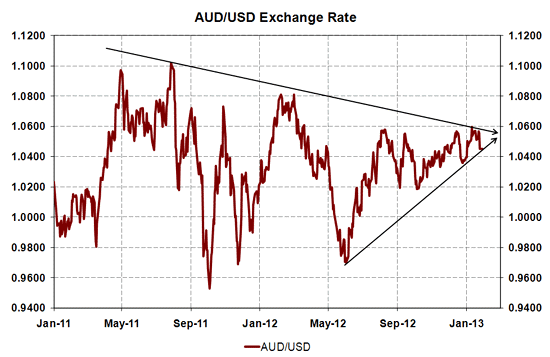
As the AUD/USD chart below depicts, the Aussie dollar has encountered major resistance at the $1.0600 level over the past six months and a fall below $1.0400 breaks the uptrend support line.
“Biological risk” raised its head as a new factor influencing NZD/USD exchange rate movements last week as the DCD traces located in our dairy exports was widely reported internationally. The rumours, speculation and headlines may have sent a brief scare across the FX markets, however the fact that the amount of DCD found was 100 times less than the European allowable limit does render the issue as immaterial.
Nevertheless, the media reports do remind us that perception is often more important than facts and the NZ economy (thus currency value) is always vulnerable to agriculture related event risks.
The media is reporting the woes of some exporting manufacturers who seem to want a subsidy from NZ taxpayers against the USD currency being weak.
New Zealand abandoned subsidies in the late 1980’s as they were detrimental to our economic well-being and distorted investment and a whole lot of other business behaviour. It is unfortunate the media does not also report the companies that do hedge their FX risks which buys them time to adjust their business models to the reality of an 80 cent exchange rate.
What is disturbing about the exporters fronting the manufacturing crisis inquiry (sponsored by left-leaning politicians) is that they are seemingly harking back for the previous “fortress New Zealand” environment that does not exist in today’s globalised economy.
The “high” exchange rate is an easy thing to blame for poor performance, however it is a financial risk for these businesses that can be managed, contained and spread just like any other business risk. Cries for special treatment for this sector of the economy should and will fall on deaf ears.
The RBNZ does now have other tools in its kit-bag to contain inflation rather than relying solely on ramping up interest rates when the economy starts to heat up.
These “macro-prudential” measures potentially being enforced on the banks are the funding ratio, LVR ratios and capital adequacy ratios.
Changes to any of these will slow bank lending, credit growth, the housing market and thus GDP growth that may be causing the inflation pressures.
The Government and the RBNZ need to respond to the headlines coming out of the manufacturing inquiry with some of these facts.
------------------------------------------------------------------------------------------------------------------------------
To subscribe to our daily Currency Rate Sheet email, enter your email address here.
------------------------------------------------------------------------------------------------------------------------------
Roger J Kerr is a partner at PwC. He specialises in fixed interest securities and is a commentator on economics and markets. More commentary and useful information on fixed interest investing can be found at rogeradvice.com
No chart with that title exists.
We welcome your comments below. If you are not already registered, please register to comment
Remember we welcome robust, respectful and insightful debate. We don't welcome abusive or defamatory comments and will de-register those repeatedly making such comments. Our current comment policy is here.