

The Reserve Bank (RBNZ) has had a good couple of weeks.
As anyone who has watched interest rates heading for the moon since mid-to-late 2021 knows, our central bank is involved in a 'to-the-death' battle with inflation, which in the space of not much more than a year rocketed from 1.5% in 2021 to a 32-year high of 7.3% in June of last year.
The RBNZ's task is maintaining inflation within a 1% to 3% range, with an explicit target of 2%. Our inflation rate has been outside the target range for well over two years and progress has been slow - much slower than expected - in reining it back in. The RBNZ's weapon of choice, the Official Cash Rate (OCR) was hiked all the way from 0.25% to 5.50% between October 2021 and May of this year as part of the hostilities.
So, in the context of this, the latest Consumers Price Index (CPI) figures released on October 17 and showing an annual rate of inflation of 5.6% as at the September 2023 quarter, were encouraging. The RBNZ had beforehand forecast a 6.0% rate - so the actual rate 'beat', in a definitely good way, the RBNZ forecast.
Digging down a bit though, and the key component of inflation - in terms of the RBNZ being actively able to do something about it - is the domestically-sourced, or non-tradable, inflation. The RBNZ had forecast that this figure - which was showing signs of remaining stubbornly high - would drop in the September quarter from an annual rate of 6.6% to 6.2%. It 'missed' slightly on this forecast as the actual figure came in at 6.3% - but close and encouraging enough.
So, anyway, some signs there that inflation is starting to 'play ball'.
Next up came the labour market figures, released on November 1. In short, the RBNZ wants to see some 'slack' develop in the jobs market and for the rate of wage growth to slow. Well, the unemployment figure, rising from 3.6% to 3.9% came in higher than the RBNZ's 3.8% forecast, while wage growth as measured by private sector ordinary hourly wages came in exactly as the RBNZ picked, at 7.1%, down from 7.7%. Super encouraging for the RBNZ.
The upshot of all this is that there is now virtually no chance the RBNZ will hike the OCR again when it has its last review of it for the year on November 29. The next review is not till February 28, 2024.
So, will this perhaps be the chance for the central bank to send us on our summer holidays with a reassuring, 'we are on track, enjoy your holidays' message? Well, you might think so, wouldn't you?
Ah, but as they don't say, every silver lining has a cloud, or in this case two clouds.
And these clouds were present, but in an almost oddly peripheral way, in the RBNZ's latest six-monthly Financial Stability Report (FSR), released on the same day as the labour market figures.
Cloud 1: The housing market has woken up again. Cloud 2: Migrants are pouring in again.
Problem?
Migrants need houses to live in. Did someone say inflation risk?
There's irony here. The new wave of migrant workers are clearly helping enormously to take the heat out of the labour market. But clearly they would already be having an impact on the upward bound rents, particularly in Auckland, the largest city, which according to Statistics NZ had population growth of 2.8%, or 47,000 in the 12 months to June 2023.
We've been building lots of houses by NZ standards, but now that's all starting to fall off a cliff. To use the above mentioned Auckland as an example, in September there were 42% fewer new dwelling units consented for Auckland than in September 2022. This in a city that's just added 47,000 people to its population.
The FSR featured this rather telling graph:
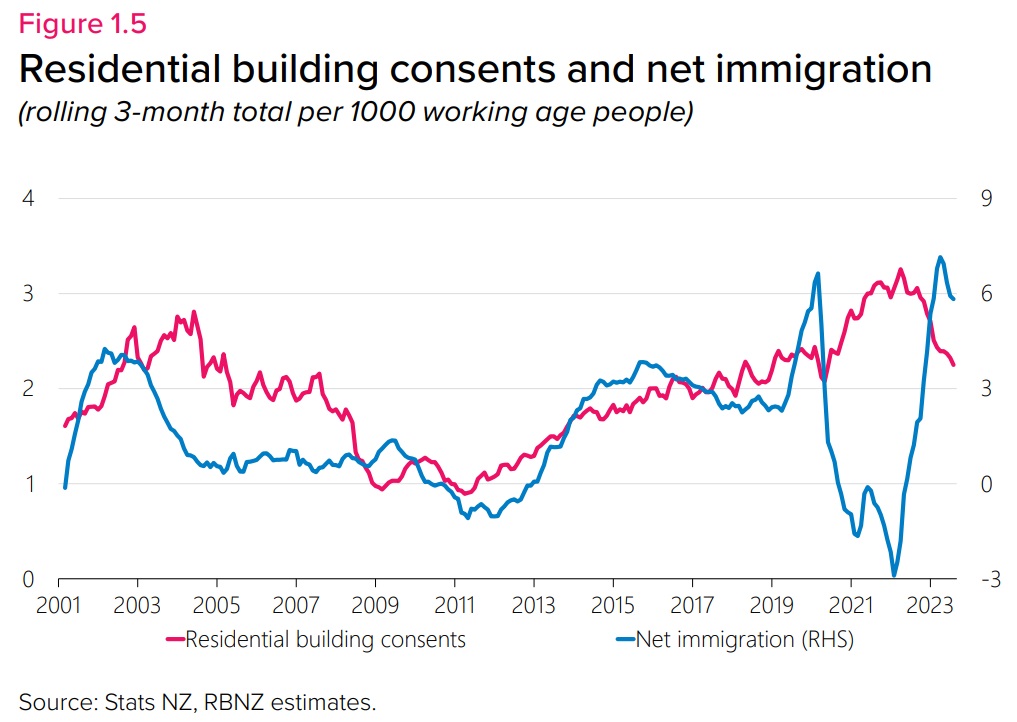
Talk about two lines heading in the wrong directions!
The RBNZ's language in describing all this in the FSR is very dispassionate. Facts are displayed without comment as to potential ramifications. The RBNZ mentions the fact that house prices have stabilised and are now rising again. It doesn't mention that the total quantum of the fall in prices was less than it had earlier forecast. It expresses no surprise at how swiftly the stabilisation has occurred and the quantum of rise - though clearly it is surprised.
Here's two quick grabs from the FSR:
"House prices have stabilised in spite of ongoing tight lending conditions."
"Several factors explain the recent rise in house prices, partly reflecting the large net immigration New Zealand is currently experiencing."
There's no attempt to suggest where these things might be leading. And, it has to be said, the Financial Stability Report is not the place to be opining about things that might have implications for inflation and interest rates.
No, that will come in the next Monetary Policy Statement (MPS) to be released in conjunction with the next OCR review on November 29. I'll have plenty more to say about that OCR review nearer the time. All I would say now is I'll be very surprised if the words 'migration' and 'house' are not featured very prominently in that MPS.
To me the mention in the FSR of the rising house prices and the role migration is playing is like a marker. It's holding something up to draw your attention without (yet) offering substantive comment. Look at this, people. It's a problem.
Earlier this year the RBNZ played down the potential inflationary impacts of the rising tide of immigration. I'm thinking it's possibly changed its mind. For how long too, will the RBNZ continue to assure us that house prices are currently 'sustainable'? (No, don't read that as AFFORDABLE!)
New Zealand has elected a National Party-led Government. The National Party has already pledged to gradually restore interest deductibility for housing investors. It will restore the 'bright-line' rule (the capital gains tax that dare not speak its name) back from 10 years to the two years it was when originally introduced by the previous National Government.
The outgoing Labour Government opened the floodgates for inbound migration after saying we shouldn't do that again. It appears most unlikely National - based on what it has said - would reverse matters.
So, what we have is an RBNZ that probably feels it is getting inflation under control, but must be wondering where a fast rising population, a perking up housing market, and a freshly permissive Government are going to take us.
The big unanswered - as yet - question is whether we could or would see a concerted rise in house prices at a time of higher interest rates. It’s clear that the super low interest rates of the recent past were petrol on the fire. But rates are much higher now and so, theoretically should be a handbrake on the housing market, preventing it rolling away again.
But when it comes to New Zealanders and houses, I would never say never. This is a country that could, with closed borders and a foreign buyers ban in place, frenetically bid its house prices up 40% during a pandemic.
Investors have been notably sitting on the sidelines. If they think those ever rising rents are starting to maybe look attractive again even against the also attractive term deposit rates, then they might be inclined to have a nibble again. The Government will be on their side.
And what about if interest rates were to fall again? Petrol, anyone? After the weaker than expected labour market figures were released this week wholesale interest rate markets have begun pricing in OCR falls in the second half of 2024. I don't think that's what the RBNZ would be saying should happen. Not. At. All.
For the RBNZ all this migration-housing-inflation soup is not a problem right at the moment. But it might be soon. If we 'misbehave' with our housing market (yet) again we may yet face the spectre of both inflation and interest rates that are higher and for longer than anybody would like to currently imagine.
What you can say is, just at the time it looks like the RBNZ is getting a handle on inflation, the one thing it would NOT need is the NZ housing market being, well, the NZ housing market..
*This article was first published in our email for paying subscribers early on Friday morning. See here for more details and how to subscribe.
We welcome your comments below. If you are not already registered, please register to comment
Remember we welcome robust, respectful and insightful debate. We don't welcome abusive or defamatory comments and will de-register those repeatedly making such comments. Our current comment policy is here.