

Here are the key things you need to know before you leave work today (or if you work from home, before you shutdown your laptop).
MORTGAGE RATE CHANGES
No changes to report today. All current mortgage rates are here. And note, you can compare mortgage offers with our new calculator that takes into account other costs and cashback incentives, here.
TERM DEPOSIT/SAVINGS RATE CHANGES
None here either. These changes essentially match the big five banks. Here is a review of the current state of play. All updated term deposit rates less than 1 year are here, for 1-5 years, they are here.
CHRISTCHURCH & QUEENSTOWN SHINE IN OTHERWISE DULL RESULT
Ready-mixed concrete production eked out its first positive annual growth in more than three years, with volumes in Q4-2025 up +0.4% from a year earlier. Leading the rise was Christchurch, up +11% and Otago/Southland region (presumably driven by the Queenstown/Wanaka area) up +13%. Auckland remained weak, down -3.5 on that same basis, Wellington was down -1.2%.
60,000 HOMES UNINSURED
Insurance affordability and the financial settings are a 'downstream symptom' of increasing risk, the Natural Hazards Commission boss says, as Southern Response continues to expect new claims.
DAIRY PRICES RISE AGAIN
The overnight dairy Pulse auction not only confirmed the prior week's sharp rises, it added to them. WMP was up a marginal +0.4% from a week ago to be up +14% from the start of 2026. Butter was up +6.8% from last week, up +18% year-to-date. And the SMP price was up +1.7% from last week, also up +14% so far this year. Everyone in the industry will welcome this confirmation of the recent rising trend, even if some of it is just USD weakness.
PUBLIC SECTOR CORRUPTION RISES AGAIN
New Zealand's Corruption Perceptions Index score has fallen by two points for the fourth consecutive year, a 10% drop overall. While we still rank equal fourth with Norway, this continued slide reflects diminishing confidence among business experts and international assessors in the integrity of the public sector. Over the past year, prosecutions involving bribery, deception, and misuse of public funds and power, including bid-rigging, cartel behaviour, driver licensing rorts and COVID-related fraud, have highlighted systemic weaknesses and a troubling disregard for both public money and integrity in general. The scale of the issue in the private sector is unknown. It isn't likely to be less.
THE SCOURGE OF UNINSURED CARS ON THE ROADS
Unlike Australia, we don't have compulsory third party car insurance (to get a car registered). The transport minister thinks the gains wouldn't be as good as some claim. (He is likely wrong about that.)
DO OUR QUIZ
Our quiz has been updated for this week's edition. You can do it here. And a new one will be added every Monday.
HOW TO MAKE $765 MLN IN SIX MONTHS, 12% PA ON CAPITAL INVESTED
ASB's CEO says she sees 'more confidence in the economy' as rising costs hold down the bank's half-year profit increase to just +1%, despite a net interest margin rise to 2.35% from 2.24% a year ago. The increase was attributed in part to higher home lending margins. Staffing rose from 6272 to 6897 employees. Parent CBA also posted a AU$5.4 bln profit result and its stock price has risen +6.8% so far today, although only up +4.8% from a year ago.
POLICY YO-YO?
Westpac economists are now forecasting six OCR hikes over the period to the end of 2027, taking the OCR back to 4.0% or more. It was last at 4% in February 2025, so a pretty rapid back-track over two years is being predicted. "We think at this point just modestly restrictive interest rates of around 4.25% will be ultimately required to keep inflation close to 2%." (Yes, it's only one analyst's prediction.)
NZX50 IN ANOTHER SMALL SLIP
As at 3pm, the overall NZX50 index is down another -0.2% so far today. That puts it up +0.5% over the past five working days. It is up +4.4% from six months ago. From a year ago it is now up +4.4%. Market heavyweight F&P Healthcare is down -1.5% so far today in a yoyo pattern. Kathmandu, Sky TV, a2 Milk, and Investore Property lead the gains for the NZX50; Serko, EBOS, Tourism Holdings, and Freightways are the main the decliners
MONDAY MORNING QUARTERBACKS
The Government has instituted an inquiry into the RBNZ's pandemic response, to be released before the election (and become a stick they can beat the Labour Party with). They have appointed monetary policy experts Athanasios Orphanides and David Archer to conduct it. Dr Orphanides is a former governor of the Central Bank of Cyprus and member of the Governing Council of the European Central Bank, and a professor of the Practice of Global Economics and Management at the Massachusetts Institute of Technology. David Archer is a former Reserve Bank assistant governor and former head of the Central Banking Studies Unit at the Bank for International Settlements, which he left in 2022. (See Transparency International's report above. If this was a genuine review, they would have called it when National/Act/NZFirst took office in 2023. Waiting to weaponise it as an election issue smells like pure theater.)
SURGING
In Australia, the number of new owner-occupier new home loan commitments rose +7.5% in the December 2025 quarter compared with a year ago. On a value basis, that rose +18.9%. For housing investor loans for the same periods, the number of new loans rose +24%, and their value rose +32%.
INFLATION ERADICATED?
There is still no inflation in China, and it has turned toward deflation faster than expected. Their annual inflation rate eased to +0.2% in January from an already very low 0.8% in the previous month. This is its lowest level since October and below market estimates of 0.4%. Food prices fell for the first time in three months (-0.7% vs 1.1% in December) while non-food inflation slowed sharply too (0.4% vs 0.8%). Meanwhile, Chinese producer price deflation eased to -1.4%.
SWAP RATES EASE SLIGHTLY
Wholesale swap rates are probably marginally softer today. Keep an eye on our chart below which will record the final positions closer to 5pm. The 90 day bank bill rate held at 2.49% on Tuesday. Today, the Australian 10 year bond yield is down -8 bps at 4.77%. The China 10 year bond rate is little-changed but now just under 1.80%. The Japanese 10 year bond is down -3 bps at 2.24 bps today. The NZ Government 10 year bond rate is down -4 bps at 4.52%. The RBNZ data is now 'prior day' with Tuesday's rate down -1 bps at 4.53%. The UST 10yr yield is down another -5 bps from yesterday, now below 4.14% and its lowest level of 2026.
EQUITIES MIXED, BUT TOKYO CONTINUES TO STAR
But the local equity market is a little softer in Wednesday trade, down -0.4% so far. The ASX200 is up +1.4% however in afternoon trade. Tokyo is up another +2.3% in its opening trade, with a post-election glow extending further. Hong Kong is unchanged today so far and Shanghai is up +0.1%. Singapore is unchanged at its open. Wall Street ended its Tuesday trade with the S&P500 down -0.3%.
OIL LITTLE-CHANGED
American oil prices are up about +50 USc from yesterday at this time at just on US$64.50/bbl, but the international Brent price is holding at just on US$69/bbl.
CARBON PRICE RISES AGAIN
There have been some more trades today on the secondary market and the price has risen +$2 to $40.25/NZU. See our daily chart tracker of the NZU price for carbon, courtesy of emsTradepoint.
GOLD FIRMS SLIGHTLY AGAIN
In early Asian trade, gold has risen slightly from this time yesterday, up +US$20/oz and now at US$5048/oz. Silver is unchanged at just over US$82/oz.
NZD ON HOLD
The Kiwi dollar is unchanged from this time yesterday against the USD, still at just on 60.5 USc. Against the Aussie we are down -10 bps at 85.3 AUc. Against the euro we are up +10 bps at 50.9 euro cents. This all means the TWI-5 is now just on 63.9 and unchanged from yesterday.
BITCOIN RETREATS
The bitcoin price is now at US$68,979 and down -2.0% from this time yesterday. Volatility has been modest however at +/- 1.8%.
Daily exchange rates
Select chart tabs
Daily swap rates
Select chart tabs
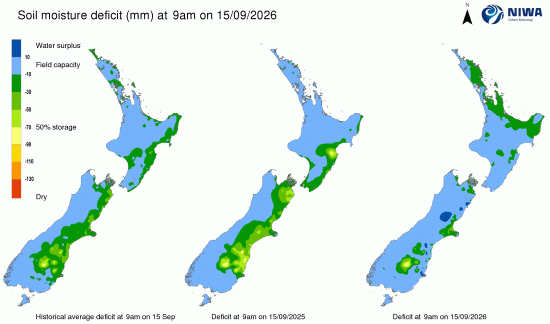
This soil moisture chart is animated here.
Keep abreast of upcoming events by following our Economic Calendar here ».
19 Comments
In Australia, the number of new owner-occupier new home loan commitments rose +7.5% in the December 2025 quarter compared with a year ago.
A 9.5% QoQ print against 4.8% expected implies roughly double the forecast impulse to housing credit in one quarter.
Aussie inflation must be worst in the developed world. And with the govt throwing everything at the Ponzi, this should really come as no surprise. The investor share of total finance continues to trend up with the FHB share trending down, even with Albo's reckless 5% deposit scheme.
https://australianpropertyupdate.com.au/apu/rba-move-prompts-big-banks-…
Aussie look similar to where we were post Covid.
CBA market cap approaching $300bn. Of the top 10 stocks on the ASX, 5 basically print money for the Ponzi; 3 are miners.
Make of that what you will.
https://companiesmarketcap.com/aud/banks/largest-banks-by-market-cap/
Public Sector Corruption Rises Again. That captioned segment, given the great deal of government printed money spent, is not entirely divorced from the entry below, the new RBNZ enquiry. There was at that time too a huge influx of public servants. It is all rather disquieting. Past exposures of corporate failures, and that of other largish entities, have always revealed that what looked bad from the outside was inevitably found to be, far worse on the inside. The Australians aptly and accurately describe this as the outfit as having been white anted. It is disquieting because trends are indicating that in NZ it is becoming more and more easy and prevalent for systems, businesses and civil services to be rorted and profligately abused and there is neither accountability nor restitution to follow.
More stunning news from the U.S. CRE apocalypse. This seems unimaginable before the pandemic:
Portland’s 20 largest office buildings have lost nearly 70% of their market value since 2019.
https://katu.com/news/investigations/combined-market-value-of-top-20-of…
Looks like NZ is still well isolated from this. The NZ listed REITs are starting to look like a decent purchase again with prices lower, presumably on interest rate fears. Most have significantly lowered their gearing over the last few years.
"Argosy Property Limited (‘Argosy’) has today announced it has unconditionally sold 4 Henderson Place, in Auckland, for $39.75 million. The sale price reflects a premium of 16.6% above its book value as at September valuation"
Maccy B take on Mad Albo's plan to flood the country with migrants but not invest in infrastructure. Aotearoa gets a mention.
The rental market will remain tight unless the federal government reduces immigration to a level below the nation’s construction capacity.
Canada and New Zealand offer templates for solving Australia’s rental crisis.
Put simply, immigration must be significantly reduced to allow housing supply to catch up. The equation is that simple.
https://www.macrobusiness.com.au/2026/02/the-solution-to-the-rental-cri…
Look what’s happened to our economy since we adopted our template
It's almost like a consumer based economy is only healthy as long as there's a steady replacement or increase of consumers.
I think you will find it’s debt that’s needed but yeah ponzi needs more entrants but now world has low birth rate
make the obvious more obvious
I think normally people trade up as markets pull back like this , but anyone who bought a first home 7 years ago (average hold time) have not got enough equity to risk the increased debt to step up the ladder. I am pretty convinced this is causing the stock buildup, its not all lower quartile.
I think the rungs on the ladder may need to compress to allow a more functional market.
People on this site get lost in the credit part of the equation. It's not insignificant, but also some of the world's least affordable cities have credit that's much more expensive, and harder to come by than in NZ.
Everyone moves to the cities because they offer more opportunities than whatever smaller town you're from. The problem is someone else usually already owns the better land in the cities, so you get to scrap with each other over the dregs, whilst being reliant on external parties for all the stuff you need to live.
Always ends the same, with or without debt. The debt just delays the death. Or maybe makes the bang bigger.
Yep, the growth is caused by an increase in population not an increase in productivity. Still at 5 million we can keep doing this for a very long time. Japan has 25 times our population in a similar area.
Our people are voting with their feet, moving to Aus, they don’t like our new template. I guess it’s because their parents have benefited and then shut off the tap.
There was a way of life promoted that was contingent on a bunch of things staying the same (or continually improving). We had population growth and productivity growth occuring simultaneously. Now both are plateauing.
But any job that's not location specific usually ends up migrating to where it can be done more efficiently. People like to think they can radically upend things just by moving location, but the model runs out pretty similar wherever it's implemented.
"There is still no inflation in China, and it has turned toward deflation faster than expected."
Surely this is precisely what should be expected in a banking model where the MS is created as a public utility, as opposed to allowing private banking cartels to create ~97% of the currency out of thin air as debt, when they write up loans.
Inflation is the silent tax on the productive economy and the working class, as the money-changers who sit closest to the global money spigots line their pockets with obscene amounts of wealth whilst they finance both sides of the forever wars.
When deploying the Public Banking Solution (PBS,) the multi-billions of currency, which would otherwise be siphoned off as unearned rent by privately owned banking corporations, would instead be received as revenue by the Treasury to be used to invest in infrastructure, the productive economy and creating long-term societal wealth. Every dollar received by the Treasury in this system is a dollar that doesn't have to be collected as a tax.
Furthermore, as a corollary to the PBS, the efficiencies derived from advances in technology mean that all production costs can be dramatically reduced. The reduction or elimination of financial costs of infrastructural and long-term wealth-generating projects means that many of these actually get done, can be self-funding, or quickly turn into a windfall for the national economy.
The trifecta is to adopt a genuinely hard-backed currency, and then by definition, attain a deflationary, financial monetary model - one that the productive economy and the working classes thrive within, and which the financial/casino/Ponzi economy, the global corporations, and their political shills, absolutely loathe.
The solution is staring society in the face, but brokering it is effectively a political impossibility when the plutocracy and their political hacks are already so totally invested in this 113-year-old wealth heist
Deflation is a monetary condition that humanity should aspire to, just as we should hold onto our essential public utilities and not hand them over to private monopolies. Absolutely foremost amongst those essentials is money creation.
A classic example of how dramatically this model has worked in the past, for the good of the entire nation, is outlined in Section 7 "The Commonwealth Bank of Australia — a Public Banking Utility Masterstroke"... from the link below"...
https://sovereignista.com/2024/02/29/banking-2-0/
Cheers
Col
If there was a fixed money supply
And you're born into the world with nothing
How would you ever be able to obtain money?
Human civilisations invariably end up as a hierarchical power structure, the form of money and debt is really just an accounting format.
We have a democratic means to tip scales but we wield it poorly.
You said... "If there was a fixed money supply"
Where on Earth does this "fixed money supply" notion come from?
In the PBS model, MS is not "fixed" - on the contrary, it provides liquidity for the productive economy rather than handing it out on a platter for the financial casino.
This model is precisely why the Bank of North Dakota has enabled that state to sail through the Great Depression and all the other private bank-orchestrated pump-and-dump schemes for the last 107 years.
When times get tough, this model increases liquidity for the real economy rather than sucking the life out of it like a giant squid.
Quoted from the link below...
"Besides a profitable business plan, politicians need a push from their constituents to take action, and most people haven’t heard of public banks and don’t understand the concept. Wider public exposure and education are necessary.
Even many politicians are unaware of how banking actually works. Chartered depository banks have the power to create money as deposits when they make loans, expanding the local money supply and increasing the capacity for local productivity. Over 95% of our money supply today is created by banks in this way.
This vast power to create money as credit is one that properly belongs in the public domain. Times are changing, and public banking momentum continues to grow. By making banking a public utility, with expandable credit issued by banks that are owned by the people, the financial system can be made to serve the people and local enterprise without draining their resources away.
Credit flow can be released so that industry and free markets can thrive, and the economy can move closer to reaching its full potential."
https://ellenbrown.com/2025/01/15/beating-wall-street-at-its-own-game-t…
Where on Earth does this "fixed money supply" notion come from?
That was implied by "hard backed" in your first post.
A small amount of research into the Bank of North Dakota shows a large amount of extremely dissatisfied customers who cite predatory lending behaviour by the bank.
If the setup there was as you are promising, North Dakota would be a more prosperous state, instead of a middle of the road one propped up by fossil fuel income. It's also at the lower end of the spectrum in the US for wealth equality - the banking system there might sound "fairer", but it has not fundamentally altered the fortunes of the public over and above that of the rest of the country who have alternate banking institutions.
If what you were floating was a panacea, the results would be more conclusive. Instead it sounds like a footnote in the Creature from Jekyll Island.
Clearly, you love to regurgitate the nonsense that the status quo private banking cartel spouts, as they continue to rob societal wealth by multiple billions every year throughout the Western world.
"A small amount of research" should have shown you that the BND itself is not implicated in these predatory practices that you site. Rather it is other lenders offering high-interest loans, such as "Rent Now, Pay Later" schemes, which have been criticised for exploiting vulnerable borrowers.
While rumours of predatory lending are circulating in the broader financial landscape, the Bank of North Dakota maintains a focus on community support and responsible lending practices. It is essential to differentiate between BND's operations and the actions of other financial entities that may engage in predatory lending.
The Bank of North Dakota operates as a public bank focused on serving the public interest, providing loans at below-market interest rates and prioritising community development, unlike private lenders that prioritise profit and shareholder interests. This ethical approach helps reduce dependency on private banks and supports local businesses and agriculture.
Your comparison between the Fed and the BND public banking model shows that you have close to zero understanding of either model, as one is owned by the state and the other is 100% owned by a cartel of thieving private banks.
In the case of the NY Fed, the most obscene money spigot on the entire planet, it is more than 70% owned by just two megabanks - Citigroup and JPMC.
As such, your attempt at trying to compare the BND model with The Creature From Jekyll Island is laughable.
DEPOSIT GUARANTEE SCHEME
This is funded by levies on individual, participating deposit takers, collected by the Reserve Bank of NZ. The levies and the formula of levy assessment are not publicly disclosed.
Why not?
What has spurred this question is that a second tier lender that I have had term deposits with typically paid greater than 2% higher interest than first tier lenders. Now it offers 0.5% more.
My understanding of how second tier lenders work is that they lend money to borrowers that are unable to secure borrowing from first tier lenders. Such borrowing is deemed to carry higher repayment risk and therefore is charged a higher interest rate reflecting the risk.
I speculate that those second tier lenders continue to lend to higher risk borrowers at higher risk weighted interest rates - business as usual.
But they now pay depositors a much lower interest rate than previously because the first $100,000 of the investor's deposit is protected by the deposits guarantee scheme, reducing risk to the depositor.
I speculate the second tier lenders have not changed the risk weighting of interest charged on money lent. I further speculate that the levies paid to participate in the deposits guarantee scheme are less than the drop in depositor interst rates. And that second tier lenders will be making a higher return from lending, over their cost of deposits, than in the era preceding the introduction of the deposits guarantee scheme. If that is the case, then it is an inequitable cost to depositors.
For transparency, the formulae of levy calculation should be made publicly available by the Reserve Bank of NZ. The deposit guarantee scheme was inititiated to provide a greater degree of security to savers in an adverse economic shock. NOT a means of increasing profitability for deposit takers, which I suspect is occurring.

We welcome your comments below. If you are not already registered, please register to comment
Remember we welcome robust, respectful and insightful debate. We don't welcome abusive or defamatory comments and will de-register those repeatedly making such comments. Our current comment policy is here.