

Here are the key things you need to know before you leave work today (or if you work from home, before you shutdown your laptop).
MORTGAGE RATE CHANGES
No changes to report today. All current mortgage rates are here. And note, you can compare mortgage offers with our new calculator that takes into account other costs and cashback incentives, here.
TERM DEPOSIT/SAVINGS RATE CHANGES
There are no changes today. Here is a review of the current state of play. All updated term deposit rates less than 1 year are here, for 1-5 years, they are here.
WEAK START I
The housing market made a weak start to 2026 with sales volumes and prices both softer in January, according to the latest REINZ data. And the number of new listings in January was the second highest for any month since the end of 2021. Although the stock of property for sale fell slightly, it is only 1.2% below October 2025’s 10-year high.
WEAK START II
According to StatsNZ electronic card transaction data, total retail sales were only up +0.4% from the same January month a year ago, with core retail up only +1.1%. There vale changes are not inflation adjusted, so that means they fell in real terms. Seasonal adjustment doesn't make the data look any better. All the same, the retail industry is desperate for any signs of gains and welcomed this result.
TURNING AROUND
In contrast, the BNZ/BusinessNZ services PMI was more upbeat. The service sector expanded again in January, following on from similar growth in manufacturing. 'The big question to end 2025 was whether the economy may be turning. Data since then has given us confidence that recent positive momentum can be sustained. The economy is growing', noted BNZ.
STABLE BUT OLDER
StatsNZ said the resident population of New Zealand was 5,342,000 as at December 31, 2025. That is up +0.6% for the year. We also ended the year with the median age of the population at 38.4 years, its highest ever.
DIFFERING VIEWS
The RBNZ H1 survey of households and their inflation expectations shows then thinking inflation will be 4.0% in one years time, just as they did in the December 2025 quarter. Still, that is quite a bit more than the M14 survey of 'experts' released on Friday which suggested it would be 2.59% in one year. However, the consumer survey isn't getting worse so the RBNZ may well like that aspect. Also see this.
NEW QUIZ
Our quiz has been updated for this week's edition. You can do it here. And a new one will be added every Monday.
MAKING EDEN PARK GREAT AGAIN
Under the new settings, Eden Park will be able to host up to 12 large concerts and 20 medium-sized concerts per year as permitted activities, without needing resource consent. That’s up from its current limit of 12 concerts, which were not permitted to be from more than six different artists or acts. Timing restrictions will also be eased.
NZX50 TURNS DOWN AGAIN
As at 3pm, the overall NZX50 index is down -0.7% so far today and falling. That puts it down -2.5% over the past five working days. It is up a meager +1.1% from six months ago. From a year ago it is now up only +0.3%. Market heavyweight F&P Healthcare is down -5.0% so far today. a2 Milk, Tourism Holdings, Vulcan Steel, and Gentrack lead gains with Meridian, Fletcher, Mercury, and Ryman the main decliners.
TO BE SOLD AGAIN?
Morgan Stanley Infrastructure, the owner of Strait Ferries and the operator of the Bluebridge Cook Strait service, is looking to offload them and has put them up for sale, or so the market chat goes.
SWAP RATES FALL
Wholesale swap rates are probably lower today except perhaps for the 1 year. Update: they eased across the maturity curve, and by a bit more than we suspected. Keep an eye on our chart below which will record the final positions closer to 5pm. The 90 day bank bill rate was up +2 bps at 2.51% on Friday. Today, the Australian 10 year bond yield is down -2 bps at 4.73%. The China 10 year bond rate is down -1 bp at 1.81%. The Japanese 10 year bond is down -1 bp at 2.20 bps today. The NZ Government 10 year bond rate is unchanged from this morning at 4.50%. The RBNZ data is now 'prior day' with Friday's rate down -5 bps at 4.47%. The UST 10yr yield is down -1 bp from this morning, now just on 4.05%.
EQUITIES MIXED BUT QUIET
But the local equity market is lower in Monday trade, down -0.7% so far following Friday's fall. The ASX200 is up +0.2% in afternoon trade. Tokyo is down -0.2% in its opening trade. Hong Kong is up +0.2% today so far but is only open for the morning, and Shanghai is closed for a week. Singapore is closed today too. Wall Street is on holiday, President's Day, and won't be back until Wednesday, our time.
OIL HOLDS
American oil prices are little-changed from this morning at just under US$63/bbl, while the international Brent price is now over US$67.50/bbl.
CARBON PRICE STABLE
There have been very few trades today on the secondary market and the price is back to at $40/NZU. See our daily chart tracker of the NZU price for carbon, courtesy of emsTradepoint.
GOLD HOLDS
In early Asian trade, gold has fallen marginally from this morning, down -US$13/oz and now at US$5028/oz. Silver is up +50 USc at just on US$78/oz.
NZD QUIET
The Kiwi dollar is unchanged from this morning's open against the USD, still at just on 60.4 USc. Against the Aussie we are down -20 bps at 85.2 AUc. Against the euro we are unchanged at 50.9 euro cents. This all means the TWI-5 is now just on 63.7 and unchanged from this morning.
BITCOIN NET STABLE
The bitcoin price is now at US$68,656 and and up just +0.1% from this morning's open. Volatility has stayed moderate however at +/- 2.1%.
Daily exchange rates
Select chart tabs
Daily swap rates
Select chart tabs
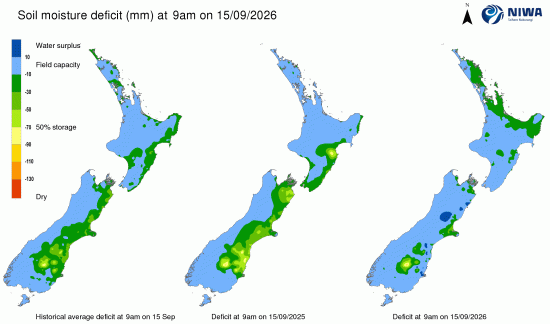
This soil moisture chart is animated here.
Keep abreast of upcoming events by following our Economic Calendar here ».
42 Comments
So Dutch lawmakers are greenlighting 36% tax on unrealized gains for rat poison, crypto, stocks & savings. Paper profits will be taxable starting 2028.
Any asset held by Dutch citizens is now at risk of experiencing forced liquidation pressure. So, it’s not just that you don’t want to hold assets as a Dutch taxpayer, you also don’t want to own assets that the Dutch own. The logic of forced liquidation is contagion.
ASML - semiconductor equipment champion and the sole supplier of extreme ultraviolet lithography machines - is currently the most-held individual stock among Dutch households and one of the most popular Dutch-listed equities.
https://dutchreview.com/news/asml-shares-now-most-popular-dutch-investm…
If Inland Revenue took down Capone
They'll make short work of crypto collectors.
It's like thinking you can slap "sovereign citizen" over your license plate, not get a rego or warrant, and be able to use public roads with impunity.
No need to fear P. Crypto and CGT are no immediate threats to the Aotearoa Ponzi.
Governments seem to change the rules every few years, nothing is safe.
The safest is probably physical greenbacks. I can be basically anywhere on earth, and if I have greenbacks, I can conduct a trade.
Will dykes be exempt?
Too true, Phoenix, especially when it comes to rat poison, the 21st-century version of tulip bulbs, only with even less intrinsic value.
I wonder how well this will work when the asset bubbles burst that the Western-facing financial casino and central banks have been busily inflating for the last few decades.
Currency debasement is already a silent tax on the working class and the real economy, and now the Dutch want to tax their economy on unrealised gains when they are measured in massively debased fiat/monopoly money? For crying out loud, this is dumber than dumb, even by today's appallingly desperate Western-based money changer standards.
The scheduled 2028 launch will be well after all the huge multiple asset bubbles have already burst - how will that work out? To me, this is just another pathetic grasping of straws by authorities who deliberately obfuscate the distinction between real money and credit, and how the massive debasement of all fiat currencies signals that the system is already broken.
Case in point - the British gold sovereign, first minted in 1817, contained 0.2354 troy ounces of silver, and had a redeemable value of £1 for 114 years straight.
After 1931, you could no longer exchange a gold sovereign for £1 at the Bank of England. In that year, the UK abandoned the gold standard, and the practice of exchanging sovereigns for their face value in pounds was discontinued.
The coin remains essentially the same except that one will now cost you ~£850 in fiat tokens, meaning it is down to 1/850th of its original face value.
In terms of gold's totally rigged spot price at today's £1633/oz (calculation £1633 x 0.23540 = £384), it is down to a measly 1/384th of that figure.
And the moral of the story? Well, the real economy, as per usual, will be taxed six ways to Sunday as the asset bubbles burst, and the entire fiat money system implodes.
When a powerhouse productive economy like the Netherlands plans desperate economic idiocy of this nature, what hope is there in hell for the remainder of the West, when the 55-year-old fiat experiment is already unravelling at a rapid rate of knots?
Well, most (emphasis on most) humans in history have only ever really transacted via physical trade. Money usually only restricted to merchants, or some level of officialdom.
The fact you, me, and any random is able to act like some sort of individual economic entity involves a fair deal of trickery indeed. Hence, most will be paid just enough to get by. You're not supposed to end up with a big surplus.
Still, well and truly beats most of those other experiences.
I'm confused about the crypto.
I thought it was an anonymous, borderless 'asset'. If so, how would a govt know who to tax when the gains are unrealized? They actually expect coin owners to honestly report their unrealized gains???
The Dutch seem intent on taxing themselves into oblivion. Capital flight anyone?
Someone gets it
" A new National Artificial Intelligence (AI) Council will be established and chaired by Prime Minister Lawrence Wong to coordinate and drive Singapore’s AI strategy."
https://www.channelnewsasia.com/singapore/ai-missions-healthcare-financ…
Would be a good gambit for a party to propose this in NZ, then ACT would have to explain why it's just more "bureaucracy"
Would have made more sense than the virtue signaling "Ministry for Regulation"
Dreadful stuff. Investigative reporting shows the ex-Aotearoa-South African Ben Mauerberger bagman involved in the online scam industry in ASEAN has been in cohorts with the Chairman and CEO of Sotheby's Real Estate UK and Dubai Girgi Azar.
In London, Azar’s Sotheby’s business was struggling. Sales were down 23% and tax reforms were pushing the ultra-rich out of the UK. He needed a win, and Dubai was booming.
While fronting luxury real estate, the Sotheby's CEO was quietly building Sovereign Capital in Dubai. This was a private investment vehicle built with Mauerberger’s inner circle. Its founders included a former Thai Deputy Finance Minister and Mauerberger’s top lieutenant, Eugene Tang.
The Sotheby's brand is now directly connected to one of the biggest criminal scams in history through Azar.
https://whalehunting.projectbrazen.com/the-swiss-attorney-and-the-sothe…
Great read thanks.
MAKING EDEN PARK GREAT AGAIN
Under the new settings, Eden Park will be able to host up to 12 large concerts and 20 medium-sized concerts per year as permitted activities, without needing resource consent.......
I don't live near Eden Park, so I don't get bothered by the noise [although I do think it's a crappy stadium for the spectator experience for oval ball sports], but it does strike me that unless it is a Six60 concert, any economic growth from a large concert is just going to foreign acts and promotors like LiveNation.
So where is the REAL net economic benefit that justifies central government stepping in and overriding localism ?
Hotels, pubs, restaurants, suppliers and contractors to Eden Park, taxis, Ubers, and all the other activities that visitors would do.
Then there are all the less obvious benefits - like professional people wanting to live here instead of thinking it’s boring as hell.
I do totally agree with that last bit. All those people who constantly whine about councils investing in "nice to haves" (like stadiums and events in them) forget that there are plenty of cities that died because the last person who lived there finally gave up waiting for something to happen, or a reason to be there. Palmerston North managed to recover from that somewhat.
Cities need some glitz and glam. Some pointless sculptures and maybe a bit of cocaine-fuelled imagination. Block after block of maximally-affordable prefab apartments do not draw in migrants and tourists, and don't put you on the map. The map is where innovative businesses want to be. Where retailers want to have a flagship store. Where airlines want to bother flying to.
I don't think Eden Park is worthy of central govt attention like this, but I salute an otherwise Soviet-themed government recognising the intrinsic value in art and intangibles.
Apparently real, in person experiences have more demand than supply at the moment.
Those that whine about the councils forget that businesses pay a lot of rates too. Many businesses care less about the supposed basics like rubbish and water, they much prefer the “vanity projects” like events and statues and town centres.
Akl property owns doing Air BnB or similar make out like bandits.
and they pay GST, so the government gets its dues too. Then all you need is a bed tax and maybe the city gets a net benefit.
Most of the media reaction to the seriously concerning card spending data today was positive, which is really weird.
It is becoming obvious that the money released by cheaper debt-servicing costs is being eaten up by local govt rates, insurance, and business margin / balance sheet restoration. Very little stimulus as a result... so the economy slides sideways, and the vibes surveys don't translate into any jobs growth. This is a recipe for stagnation. Meanwhile bank economists and the commentariat fill up column inches with 'when will RBNZ act to slow the economy down' articles.
We are about to find out that our post-GFC recovery was made possible by Govt capital investment, a huge injection of global reinsurance money, and a lucky as hell drop in imported energy prices from 2013 to 2015. Is that happening again? Well, Govt capital investment is definitely up, but it won't be enough on its own and most of the projects are crap.
LNG serves to replace a fuel we strategically went with because it was domestic, secure, inexpensive and relatively easy to transport with an internationally-priced, geopolitically affected pricy option. I think it'll act as an inverse energy price boost in the next decade or two. Maybe that'll make electrification actually competitive with gas and it'll amount to nothing, but we really don't have a lot of tailwinds to look forward to into the 2030s. It would be nice to see government recognise that in 10 years even MPs from their team are unlikely to look back on this period as one where sane choices were made.
most of the projects are crap
Most of the post GFC projects were fairly crap also.
Therein lies the problem with turning on money taps every time there's a downturn; you open yourself up to hasty, poorly conceived and executed lolly scrambles.
"Therein lies the problem with turning on money taps every time there's a downturn; you open yourself up to hasty, poorly conceived and executed lolly scrambles."
Sort of makes the case to have a long term plan in place, well researched by a competent (and well resourced) public service that can be implemented/accelerated or slowed as required.
If it were that worthwhile, you wouldn't have it sitting there just above idle.
But we are getting somewhere, it's not just enough to have hard and fast rules, it's really about the implementation. Which is something you want to work out before a recession, rather than during. Otherwise we are creating additional liabilities, just to smooth over economic down cycles.
"If it were that worthwhile, you wouldn't have it sitting there just above idle."
Why not....capacity, need and timing fluctuate but when something is needed asap or short term (including renewal /maintenance) it is a bit late to begin a planning process that is going to have any near term impact, hence our ongoing problems with poor and unnecessarily expensive options/decisions.
There is an increasing reality that such things must be planned, started and darn well near finished in one election cycle. The electorate is jumpy and impatient these days, and non-delivery is a very real criticism.
That means quick and dirty. Not necessarily cheap. But like we're seeing with recent highways, you can always rip them up the next year and do them again.
That appears to be so, however I suggest that is a symptom not the cause.
Why not
The energy and resources incurred just in the planning and commissioning stage means you want to get into the project, not just have it waiting for a rainy day.
It's also debatable how much spare capacity the construction sector has to divert to recession derived increases in public demand. Like, a bit, but likely nowhere near enough to cover the shortfalls across the country in all industries. Laid off cafe workers take a while to get good at concrete forming.
"The energy and resources incurred just in the planning and commissioning stage means you want to get into the project,"
You may wish to get into it but that dosnt mean it is the sensible thing to do. We (and other states) did exactly that in times past and it maintained a level of competence/capability that wasnt constantly being lost.
The point of the exercise is that the likes of the construction sector (and it does not only apply to that sector) does indeed have excess capacity at different stages of the cycle but under current settings we suffer the effects of boom and bust losing experience and capacity in the process that has to be rebuilt as evidenced by the industries own calls for pipelines of work everytime workload drops off.
It all begins with the planning....and we have lost the ability to do so. The private sector do not have the incentive nor the decision making capacity (authority) to do it so it must be done by the state.
You may wish to get into it but that dosnt mean it is the sensible thing to do
Expending lots of money not to do something doesn't sound very sensible.
it maintained a level of competence/capability that wasnt constantly being lost.
We're probably unlucky enough to have the construction labour force contract 5% in a down period. And that's not the best 5%.
Most of the lost competence is down to shifting desires for the sorts of work people want to do, the increased emphasis on university education over trades over the past few decades - because we thought that the economic carry over benefits from education was somehow a constant immutable.
It all begins with the planning....and we have lost the ability to do so. The private sector do not have the incentive nor the decision making capacity (authority) to do it so it must be done by the state
Well, it's too bad the state has made the process of construction so counter intuitive.
So after this exercise, are we promoting public spending in down periods, or some sort of strategic, decades long infrastructure roadmap with associated ministry of works?
"Expending lots of money not to do something doesn't sound very sensible."
That would depend on a cost benefit analysis....how much does the poor or lack of planning cost us? and it would be wise to remember that that 'cost' to the state is someone else's turnover.
"We're probably unlucky enough to have the construction labour force contract 5% in a down period. And that's not the best 5%."
Numbers are higher than that but it is not the construction capacity loss per se that is the problem, as stated it is the loss of the ability to plan....a loss of capability more so than capacity.
"So after this exercise, are we promoting public spending in down periods, or some sort of strategic, decades long infrastructure roadmap with associated ministry of works?"
A version of both.
That would depend on a cost benefit analysis
The cost benefit analysis happens earlier on in the process. Once you decide something is worthwhile, you cement it by finalizing all manner of things like engineering and architectural plans, and all the requisite consents and permissions.
That can all take years and much expense. Your proposal sounds like doing all that, and then having the project tick over, hoping for a down period to do a "surge". If you're serious enough to get something to shovel stage, you're generally going to want to box on with it. Construction projects usually go very badly when reliant on randomized externalities, the programmes for large capital works can be years long, requiring each stage to occur in a defined timeframe, so you're capable of resourcing the next one.
it is the loss of the ability to plan
Oh we can plan. Oh boy how we can plan. It's the loss of ability to implement things in an effective and efficient manner.
I'm not sure how the planning ability gets lost in a downturn either.
A version of both.
We can both probably agree we have a strong preference for competent central government. We are probably at odds with how feasible that is with our current political machine.
I am also fairly skeptical how worthwhile short notice projects to tide us over during a recession are. Like, we'll keep some jobs and fiscal velocity, but it's sorta like buying fuel using after pay. Yes, you made it to work today, but you're doing something fundamentally wrong in the medium to long term.
"That can all take years and much expense."
Yep it can , but you continue to claim 'expense' and the need to act urgently....I again draw your attention to the so called 'cost', it is someone elses turnover, the trick is to ensure it is worthwhile spending and how can you do so without planning?
"Oh we can plan. Oh boy how we can plan."
Really?...cook straight ferries and LNG plants would suggest not, not to mention building in floodplains to name a few.
"Yes, you made it to work today, but you're doing something fundamentally wrong in the medium to long term."
Again...what is the role of planning?
Ah, you meant plan well.
Yeah nah, that's been a while. I can't recall a government project I've been involved with that I'd call even remotely wise. Instead I have to take my standard rates, and allow another 30% to cover the additional labour to do it how the state commissars dictate. The issue isn't a lack of planning capacity, it's the overall philosophy driving the methods.
I don't think Keynes envisaged the sort of time frames it takes to get something built in 2026. By the time they managed to plan and build the Hoover Dam we'd be at the "uhhh, don't think we budgeted enough" stage. Then again 100 or so people died in the process.
The private sector do not have the incentive nor the decision making capacity (authority) to do it so it must be done by the state.
The private sector in relation to construction, often plan based on the expected continuance of the 10 year boom and bust cycle. If this were to change and level out then they would likely be more cautious, given the expected growth of the past were not materialising as expected and along with what they financially planned for. This is another fatal flaw of our country, given the level of employment, wages, and tax etc that the industry provides.
A partner at KPMG Australia has been fined AUD10,000 after uploading materials to an AI platform to cheat on an internal training course about the technology. 28 other instances but lower-level on the KPMG pecking order.
I'm not sure this is an "offence." If anything, this behavior potentially shows initiative.
https://www.cyberdaily.au/security/13218-kpmg-partner-uses-ai-to-cheat-…
Many corporates have policies that say you can't upload any corporate info to the AI sites, but it seems like common practice to upload various Excel sheets full of data to help with reconciliations etc. I imagine there will be lots of problems in future, either data breaches, or employment disputes. Also, ELT types are the worst offenders at using AI for insincere sounding AI-sloppy word salads .
I'd say there's many Executive assistants and Personal assistants doing this for minutes summaries etc from a few that I know.

We welcome your comments below. If you are not already registered, please register to comment
Remember we welcome robust, respectful and insightful debate. We don't welcome abusive or defamatory comments and will de-register those repeatedly making such comments. Our current comment policy is here.