
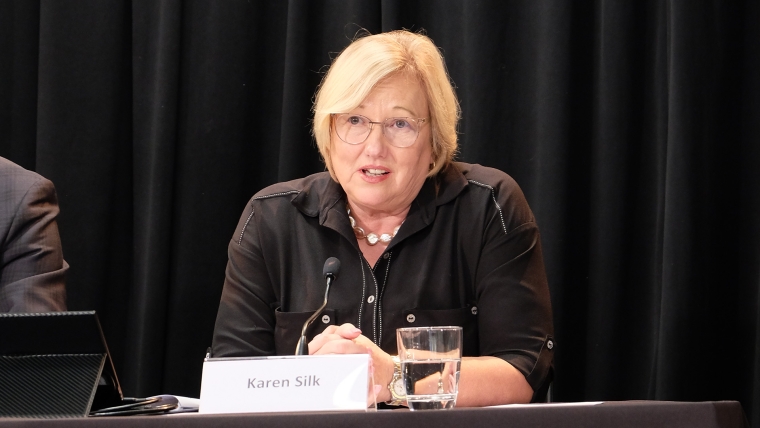
While people may think the Reserve Bank (RBNZ) is becoming more restrictive with monetary stimulus, Assistant Governor Karen Silk says it’s still accommodative at the levels the central bank is talking about.
“There’s still some pretty good monetary stimulus still sitting there, supporting the economy,” Silk told Interest.co.nz on Monday.
“You can have a position where inflation starts to come down and that spare capacity starts to get utilised at the same time, and [there’s] a convergence of the two, and that’s what you start to try and direct it towards.”
Silk’s comments come after the RBNZ’s six-member Monetary Policy Committee (MPC) raised the Official Cash Rate (OCR) to 2.50% from 2.25% last week. When it came to its decision to hike, the RBNZ noted that although oil prices have fallen, the effects of the oil shock would linger for some time.
“With inflation still above target and economic activity expected to strengthen, some further reduction in monetary stimulus is likely to be required to return inflation to the 2% target midpoint,” the RBNZ said.
Asked about the factors that were taken into account when it came to the RBNZ’s latest OCR decision, Silk told Interest.co.nz what was happening in the Middle East was a fluid situation.
In June, a deal was announced between the United States and Iran to end conflict in the Middle East, which saw share markets rise and oil prices drop. But the deal is now in doubt as Iran said it has closed the Strait of Hormuz, and attacks between the United States and Iran have continued.
Silk said the RBNZ, in May, saw an increase in oil prices which had come back quite substantially after the Middle East deal was signed.
“Our outlook that we were presenting at the end of last week was for a substantially lower kind of headline CPI [Consumers Price Index] as a result of that", she said.
Even in that situation, it was still going to take time for supply chains to adjust and to get back to normal, Silk said, and there would be some lingering effects that would flow through, and more indirect price increases as time goes on.
Examples of indirect price increases include things that involve petrochemicals such as plastics and packaging, and fertiliser.
The lingering effects were definitely taken into account when it came to last week's OCR decision, she said.
Other things that were taken into consideration by the RBNZ when it came to the OCR was global activities being more resilient than anticipated along with continued investment in technology supporting AI. Economic indicators also played a role.
Silk said when you start combining all of those things together, along with an easing back of financial conditions, “you’re sitting there and going, the track that we showed in May, which was showing a gradual reduction in the level of stimulus there, again, just reinforced for us that we could actually start to reduce the level of stimulus that is sitting in those rates”.
As for the upcoming decision, which is set for September 2, Silk said the MPC would have a full round of data that has come through so they would be looking at what’s happening with activity domestically and what’s happening with prices.
“We’ll have CPI. We’ll have at least two more SPI [Selected Price Indexes] by then. So we’ll have a pretty good feel for that.”
Ahead of Monday's release of the Performance of Services Index (PSI), Silk said “that will be interesting to see because [the services industry has] been more negative than the manufacturing sector … So we’d be wanting to see what’s happening there”.
Globally, there was still a lot of water to go under the bridge, Silk said, and the geopolitical situation was still quite fraught with what was happening in the Middle East and Ukraine.
“There’s a broad range of uncertainty around what’s going to happen in that global area, and we’re just going to need to continue to watch that closely," she said.
The election
Following last week’s OCR announcement, Former Minister Peter Dunne told Interest.co.nz that the question we don’t have a clear answer to is whether the public will perceive the change as an economic correction or a dampening down of growth and potentially of confidence “which means the tough times continue a little longer, the mortgage goes up, all those sorts of things”.
“Whether that happens, in a way, doesn't matter. It’s the perception and the fear, particularly four months out from an election," Dunne said.
Following September's Monetary Policy Statement, a review of the OCR is also set for October 28, a week before the election and during the early voting period.
When asked how the RBNZ was working to make sure their OCR decisions don’t become politicised, Silk said that was not something within their control.
“It’s not the thing that’s front of mind for us when we’re making our decisions … Monetary policy is independent of that and our job is to focus on what we need to do to bring inflation back [to the target midpoint],” Silk said.
“It’s not focused on what may or may not be happening from a political perspective that sits around it.”
We welcome your comments below. If you are not already registered, please register to comment
Remember we welcome robust, respectful and insightful debate. We don't welcome abusive or defamatory comments and will de-register those repeatedly making such comments. Our current comment policy is here.