
New Zealand's quarterly GDP may be cut by as much as 0.4% if the travel ban now put in place for Chinese nationals to this country lasts for two months, Westpac economists say.
In their Weekly Economic Commentary the Westpac economists say the economic costs to New Zealand will arise not from the virus itself, but from the measures taken globally to try to contain it.
"Almost 60 million people are already effectively under lockdown in China, and people elsewhere in China are avoiding gathering in numbers. High-end New Zealand food exports destined for such gatherings have already been impacted. Crayfish was the first example, but we expect other seafood, fruit and meat exports will soon be seriously disrupted, as well as lesser disruptions to other exports stemming from the general slowing of economic activity in China," they say.
But the biggest impact on the New Zealand economy will stem from fewer people travelling between the two countries.
The Westpac economists have calculated a "plausible scenario" in which seasonally adjusted visitor arrivals to New Zealand drop by 11% over the coming three months.
"That, on its own, would reduce New Zealand quarterly GDP by around 0.4 percentage points," the economists say.
"The assumptions underpinning that are that we receive zero visitor arrivals from China for two months, followed by half the usual number in the third month. We further assume that arrivals from the rest of Asia are dented by 20%. On top of the direct impact of restricted travel, the New Zealand economy will also face second-round effects such as reduced spending by furloughed tourism workers, and the GDP impact from disrupted goods exports.
"The crucial factor is how long the virus remains disruptive to the economy. Should the epidemic recede quickly, then the hit to the economy will prove fleeting and the recovery very rapid. The hit to annual GDP would be far less than 0.4 percentage points, and the implications for the Reserve Bank and other economy-watchers would be limited.
"If the epidemic disrupts economic life for longer than SARS or Swine Flu did, then the consequences would be more severe. For example, would-be students travelling to New Zealand might cancel their plans altogether, rather than merely postponing their travel."
ANZ economists, in their Weekly Focus publication say the more widespread the outbreak becomes and the longer it goes on, the greater the risks are to the Chinese economy, the global economy and to New Zealand.
"We are currently assuming that the outbreak will have only a modest dampening impact on our export volumes and prices, with the hope that the virus is contained soon," they say.
"However, the possibility of a larger impact cannot be ruled out. There are similarities between the new coronavirus and the 2003 outbreak of SARS, but also some important differences. One key difference is that New Zealand’s trade exposure to China is massively higher than it was in 2003."
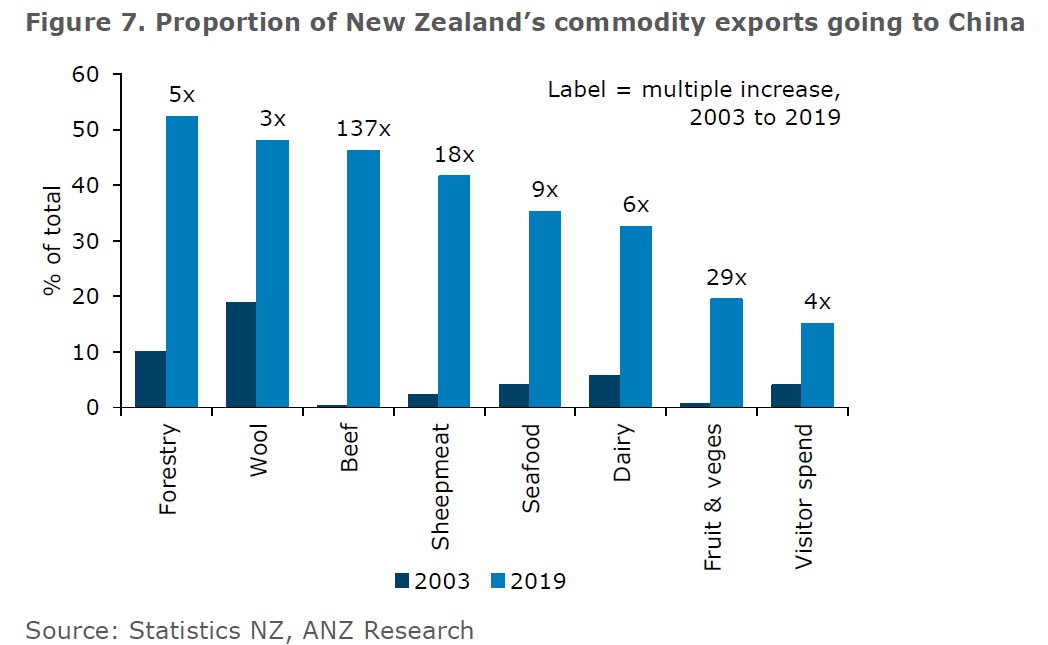
The ANZ economists say the magnitude of the total economic impact is highly uncertain "but the overall direction of risk is clear".
It could be expected they say that there would be a negative impact on GDP in the short term (the first half of this year) at least, primarily as a result of the impact on soft commodity prices, trade channel disruption, and reduced tourism and travel exports.
"The impact on GDP growth will be temporary, but could be sharp if the disruption is severe."
The impact of a more persistent outbreak would depend crucially on the resilience of global and domestic demand, confidence effects, and possible NZD and policy responses. There could also be flow-on effects over time to a range of industries, the labour market and spending.
"For inflation, we would expect to see a dampening impact in the short term at least. Food prices, for example, will be lower, with reduced supply to China potentially causing an increase in product available domestically."
The ANZ economists say the Reserve Bank, which is making its first review for the year of the Official Cash Rate on February 12, can be expected to "look through" temporary effects.
"In a bad/prolonged scenario, OCR cuts could be judged necessary in order to shore up confidence and the inflation and labour market outlooks. But it is early days and there is much uncertainty, so that certainly won’t be on the cards at this stage. For the February MPS, the RBNZ will likely acknowledge the tragic developments associated with the outbreak, the huge uncertainty it presents, and potentially the channels through which New Zealand may be affected, drawing parallels with the 2003 SARS outbreak.
"These risks will temper the RBNZ’s optimism regarding the domestic outlook. The medium-term domestic outlook would otherwise have been more positive, with a stronger outlook for the housing market and fiscal spending. For now, the RBNZ can be patient – and will watch, worry and wait."

We welcome your comments below. If you are not already registered, please register to comment
Remember we welcome robust, respectful and insightful debate. We don't welcome abusive or defamatory comments and will de-register those repeatedly making such comments. Our current comment policy is here.