

The post-lockdown bounce in business confidence appears to be running out of steam, according to the full-month July ANZ Business Outlook Survey.
The preliminary readings for the survey as of early this month showed a surprisingly strong bounce from the lockdown - but there was always a suspicion that this bounce was in part a reflection of pent up demand and that it wasn't likely sustainable.
And in releasing the final survey results for the month on Thursday, ANZ economists said it showed "some slippage compared to the preliminary July read".
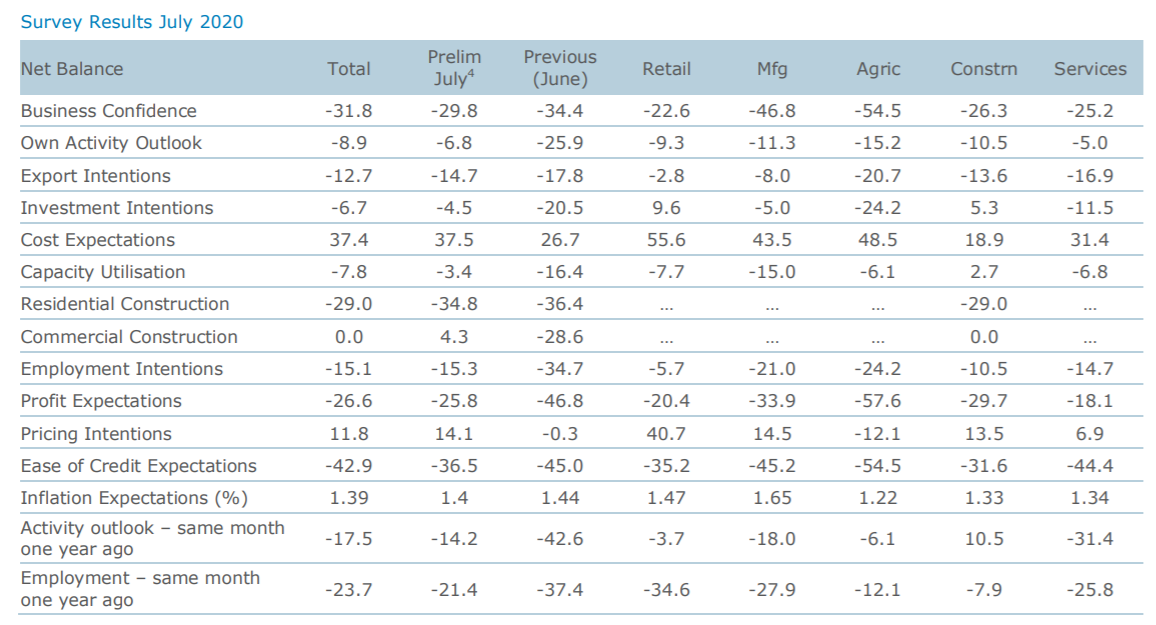
Headline business confidence was at -32%, slightly lower than the preliminary read of -30% but better than June’s -34%.
A net 9% of firms expect weaker activity for their own business, well up on June’s -26%, but the improvement has stalled since the preliminary July read of -7%.
Among other key findings, the retail sector has driven much of the rebound since June, while the export-focused agriculture sector is now the most negative regarding expected activity, export intentions, profitability, credit availability, investment intentions and employment intentions.
Some 31% of firms say they intend to lay off staff, and 24% say they have fewer staff than a year ago (some of these will be the same firms). These numbers have, however, improved significantly from their lows.
“The vigorous bounce out of lockdown appears to be topping out, with most activity indicators in the ANZ Business Outlook survey slipping slightly from their early-July preliminary reads, albeit still well up on June,” ANZ Chief Economist, Sharon Zollner said.
“The New Zealand economy is in a relative sweet spot. Of course there’s the massively important fact that we don’t have community transmission of Covid-19 and therefore have fewer restrictions on our lives than almost anywhere else in the world. But also, we’re in a sweet spot in terms of the evolution of activity.
“Bounces are fun, but this one has probably nearly run its course.”
“The rebound out of lockdown has been enthusiastic for retail, domestic tourism, and the housing market.
“And the economic pain arising from the closed border and sharply weaker global growth is yet to be fully felt – partly because an economy is just a slow ship to turn, but partly because of the enormous fiscal stimulus such as the wage subsidy scheme that is masking the real income hit that the economy is experiencing.
“Unfortunately, that blow is coming; it’s inevitable. That the border will remain closed for the rest of the year is one of the few certainties in our economic forecasts at the moment. And that fact, in and of itself, means a big hole in economic activity, centred on tourism and the foreign education sector.
“The blow won’t be felt evenly, but it will be felt. Looking at the full-July Business Outlook data versus the more-optimistic take at the beginning of the month, the post-lockdown bounce may be running out of puff. Gravity is calling.
“All up, this might be as good as it gets for a while. Still, looking at what’s happening abroad, we can count our lucky stars.”
Zollner cited some of the following key themes coming out of the latest survey:
- On the activity side, a particular weak spot is agriculture export intentions, while more broadly, the weaker sectors are manufacturing, agriculture and services. Retail is now one of the more optimistic sectors, as is construction.
- Looking at how the data has changed compared to June, increasing pressures on the agriculture sector are again evident. Business confidence in the manufacturing sector also fell unusually sharply, which may be related to renewed Covid-19 troubles in the key market of Australia.
- Cost pressures and pricing intentions are continuing to lift off their lows, though to a lesser extent in the services sector.
- The labour market is looking a little better – employment intentions in the services sector bounced back considerably, though levels remain weak, with hospitality and tourism under extreme pressure. Retail sector employment intentions have also bounced back, and to stronger levels, presumably as a result of the sharp bounce in spending seen post-lockdown. However, on net the sector is still intending to reduce employment.
We welcome your comments below. If you are not already registered, please register to comment
Remember we welcome robust, respectful and insightful debate. We don't welcome abusive or defamatory comments and will de-register those repeatedly making such comments. Our current comment policy is here.