

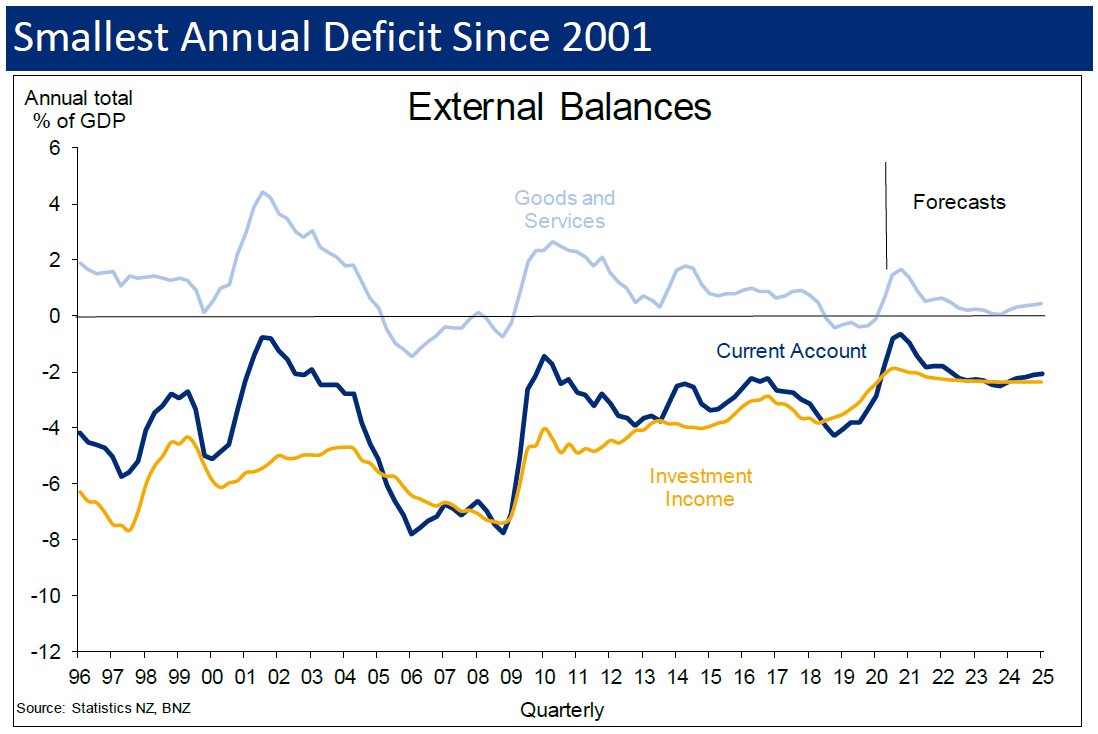
The relatively low imports arriving in New Zealand this Covid year have helped the deficit between what we get from exports and what we spend on imports to shrink to the lowest level since 2001.
Statistics New Zealand reports that our current account deficit for the year to September 2020 was $2.6 billion, representing 0.8% of our GDP. That compares with a $11.7 billion deficit for the same period up to September 2019.
You have to go back to the end of 2001 for the last time the deficit was so low relative to GDP, while to find a lower figure than the 0.8% you need to go back to 1989.
BNZ senior economist Doug Steel said the near-term weakness in imports "may yet see NZ post its first annual current account surplus since 1973", although that is not the BNZ economists' formal forecast given the "expected large tourism hole this summer" due to closed borders.
"Economic recovery and supply chain improvement is expected to bring a somewhat bigger deficit over the years ahead. A near term annual surplus or not, the bigger point is that our external account forecasts show nothing on the horizon to even slightly heighten discomfort levels at the likes of the rating agencies," he said.
ASB economist Nathaniel Keall said the annual current account deficit had narrowed markedly over the course of 2020 "thanks to the pandemic".
"As we highlighted when the pandemic began, the NZ current account deficit has reduced markedly over the course of the year. NZ current account deficits often reduce during downturn – but not for the right reasons," he said.
"The resilience of NZ’s goods export values through the pandemic has also supported the current account balance, due to the sector’s high exposure to China (which has recovered from the pandemic faster than most), and the fact that commodity prices have held up well. Supply chain disruption, the global shipping container shortage and lengthy port delays have also weighed down import activity.
"We expect the annual current account deficit to narrow a bit further over Q4 but to begin to widen again over time. As the global economy emerges from the pandemic, domestic spending and corporate profitability are likely to pick up and COVID-induced disruption in international trade should fade from view. Still, the timing of the movement is highly uncertain and contingent on the rollout of the vaccine, and the broader economic recovery."
In terms of the September quarter, Stats NZ said the seasonally adjusted current account deficit was $438 million.
That represented a -$1 billion change from the June 2020 quarter, which was a record surplus.
Stats NZ said the return to a current account deficit, after the record surplus in the June quarter, was driven by a $1.4 billion decrease in the seasonally adjusted goods surplus.
The main contributor to the deficit was the rise in goods imports of $1.1 billion, following a fall in the June 2020 quarter.
“The rise in goods imports was mainly driven by an increase in car imports,” international statistics senior manager Peter Dolan said.
We welcome your comments below. If you are not already registered, please register to comment
Remember we welcome robust, respectful and insightful debate. We don't welcome abusive or defamatory comments and will de-register those repeatedly making such comments. Our current comment policy is here.