

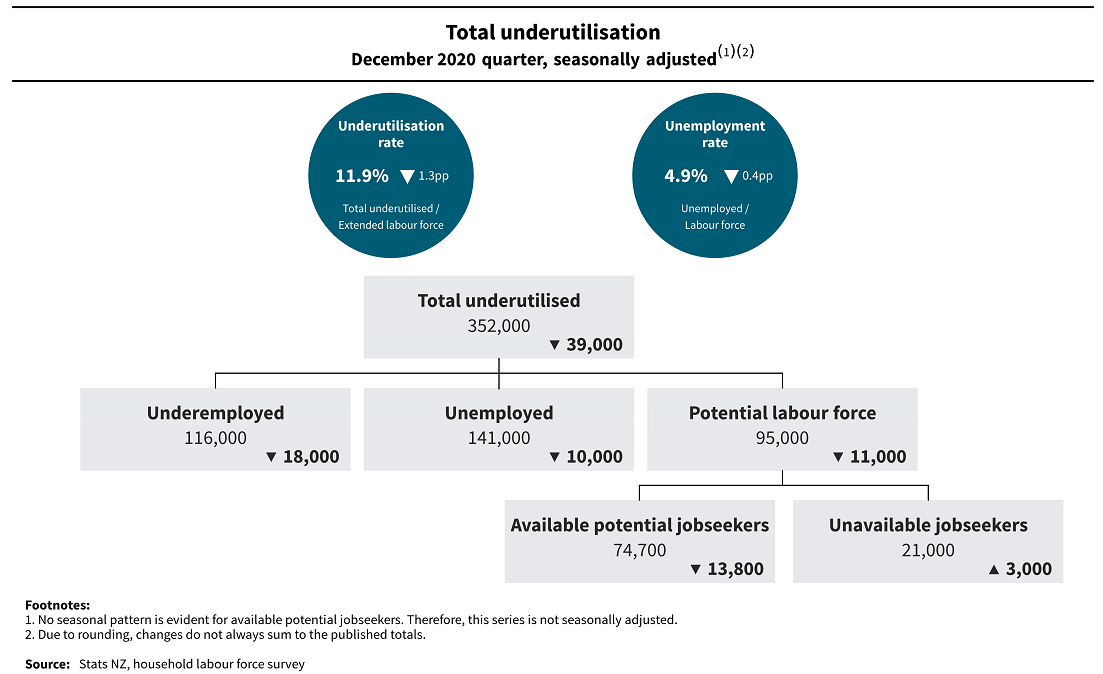
Unemployment has confounded all expectations again - by dropping to 4.9% in the December quarter.
The fall, Statistics New Zealand says, followed the highest ever quarterly rise (to 5.3%) in the September quarter.
Economists had universally expected that the unemployment number would rise again in the December quarter, with most economists picking a figure of 5.6% - which is what the Reserve Bank was picking.
The latest figure may well end any talk of further drops by the RBNZ in official interest rates. Indeed, ANZ economists (who had forecast a further reduction in the Official Cash Rate from 0.25% to 0.1%) reacted to the unemployment news by saying they no longer expected further rate reductions.
The dollar rose by about quarter of a cent, to US71.9c on the news.
The reaction to the latest figures was predictably one of enormous surprise.
ASB senior economist Mike Jones: "We’d suggested the risk was for a stronger set of labour market indicators today, but we were nonetheless left gob-smacked at just how strong the labour market in Q4 proved to be. Unemployment not only fell, but fell a long way, from 5.3% to 4.9%% - well below our and market expectations of an increase to 5.6%. This was thanks to a stronger-than-expected 0.6% lift in jobs growth, above our (+0.1%) and market (-0.1%) expectations. Labour supply ticked up about as much as expected; the participation rate nudged up to 70.2%."
Kiwibank chief economist Jarrod Kerr: "...Today’s report was truly remarkable.
"... A 4.9% unemployment rate is a remarkable result, considering the earlier estimations of a move towards 10%. Provided we make our way through 2021 without any major lockdowns, or economic disruptions, we’re firmly fixated on the light at the end of the Covid tunnel. Statistics on Covid cases will (hopefully) be overwhelmed by statistics on Covid vaccinations. And, all going well, the Kiwi economy should record a solid 3-4% growth rate this year."
Westpac senior economist Michael Gordon: "This surprise will be very important for the Reserve Bank. The surging housing market, surprisingly high inflation, and now falling unemployment all make it obvious that the combined efforts of the Government and Reserve Bank to support the economy through the Covid shock have had a much more powerful effect than anticipated. This will call into question just how much ongoing stimulus, particularly over the period when the Covid vaccine is rolled out and global travel resumes."
The Government was quietly satisfied. Finance Minister Grant Robertson: "The Government’s decisive actions to keep people connected to their jobs and support businesses and households through the COVID-19 pandemic has been reflected in today’s positive numbers.
"Confidence in the Government’s handling of the economy has also been reflected in recent business surveys, with firms intending to hire more staff."
Stats NZ said the increased number of jobs in the construction industry offsets losses in media and tourism related industries over 2020.
“Although overall employment is similar to a year ago, looking at movements by industry shows how New Zealand jobs have changed in response to COVID-19 and its restrictions,” labour market manager Andrew Neal said.
Nationally, the household labour force survey (HLFS) showed an annual increase of 21,000 people whose main job was in the construction industry, up to 278,300 people in the December 2020 quarter. Of this increase, 15,200 were men and 5,800 were women.
The seasonally adjusted number of unemployed people fell by 10,000 in the December 2020 quarter, to 141,000. The decrease was split evenly between men and women – the number for both fell by 5,000.
Despite this quarterly fall, the number of unemployed people is still 25,000 higher than it was a year ago, increasing from 116,000 in the December 2019 quarter (a rise of 21.9 percent). The annual increase was 15,000 for women and 11,000 for men.
The number of people not in the labour force (NILF) fell by 3,000 over the quarter.
The seasonally adjusted number of employed people rose by 17,000 over the December 2020 quarter. This follows falls in the previous two quarters of the household labour force survey (HLFS), by 7,000 in the June 2020 quarter, and 19,000 in the September 2020 quarter.
Feelings of job security have improved since the September 2020 quarter, with 79.1% of people in December 2020 quarter saying there was almost no chance or a low chance that they would lose their job or business in the next 12 months, compared with 74.3% in the previous quarter.
Since the December 2019 quarter, the number of seasonally adjusted employed people had a small increase of 19,000 (0.7%). This annual growth is lower than seen in recent pre-Covid years.
The employment rate was 66.8% in the December 2020 quarter, compared with 66.4% in the September 2020 quarter, and 67.6% in December 2019 quarter.
Although the employment rate is lower than a year ago, New Zealand currently has the fifth highest employment rate amongst 15–64-year-olds of all the OECD countries.
In the year to the December 2020 quarter, average ordinary time hourly earnings increased to $34.14 (up 4.2%) as gross pay rose more sharply than paid hours.
The labour cost index (LCI) salary and wage rates (including overtime) increased 1.6% in the year to the December 2020 quarter, while unadjusted LCI increased 2.5%.
The LCI is often compared with the consumers price index (CPI) to see how wage inflation compares with consumer inflation (the change in prices of goods and services bought by households). Annual CPI inflation was 1.4% in the year to December 2020.
We welcome your comments below. If you are not already registered, please register to comment
Remember we welcome robust, respectful and insightful debate. We don't welcome abusive or defamatory comments and will de-register those repeatedly making such comments. Our current comment policy is here.