

New Zealand's amazingly resilient employment market has once again shattered all expectations in the June quarter - seemingly giving the Reserve Bank little option but to raise interest rates when it next reviews these in two weeks.
Economists were quick to seize on the figures as showing that the RBNZ needed to act, and fast. The new 'norm' of predictions is that the Official Cash Rate will be hiked from the current emergency setting of 0.25% to 1.0% by November. The OCR was at 1% before the RBNZ cut it in March 2020 in response to the rapidly escalating Covid crisis.
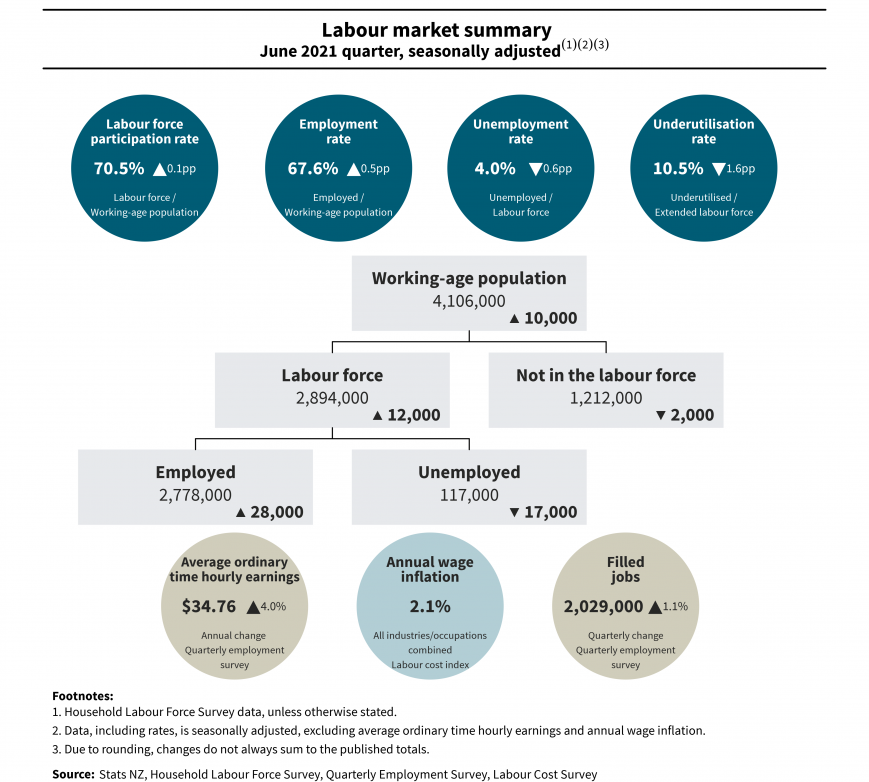
Statistics New Zealand said the unemployment rate plunged to just 4% in June, from 4.6% (revised down from the earlier reported figure of 4.7%) in the March quarter - that's way better than the average economists' forecasts of a 4.4% rate and the RBNZ's forecast of 4.7%.
Additionally, the measure of 'underutilisation', which the RBNZ has been paying close attention to, also dropped sharply in the latest quarter to 10.5% from 12.1% (revised down from the earlier reported 12.2%).
The 'participation rate' rose to 70.5% from 70.4%.
The increasing heat in the labour market is fuelling pay rises, with private sector wages gaining 0.9% in the quarter, for an annual increase of 2.2%. This is ahead of many economists' forecasts, and slightly up on the 2.1% the RBNZ expected.
Kiwibank chief economist Jarrod Kerr said: "Today’s report all-but confirms a rate hike from the RBNZ in August. Strap yourselves in."
The RBNZ decision is on August 18.
A rising tide
Kerr's expecting to the see the RBNZ hike four times over the next year to 1.25%, with another hike to 1.5% likely by the end of 2022.
"All lending rates have risen and will continue to rise from here. If realised, the four-plus RBNZ rate hikes will see mortgage rates closer to 4%, with sub-3% rates evaporating quickly."
Capital Economics Australia and New Zealand economist Ben Udy says the latest figures confirm the expectation of a rate rise on August 18.
"If anything, the strength in the labour market creates a risk that the RBNZ hikes rates by 50 basis points rather than our current expectation of a 25 basis point rise."
ASB chief economist Nick Tuffley said "the sheer strength" of the NZ labour market over the June quarter indicates the RBNZ is "likely to lift the OCR [Official Cash Rate] relatively swiftly over coming months".
"We now expect the OCR will increase by 25bp in each of August, October and November, reaching its pre-Covid rate of 1% by the end of this year."
ANZ economist Finn Robinson and chief economist Sharon Zollner said they now also expected the OCR will be raised at the August, October, and November meetings.
They've added in two more hikes in February and May for good measure, "bringing the OCR to a terminal rate of 1.5% by mid-2022".
Economy 'becoming quite overheated'
"Today’s data shows we’ve flown past full employment, and the economy is becoming quite overheated," they say.
"The RBNZ needs to hike the OCR promptly to get on top of this. We now expect faster hikes this year, but have tweaked our OCR endpoint down from 1.75% to 1.5% in light of the RBNZ’s recent announcement that they will further tighten macro-prudential policy.
"The faster unwind of the 75bp Covid OCR cuts also at the margin implies a lower endpoint will be needed to do the job of cooling the economy. With household debt at record highs and 80% of mortgage debt floating or fixed for less than a year, we don’t doubt the Reserve Bank’s ability to get traction."
Robinson and Zollner said given the strength in latest wage data, "we think that’s only the beginning of strong wage rises this year".
Balance of power shifts
"The balance of power in the labour market has shifted markedly towards workers over the past year, and this is showing up in employees’ bank accounts."
Some of the employment figures detail:
- For men, the unemployment rate fell to 3.8%, down from 4.6% last quarter.
- For women, the unemployment rate fell to 4.3%, down from 4.6%.
The seasonally adjusted number of unemployed people fell to 117,000, down 17,000, or 12.4%. This is the largest quarterly percentage fall since the Stats NZ's Household Labour Force series began in 1986.
- 12,000 fewer men were unemployed.
- 5,000 fewer women were unemployed.
We welcome your comments below. If you are not already registered, please register to comment
Remember we welcome robust, respectful and insightful debate. We don't welcome abusive or defamatory comments and will de-register those repeatedly making such comments. Our current comment policy is here.