
By Jenée Tibshraeny
Tens of billions of dollars are being pumped into the New Zealand economy, as like other central banks, the Reserve Bank (RBNZ) is “printing money” through its quantitative easing (QE) programme.
It’s buying New Zealand Government Bonds from banks and fund managers, freeing up cash for them to invest elsewhere. This bond buying is also lowering interest rates, giving businesses and households an incentive to borrow to invest to boost the economy.
Unlike other central banks, the RBNZ has never before lobbed what could be north of $60 billion into the economy.
The Government is by law required to leave the RBNZ to do its thing - use its tools to keep inflation and employment at target levels.
Yet Finance Minister Grant Robertson isn’t considering the flow-on effects of the seismic intervention the RBNZ is rightly or wrongly making in the economy.
He really needs to think about:
- What needs to be done to ensure that $60 billion gets to those who need it, as well as the most productive parts of the economy;
- How the cost of repaying the debt will be spread across society.
These issues are important because QE done after the 2008 Global Financial Crisis (GFC) contributed to asset prices - property and equities - ballooning, all the while inflation remained stubbornly low.
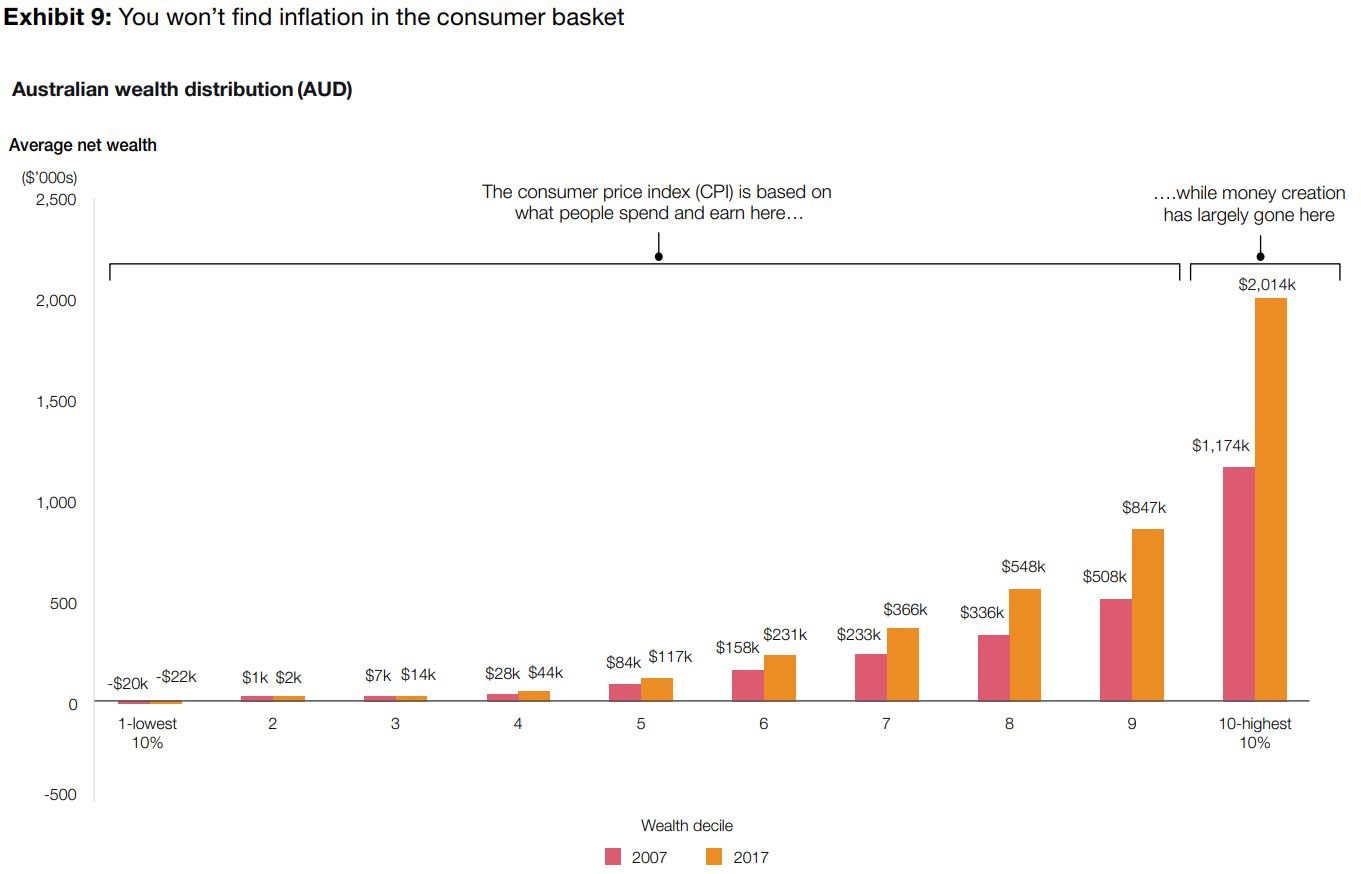
In other words, the cash didn’t flow through the entire economy. This graph put together by PwC in Australia illustrates how the money created went to the wealthy, asset-owning class.
While property prices are forecast to take a dip in the short-term, what’s to say that $60 billion won’t help pump them right up again in the medium to long-term?
There is an argument QE is already contributing to equity prices rebounding faster and much more than expected given the dire state of the global economy.
As fund managers have sold their government bonds to central banks, they’ve freed up cash to buy shares. What’s more, because share values have fallen, they’ve had to buy more to maintain the prescribed asset allocations of the funds they manage.
It’s still early days in the context of this crisis, and we’re undoubtedly in for much more share market volatility, but the point is, governments around the world can’t ignore the impacts of QE.
Robertson: Impacts of QE 'still to be told'
Talking to interest.co.nz, Robertson said his focus was on the direct response to the COVID-19 crisis.
In terms of the way the cash coming into the economy is being distributed, Robertson made a fair point: “A big part of the spending that’s happened in the last few months has gone straight into people's pockets via the wage subsidy scheme.”
He has previously said he isn’t keen on breaking away from the convention and enabling the RBNZ to buy bonds direct from Treasury with the aim of funding specific government policies, rather than with the aim of meeting its monetary policy mandate. An argument is that this could prevent the money from working its way into the economy via the banking system, which benefits those who own assets.
Robertson said the impacts of QE on asset prices were “still to be told”.
“I’m not yet seeing anything that indicates to me that that’s a major concern, but obviously we keep our eye on it.”
Put to him that it was too soon to see concerning levels of asset price inflation, Robertson said: “We’re very much aware of the potential for it and obviously after other crisis in the global economy we’ve seen those kinds of effects…
“For now, the financial system’s stable. Banks are lending in line with their policies and in line with the expectations the RBNZ has on them.”
Robertson also put the onus back on the RBNZ, saying it could employ loan-to-value ratio restrictions again, limiting bank lending against property, should the housing market overheat.
He wasn’t a fan of looking at the situation through an intergenerational lens, saying the Government’s response to COVID-19 would benefit all generations.
Looking at tax and the repayment of debt side of the equation, Robertson said the focus now should be on putting money in people’s pockets, not taking it out.
He said the Labour Party was still working on the tax policy it would take to the election. He couldn’t say whether the policy would be revenue neutral, but noted the prime minister had ruled out a capital gains tax under her leadership.
Both Robertson and National leader Todd Muller made the argument debt will naturally come down as the economy grows.
Muller said he wouldn’t increase taxes should his party be elected in September. However, he was open to tweaking the tax the system.
New crisis, same story
Clearly, with an election around the corner, politicians would rather keep the focus on how they’d spend, rather than how they'd repay.
As for looking at the way QE is done, and exploring whether the RBNZ could buy those bonds direct from Treasury, cutting out the banking system in the middle - it's complex and no one wants to risk “outside of the box” thinking looking like they want to turn New Zealand into a banana republic.
But most importantly, politicians don’t want to rock that boat in any way, shape or form to give people the impression their assets might be devalued.
This would of course be a particularly foolish thing to do at a time a pandemic is already shaking the ground on which the country’s $1.2 trillion housing stock is precariously built.
But a sensible discussion on changes that might be best made in the medium-term, needs to begin now.
You cannot throw a wad of cash a fifth of the size of the country’s annual GDP into the economy and hope it gets to where it needs to be, before the tab is tidily split according to how much different parts of society gobbled up.

We welcome your comments below. If you are not already registered, please register to comment
Remember we welcome robust, respectful and insightful debate. We don't welcome abusive or defamatory comments and will de-register those repeatedly making such comments. Our current comment policy is here.