

By Bernard Hickey
The Reserve Bank is expected to cut the Official Cash Rate by 25 basis points to 2.0% next Thursday, and some think it could even cut it by 50 basis points if it is serious about getting the currency down and meeting its inflation targets.
Normally the banks would just fall into line and pass on all of the expected cut to both mortgage borrowers and term deposit savers, but this time is likely to be different and that's a good thing.
The banks could choose not to pass on much or any of it to both floating mortgage rate borrowers and those re-fixing their mortgages or rolling over their term deposits.
They have already started doing this. The banks collectively have only passed on about 35 basis points of the 50 basis points of two OCR cuts since December. They have only passed on about half of the 70 basis points of falls in two year wholesale 'swap' rates to their advertised two year fixed mortgage rates.
They've done this for two reasons. Firstly, their borrowing costs on international wholesale markets have increased slightly. It's hard to tell exactly how much those costs have increased and how much of that cost increase can be justifiably passed on, but there has been some increase. Secondly, the banks want to increase their profit margins to build up their stocks of capital in preparation for some losses on dairy loans and because regulators both here and in Australia want them to hold more capital to back their mortgages.
This is bad news from a borrower's point of view, but could turn out to be good news for savers.
ANZ CEO David Hisco essentially called last month for a truce between the banks over their extremely intense competition for mortgage customers over the last three to four years, and in particular for rental property investors.
ANZ itself has been among the most aggressive, particularly in Auckland, but Mr Hisco called time on the battle when he said the housing market looked over-cooked and that he would actually like to see the Reserve Bank require all landlords have a 60% deposit, rather than the 40% one the regulator is proposing from September 1.
ANZ's economists also banged the drum this week about the potential for banks not to pass much of it on, either to term depositors or savers.
They pointed out that mortgage lending was now growing significantly faster than term deposits for the first time since the Global Financial Crisis. That means that banks are having to go overseas to borrow to fund the extra mortgages, which our credit rating agencies and the Reserve Bank itself are not keen on.
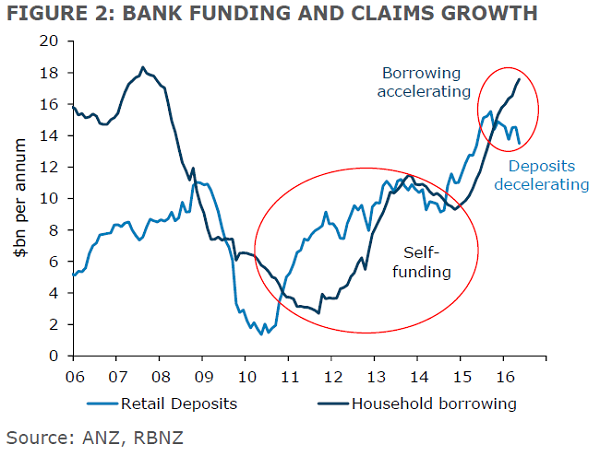
One way to encourage more saving and less borrowing is to not cut rates for either.
Right now the Reserve Bank is stuck between the rock of a housing market inflating at double digit rates, and a Consumer Price Index that is inflating significantly less than the Reserve Bank is supposed to target. CPI inflation of 0.4% is well below the 2% mid-point of the bank's target band and has been for over four years. This week's figures showing wages grew in the June quarter at their slowest rate in 6 years, which only reinforced the conundrum.
The Reserve Bank should be be cutting the OCR aggressively to get the currency down and get inflation back up again, but is worried that big rate cuts could worsen the financial stability risks building inside the housing market.
The banks could help savers and give the Reserve Bank some more breathing room by not passing on much or any of next Thursday's rate cut to both borrowers and savers. It will help them build up bigger buffers for the losses to come and reduce the risks that a future Global Financial Crisis could freeze a significant chunk of bank funding.
Borrowers will not love it, but the economy and the banking system would be better off if the banks chose not to pass it on.
A version of this article was published in the Herald on Sunday. It is here with permission.
We welcome your comments below. If you are not already registered, please register to comment
Remember we welcome robust, respectful and insightful debate. We don't welcome abusive or defamatory comments and will de-register those repeatedly making such comments. Our current comment policy is here.