

There's an old saying that a picture is worth a thousand words. So how many words is a flowchart worth?
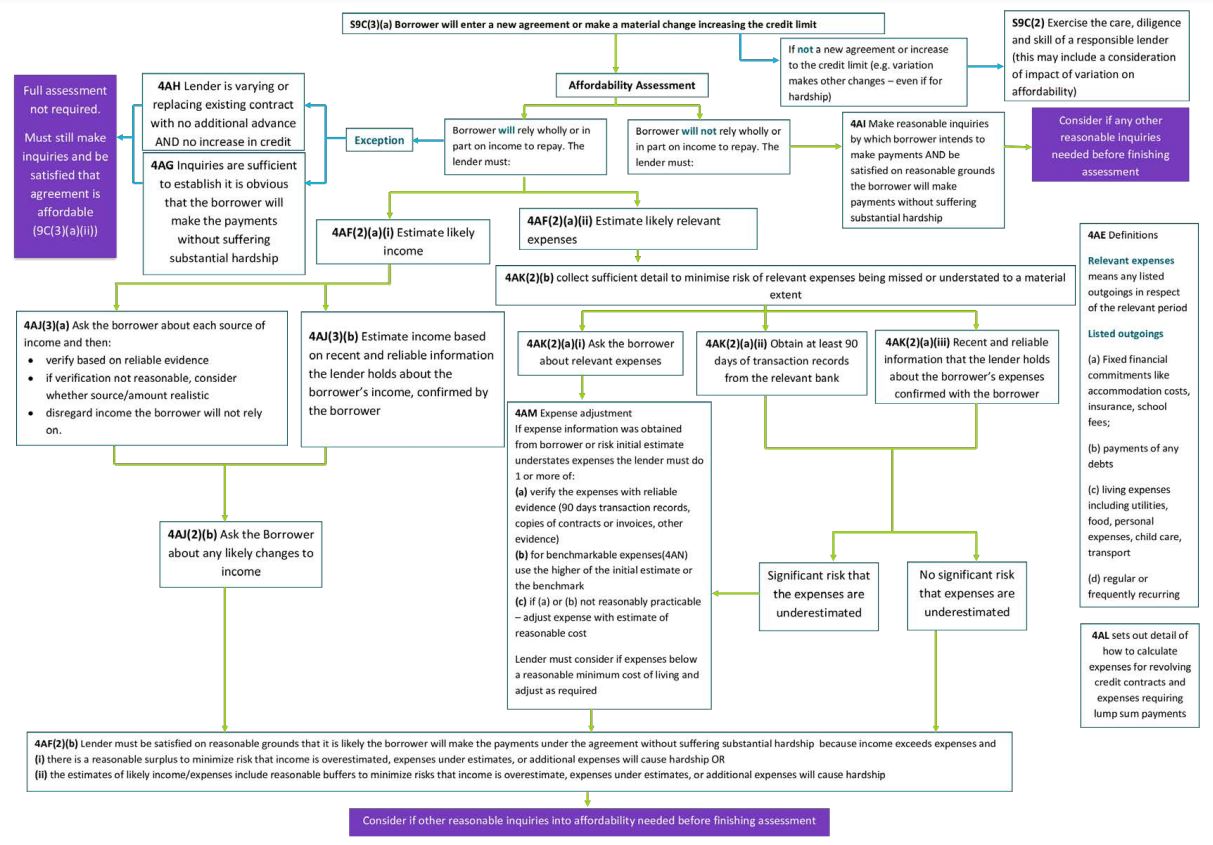
That's a good question when it comes to the wordy one below, which features in an updated version of the Responsible Lending Code.
In a press release highlighting changes to the Credit Contracts and Consumer Finance Act (CCCFA) which took effect from December 1, Commerce and Consumer Affairs Minister David Clark said unfair lenders had been cashing in on Kiwi consumers for too long, and New Zealanders could expect better protection from high-cost loans and unaffordable debt.
However critics are far from impressed, saying there was no problem to be solved and the new rules are too prescriptive. John Bolton of mortgage broker Squirrel, perhaps the most vocal critic, worries about a government-induced credit crunch and said a fight for the free market economy is underway. Bolton has launched a petition seeking to have consumer finance laws reworked.
Looking at the flowchart, there are certainly plenty of hoops for lenders to jump through. In a report on the CCCFA changes, law firm Bell Gully notes despite intending to help lenders navigate the new regulations, the Ministry of Business, Innovation & Employment's updated Responsible Lending Code instead highlights its Byzantine nature.
"The flowchart provided in the Code [below], though intended to simplify things, highlights the remarkable complexity of the new regime and the numerous gateways and decision points that lenders must navigate," Bell Gully said.
Why is it happening?
So why has the Government made changes to consumer lending laws and what are they?
The Labour-led government came to power in 2017 arguing changes made to the CCCFA by the National-led government in 2015 didn't go far enough to combat predatory loan shark and mobile trader behaviour. This concern was outlined by the then-Commerce and Consumer Affairs Minister Kris Faafoi in 2018.
“I’ve spoken with people who have been given loans that are clearly unaffordable for them, and others who have been lashed with huge penalties and fees. These practices trap people and whanau in an appalling debt spiral that is very difficult to get out of. We need to ensure the regulatory settings are right to stop the practices that get people into these terrible situations," Faafoi said in 2018.
However, critics such as Bolton say the changes go too far, stretching into all consumer lending including home loans. Banks are "forced to not trust what you tell them and dive into the details of your life," he said.
Bell Gully notes the Government first introduced responsible lending obligations in 2015 with the objective of ensuring consumer loans were suitable and affordable for borrowers.
"The obligations included new requirements on lenders to make 'reasonable inquiries' of borrowers before issuing loans, and to assist borrowers to make 'informed decisions.' The regime was intended to be flexible and 'principles based' and allowed a broad range of approaches to the various requirements. However, the principles were so broad it made it difficult for lenders to know precisely what was required. Equally, it proved difficult for the Commerce Commission to identify specific breaches, and the principles were very rarely enforced," Bell Gully said.
"In reaction to the uncertainty and to bolster the responsible lending regime, the Government has [now] introduced new regulations with much more prescriptive requirements around: (a) the suitability and affordability tests which lenders must conduct before issuing a loan to a borrower; and (b) advertising of consumer credit contracts."
In regards to new rules, Clark's press release highlights four key areas:
- Detailed standards for lenders assessing the affordability and suitability of loans
- Additional record-keeping requirements on lenders and duties on their directors and senior managers
- Responsible advertising standards
- Greater transparency and access to redress before debt collection starts
Bell Gully said suitability regulations are designed to set out a list of specific inquiries, including in respect of a borrower’s purpose in seeking credit, the required term of the loan, and the amount, plus other more intricate matters such as whether they accept the cost of any “non-avoidable” fees for add-ons that were not part of their stated purposes.
"The affordability regulations require various inquiries to identify whether the borrower can make repayments without suffering substantial hardship. In general terms: if the borrower will rely on income to make repayments - for certain high-cost loans - the lender needs to create an estimate of the borrower’s income and then also expense estimates using various specified tests, including new requirements to verify information received. Where the lender knows that the borrower will rely on means other than income to make repayments - or where other exceptions apply which indicate the risk to the borrower is low - a more flexible standard applies," Bell Gully said.
"The regulations governing responsible lending are complex and include a number of untested standards which are capable of wide-ranging interpretation."
Potential penalties for directors
Additionally lenders' directors and senior managers must undertake due diligence to ensure their organisation complies with the CCCFA.
"This includes: implementing, and requiring staff to comply with, procedures to ensure compliance with the CCCFA; ensuring that appropriate systems are in place to identify deficiencies with these procedures; and promptly remedying any deficiencies identified. There are significant pecuniary penalties in place if directors or senior managers breach this duty of up to $200,000 per breach, or joint and several liability for damages awards against the lender," said Bell Gully.
And there are potential civil pecuniary penalties of up to $200,000 per individual.
"Lenders are not permitted to indemnify any director or senior manager for civil pecuniary penalties or for any costs incurred in defending any proceedings where civil pecuniary penalties are awarded. A court may also order that a director or senior manager is jointly and severally liable with the lender to pay statutory damages or compensation where the lender has breached the CCCFA and the debtor can recover statutory damages or compensation, where the court is satisfied the director or senior manager breached their due diligence duty in respect of that same matter," said Bell Gully.
More hoops for borrowers to jump through
Last month Consumer NZ Chief Executive Jon Duffy told interest.co.nz the CCCFA changes were likely to result in borrowers having to "jump through a few more hoops before being given credit."
"While this may be painful in the short term, the new rules are intended to protect consumers and prevent them from taking on unaffordable and unsuitable debt," said Duffy.
Ruth Smithers, Chief Executive of FinCap which develops and supports free financial mentoring services, said protections in the CCCFA are valuable for everyone in the community.
"Our financial mentors do excellent work in their communities and there will be more referrals to them under the [CCCFA] changes. What is meaningful is these changes will mean fewer people have to choose between eating and repaying a loan," said Smithers.
"The new law applies to all credit applications, small and large, including new loans and changes to existing credit arrangements. Examples include borrowing to buy a dishwasher, upgrading your car on finance, getting a home loan, or extending your credit card limit."
"It might be harder for consumers to get credit or a loan because the more detailed information that lenders need to collect may show the applicant can less easily repay the debt. Lenders will now also need to build in reasonable surpluses or buffers to ensure applicants will be able to repay the loan," said Smithers.
In a submission on the CCCFA changes in 2019, the New Zealand Bankers' Association (NZBA) said it had identified several areas where it was useful to stand back and consider what the proposed change was trying to achieve, and whether that change was a measured and proportionate response.
"One key to reducing harm from problem debt is supporting access to responsible, lower-cost borrowing. However, in our view, several of the proposed changes may unintentionally lead to conservative lending practices to the detriment of consumers," said the NZBA.
"We are especially concerned about the impact conservative lending practices may have on vulnerable consumers, including low-wage workers, immigrants, and refugees. Our members’ experience is that these communities already find it difficult to access credit from mainstream creditors, making them particularly vulnerable to predatory lending practices. Conservative lending practices, which drive consumers to higher-cost and potentially irresponsible lending, run counter to the important policy objectives of promoting financial inclusion and access to safer credit."
'Removing the flexibility of the market to solve problems'
Bolton said the CCCFA changes are a bigger deal than the Reserve Bank's high loan-to-value ratio (LVR) home loan restrictions because they are enshrined in law, whereas the LVR restrictions can be turned on and off.
Bolton, who has previously worked for banks, said the new laws are too prescriptive about how banks have to approve loans. This means credit managers can no longer make judgments because now everything has to be black or white.
"Credit managers look at every deal, at the total picture and get a gut feel on what's good. They can't do that anymore. There's a lack of discretion to assess someone's individual circumstances to make the best decision for them," said Bolton.
He's concerned there will be a government-induced credit crunch, arguing the Government is "removing the flexibility of the market to solve problems."
"It's a fight for the free market economy," said Bolton.
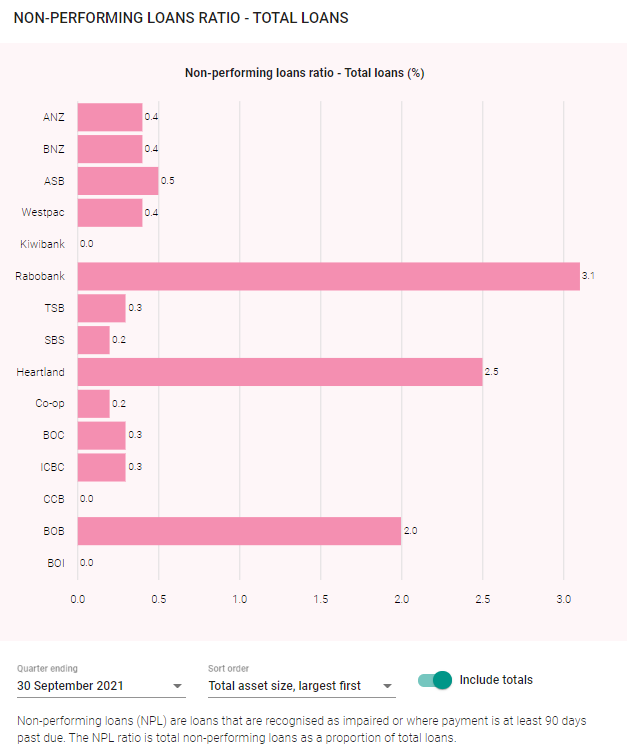
He goes on to say that NZ banks' are already conservative lenders, with low loan loss rates as highlighted by the Reserve Bank chart below.
Has the day come for non-bank lenders?
Bolton reckons one upshot of the CCCFA changes will be more home loan business for non-bank lenders such as Resimac, Pepper Money and Bluestone. Such lenders typically charge borrowers higher interest rates than banks.
Non-bank lending institutions are currently just a drop in the ocean of the home loan market. At the end of October $4.773 billion, or 1.5%, of outstanding home loans were held by non-banks, according to Reserve Bank statistics. The other 98.5%, or $321.555 billion, was held by banks.
But Bolton said non-bank mortgage lenders are now struggling to meet demand, in some cases with 15 day turnarounds for loan applications. For now they don't have the systems, processes or people on the ground to cope with the volume that's going to hit them, he said.
But because they're wholesale funded, funding's not a constraint. Resimac is listed on the Australian share market, as is Pepper after a sell-down by private equity group KKR. Bluestone is owned by private equity fund Cerberus Capital Management. Because of this Bolton suggests "they've got the capacity to step up, [and] the opportunity's in front of them."
Currently he estimates non-banks have 10% to 15% of the broker market, with brokers accounting for about 40% of home loans. He reckons non-banks, which don't have to comply with Reserve Bank LVR restrictions, could grow to 20% of the overall market.
Basecorp Finance Chief Financial Officer John Moody said Basecorp has noticed a significant increase in borrower interest since July, which he attributes to banks preparing for the CCCFA changes and potential Reserve Bank debt-to-income ratio restrictions for borrowers. Hamilton-based non-bank lender Basecorp has borrowed $500 million through two issues of residential mortgage backed securities this year.
In 2021 Basecorp has seen loan originations running more than 50% ahead of 2020, Moody said.
He said loan originations have increased markedly in November and December because borrowers are struggling to secure approval through banks under the new CCCFA criteria.
"These are in our view deals that would have been clearly bankable under the old regulations and credit policies of the banks."
"We understand from talking to a number of brokers in recent weeks that turnaround times have worsened significantly from October onwards, with this looking to be upwards of three to six weeks at present. Bank systems, and staff, are really struggling with the implementation of the new lending policies in response to the CCCFA, [and] both banks and a number of non-banks closed off early in late November/early December to new applications," Moody said.
In its annual non-bank Financial Institutions Performance Survey out this week, KPMG said non-bank lenders expect the CCCFA changes will see the cost of the lending process increase with this pushing up the interest rates they charge borrowers. Additionally the survey of 26 non-bank financial institutions suggests there'll be an increase in loan declines by 20% to 25%, and an increase in loan approval times by 25% to 50%, KPMG said.
Could NZ follow Aussie roll back?
Clark said as Minister of Commerce and Consumer Affairs, it's his responsibility to address concerns about lending practices, especially for those in vulnerable circumstances.
"This is why the Government has made a number of changes to the CCCFA. The Amendment Act and regulations require lenders to follow a robust process to determine borrowers’ income and expenses and will help to ensure that lending is affordable and suitable," said Clark.
"Lenders who act responsibly are already doing this and their borrowers will see less change as a result. The changes were developed after extensive engagement with the sector. I am confident the regulations will improve the quality and robustness of assessments carried out across the board."
"While the flow of consumer lending may be one part of the country’s economic recovery, this must not come at the cost of household borrowers being given debt they cannot pay back," Clark said.
So over time, will lenders and borrowers adjust to the new rules? Or could at least some of the new rules be rolled back?
Bell Gully points out that in Australia, which originally inspired the introduction of responsible lending rules in NZ, the Government is now looking to ease restrictions on lenders, warning against “unnecessary barriers to the flow of credit to households.” This is after Federal Treasurer Josh Frydenberg announced last year that the Government would "simplify the system by moving away from a 'one-size-fits-all' approach while at the same time strengthening consumer protections for those that need it."
"If the Australian government successfully pares back the regime, as proposed, it will leave a stark contrast to the detailed and prescriptive demands of New Zealand’s new framework," Bell Gully said.
*This article was first published in our email for paying subscribers early on Wednesday morning. See here for more details and how to subscribe.
We welcome your comments below. If you are not already registered, please register to comment
Remember we welcome robust, respectful and insightful debate. We don't welcome abusive or defamatory comments and will de-register those repeatedly making such comments. Our current comment policy is here.