

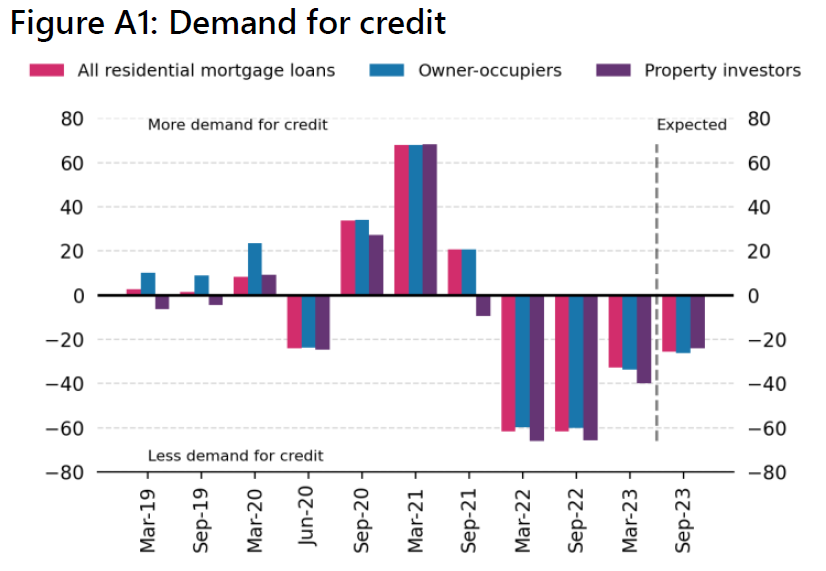
The country's banks are telling the Reserve Bank that they expect mortgage borrowing is going to remain "subdued" over the next six months.
The RBNZ has released its latest six monthly credit conditions survey of 15 New Zealand registered banks, including the five largest banks. The Survey period covers credit conditions observed between October 2022 and March 2023 and asks how banks expect conditions to evolve over the next six months.
Mortgage business has dried up in a big way for the country's banks. RBNZ figures for January and February showed that new mortgage commitments in those two months totalled just $6.6 billion compared with $10.4 billion in the first two months of 2022 and a whopping $14 billion in the first two months of 2021.
In its summary of comments from the banks, the RBNZ said that the banks were reporting that soft demand was the result of higher interest rates, perception that house price will fall further, and uncertainty around the outlook for economic activity.
The banks reported that the slowdown in mortgage borrowing "was broad-based across all types of buyers and most regions".
"Banks noted a series of major headwinds dampening household demand, namely rising mortgage rates, a higher cost-of-living, and rising building costs," the RBNZ said.
"Demand for lending has also been soft due to declining house prices and the uncertain economic outlook domestically and globally.
"Over the next six months, mortgage demand is expected to remain subdued, as the same underlying factors remain present, including high interest rate environment, speculation of further fall in house price and weak economic outlook. Borrower sentiment will likely tend towards more caution due to the fast-changing housing market conditions," the RBNZ said.
The current economic environment was seeing most banks maintain a conservative lending approach, with affordability assessment using higher assessment rates than seen in recent years.
"Banks have been willing to accommodate requests for conversion from Principal and Interest to Interest Only, to provide relief to customers facing rising debt servicing costs and living costs," the RBNZ said.
The RBNZ said that the banks were also reporting that credit demand for commercial property has "significantly reduced in the past six months and is expected to be subdued in the near term".
Again, the rapid interest rate and inflation rise and falling property prices are contributing to a low demand market.
"On the development side, cost inflation and supply chain delays are still prevalent. It has also become more difficult for customers to achieve minimum qualifying presales in the current housing market downturn," the RBNZ said.
"Property yields have not shifted as materially as interest rates have risen and there might be a sustained correction of property values over the next six-to-12 months as sellers have to alter price expectations to align with purchaser return requirements.
"The Auckland floods and Cyclone Gabrielle have had significant impacts on a number of the banks’ customers, and solutions were initiated to assist these customers. The extent of the impact and the solutions required are difficult to assess at this stage."
The banks are reporting that credit availability for commercial property has been tightened over the past six months. Banks continued to be quite cautious around lending to new commercial property clients owing to the deterioration in the economic outlook.
However, banks appetite for investment grade lending remained for prime office, industrial and retail assets with non-discretionary tenants (supermarkets/large box retailers). This trend is predicted to continue.
"In general, banks have not changed their lending standards and funding is available, but many customers cannot meet existing standards because of rising interest rates and falling demand. However, most banks have eased their interest coverage requirement in line with the rise in interest rates. There has been some signs of customer serviceability stress given high interest rates, low profitability, and housing market uncertainty. Banks were willing to work with clients under stress," the RBNZ said.
The country's banks have reported that credit demand has been "generally subdued" across all business sectors.
We welcome your comments below. If you are not already registered, please register to comment
Remember we welcome robust, respectful and insightful debate. We don't welcome abusive or defamatory comments and will de-register those repeatedly making such comments. Our current comment policy is here.