
By David Chaston
Here is a question from our Facebook page:
Chris asks: Would like to see an article that examines whether variable interest rates will eventually return to being higher than fixed term rates?
Our response:
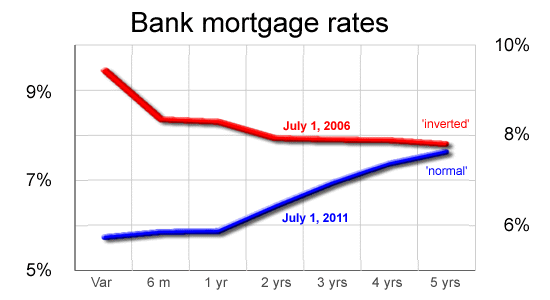
When short term rates are higher than longer term rates, we have what is known as an 'inverted yield curve'.
Many readers will recognise the situation because it happened in New Zealand fairly recently. From 2002 to 2008 this was generally the case - and for many it seemed 'normal'.
But in reality, such a situation is an anomoly. In the big long picture, rate inversions are fairly rare.
Put yourself in the shoes of a lender. Lending for a day is less risky than lending for 10 years. And the price of risk is interest, so, generally, longer term interest rates will be higher than shorter term ones. If you want to get technical, this is called the risk premium theory. There is another one called the liquidity premium which basically says that investors value short term investment more than long term investments because if they lock their money away for a long time they are forgoing the opportunity to invest it elsewhere.
So a postively sloped yield curve - that is, short term rates lower than long term rates - is the normal state of affairs.
But life is not always normal. If the market thinks that a recession is on the horizon, then it will expect short term rates to fall in the future. Now a long term rate is just a series of short term rates. For example a 2 year rate is the current 1 year rate plus a 1-year-forward-1-year-rate. If the 1-year-forward-1-year-rate is less than the current 1 year rate, then the 2 year rate will be lower than the 1 year rate (e.g. 1 year rate =10%; 1 year forward 1 year rate =5%; then the 2 year rate = 7.47%). The opposite also hold true: if rates are expected to rise, the yield curve will get steeper. This is called the market expecatations theory.
So if the expectation for falling short term rates is strong enough to trump the risk and liquidity forces, et voila. an inverted yield curve - that is, long term rates lower than short term rates.
Inflation and inflation expectations also play a role. Inflation eats away at the real value of money, so if you are going to tie it up for a long time and you expect inflation either to be high or rising, then you will need a higher rate of interest so you can buy the same number of cans of beans.
Conversely, if you have high inflation and you expect it to be falling, then longer term interest rates may be lower than short term interest rates.
Or, if some far-away official decides that cheap-and-plentiful credit would be good for them (and the world) and floods the monetary system with monumental amounts of credit. This additional supply pushes down short term rates and gets people worried about inflation - and the yield curve gets steeper.
That is exactly what US Fed charrman Alan Greenspan did. He flooded the world with incredibly cheap US dollars, and that distorted interest rate markets world-wide, including ours.
We now know that the 'Greenspan put' was a huge mistake. Even Alan Greenspan acknowledges the error.
It was artificial, and it could not last. The Global Financial Crisis was born in this mistake.
Unwinding it is causing incredible pain, and there is more to come.
Markets unwinding
Markets are now adjusting and unwinding.
While it is possible short-term rates could push up higher than longer-term ones, I would not bet on it. It was probably a once-in-a-generation event when it happened between 2002 and 2008. It is not 'normal'.
More likely, our rate curves will steepen. Investors will want to be paid an increasingly sharp premium to waiting longer for their money. We understand the risks better because we are living them.
Governments may be addicted to cheap credit (the US and Europe expecially) and find it incredibly hard to get off the drug. But one thing we do know for sure - all the vast amounts of money that central banks have thrown at their problems has not cured anything; if anything, it has made them worse. The appetite has largely gone out of the 'cheap credit' solutions. The policy pendulum is swinging the other way.
RBNZ governor Alan Bollard is trying to figure out how to unwind New Zealand's very low OCR. Yesterday's 'no change' decision has been hamstrung by the offshore uncertainty in the US and Europe. Without that we would be raising rates by now. He still intends to, we just don't know the timetable. But it will happen. See our article on the OCR decision here.
As the OCR goes up, so will longer term rates (via the swaps and futures markets). The RBNZ has a new tool in the 'core funding ratio' and it is using that to limit the access our banks have to cheap offshore money. Because they are limited in that way, and the banks are now required to lengthen their maturity profiles, longer term money will need to be chased by these banks, and they will do that by offering higher interest rates - higher than the rising short-term rates.
It is in this way the rate curves will steepen.
Don't bet on inverted rates returning anytime soon.
You can review the New Zealand rate curves here >>
We welcome your comments below. If you are not already registered, please register to comment
Remember we welcome robust, respectful and insightful debate. We don't welcome abusive or defamatory comments and will de-register those repeatedly making such comments. Our current comment policy is here.